

Advancing Automation Research and Development in Agriculture Act This bill directs the Department of Agriculture (USDA) to establish within USDA a stand-alone competitive research and extension grant program to increase the competitiveness of specialty crops in the United States through the advancement and acceleration of mechanization and automation. Specialty crops are fruits and vegetables, tree nuts, dried fruits, and horticulture and nursery crops (including floriculture). The bill provides specified funds for FY2024 and each succeeding year to carry out the program. The grant program includes projects that create or improve cost-effective technologies to reduce a specialty crop grower's manual labor requirements and increase the efficiency of crop production, resource management, harvesting, processing, post-harvest technologies, and packaging; increase adoption of mechanization and automation technologies; and accelerate automation and mechanization through prototype development, in-field trial testing, ongoing industry engagement, and rapid commercialization. Entities eligible for the grant program are federal agencies, national laboratories, colleges and universities, research institutions and organizations, private organizations and corporations, state agricultural experiment stations, individuals, and organizations representing specialty crop growers.
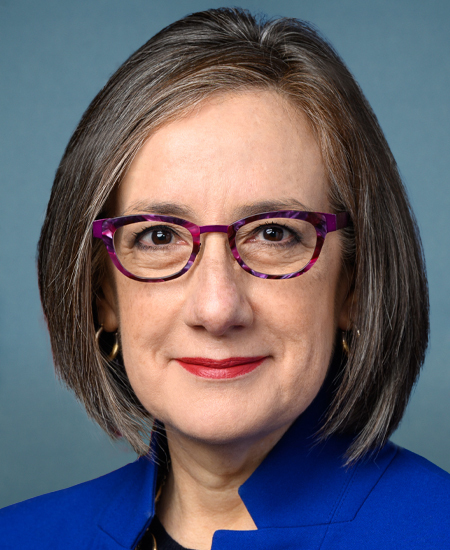
Rep. Andrea Salinas
Sponsored bills
Maddy summaryHRES 645 is a non-binding House resolution recognizing August as "Chicano Heritage Month" to celebrate the contributions of Mexican Americans to U.S. history. It highlights historical figures like labor leaders Cesar Chavez and Dolores Huerta, landmark court cases (e.g., *Mendez v. Westminster* ending school segregation), and cultural impacts such as Selena's influence on music. The resolution does not create new laws or policies but serves as a symbolic acknowledgment by the House to honor this heritage. It encourages the public and institutions to observe the month with events celebrating Mexican American contributions.
Providing Essential Temporary Shelter Assistance For Emergencies Act of 2023 or the PETSAFE Act of 2023 This bill directs the Federal Emergency Management Agency (FEMA) to establish a pilot program to provide grants for mobile pet shelters during emergencies and major disasters. FEMA may provide funds to state, local, and tribal governments to establish a new pet shelter site that is a mobile unit, which may be a companion animal mobile equipment trailer, to be used in case of evacuation due to emergencies and major disasters. FEMA's authority to approve projects under this bill shall cease on January 1, 2029.
Maddy summary# Summary of the "Protecting Our Democracy Act" This comprehensive legislation aims to strengthen democratic processes, increase government transparency, and prevent foreign interference in elections. Key provisions include: ## Ethics and Transparency - **Ethics Pledge**: Requires all appointees to sign an ethics pledge committing to: - Ban on gifts from registered lobbyists - 2-year revolving door ban (prohibiting participation in matters related to former employers) - Golden parachute ban (no special payments from former employers) - Commitment to decision-making based on public interest - **Tax Transparency**: Requires presidential and vice presidential candidates to disclose 10 years of tax returns, with sitting presidents submitting returns within 30 days of enactment ## Campaign Finance and Foreign Interference - **Foreign Contact Reporting**: Requires political committees to report any contact with "covered foreign nationals" within 1 week - **Enhanced Penalties**: Criminal penalties of up to $1 million and 5 years in prison for violations - **Online Advertising Rules** ("Honest Ads Act"): - Requires clear disclosure of who paid for political ads online - Mandates machine-readable public databases of political ads - Requires visible sponsor identification that remains when ads are shared - Defines "qualified political advertisements" to include various online formats ## Preventing Patronage Systems - Limits exceptions to competitive service for federal positions - Restricts transferring positions between competitive and excepted service - Requires employee consent for position transfers ## Use of Federal Property - Prohibits holding national political conventions on federal property - Requires publicly available visitor records at White House and other official locations (with privacy exceptions) The legislation establishes detailed definitions, reporting requirements, and enforcement mechanisms across multiple agencies, with the goal of increasing transparency, preventing foreign interference, and ensuring ethical conduct in government service.
Maddy summaryThis bill establishes a federal system to coordinate efforts across agencies to address health risks from extreme heat. It creates a National Integrated Heat Health Information System (NIHHIS) and an interagency committee to develop a strategic plan for heat health planning and response. The bill authorizes funding for community resilience projects that prioritize historically disadvantaged communities and those with environmental justice concerns. It mandates a study to identify gaps in heat information and response systems across the country. The legislation aims to reduce health impacts of extreme heat, particularly for vulnerable populations including the elderly, low-income communities, and communities of color.
Maddy summaryThis bill requires phone calls, texts, and chats to 9-8-8 (the national suicide prevention and mental health crisis hotline) to be routed to the nearest participating crisis center within 90 days of enactment, while protecting caller privacy by not revealing precise location. It mandates all phone carriers to transmit every 9-8-8 call or text - including those from prepaid or non-initialized handsets - and updates phone systems to allow direct 9-8-8 dialing without extra steps. The law affects crisis centers (by directing calls to their area), callers (through improved routing and privacy), and phone carriers (by requiring transmission compliance). These changes aim to make the 9-8-8 system more efficient and accessible for those seeking mental health support.
Maddy summaryThe ACHE Act requires the National Institute of Environmental Health Sciences to study health impacts of mountaintop removal coal mining on communities near mining sites in Kentucky, Tennessee, West Virginia, and Virginia. It temporarily halts all new federal permits for such mining until a health risk determination is made, while mandating ongoing pollution monitoring (water, air, soil) at existing sites with monthly public reporting. The bill directly affects coal mining companies operating in designated steep-slope regions of those four states. Key provisions include the health study, permit moratorium, and public monitoring requirements, which end once the health risk determination is published.
Providing Access to Treatment and Housing Act of 2023 or the PATH Act of 2023 This bill establishes a specific office and authorizes grants to support the provision of mental and behavioral health services for unhoused individuals. Specifically, the bill establishes the Center for Unhoused Individuals in the Substance Abuse and Mental Health Services Administration (SAMHSA). The center must develop policies and coordinate federal, state, and local action to expand unhoused individuals' access to mental, behavioral health, and housing services. The center may award grants to public and nonprofit entities to support these activities. SAMHSA must also award grants to state, local, and tribal governments to improve these services for unhoused individuals, with priority given to areas with high rates of housing instability and above-average housing costs.
Maddy summaryHR 4901, the Reproductive Health Care Accessibility Act, aims to improve reproductive health care access for people with disabilities by addressing systemic barriers they face. The bill funds training for health care professionals on providing culturally competent care, creates initiatives to increase the number of health care providers with disabilities in reproductive health fields, and establishes a National Technical Assistance Center to help providers improve services. It allocates $10 million annually for these programs from fiscal years 2024 through 2028, with additional funding for a research study on effective reproductive health care approaches. The bill directly affects people with disabilities seeking reproductive health services, health care providers, and educational institutions training health care professionals.
Maddy summaryThis bill creates a federal loan repayment program to help mental health professionals (like counselors, psychologists, and social workers) repay student loans. It directly affects individuals who have taken out education loans for mental health degrees and agree to work in underserved areas. Key provisions require participants to commit to 3-6 years of full-time service in designated mental health shortage areas or counties with high overdose death rates, with funding increased to $100 million annually for 2023-2032. The program expands eligibility to cover all mental health-related fields, including behavioral health roles.