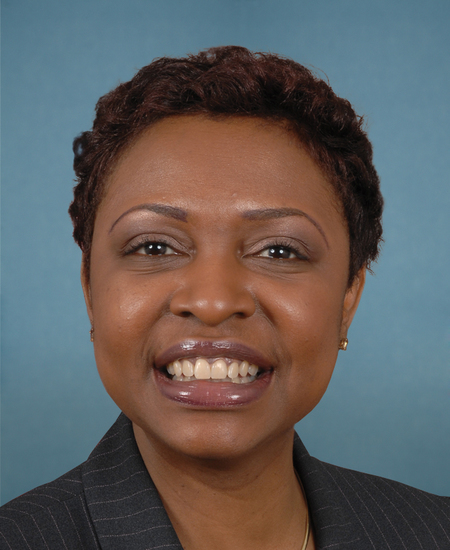
Photo of Yvette D. Clarke
D United States House · District 9 · New York On the 2026 ballot

Rep. Yvette D. Clarke

Compare
Total votes
2,837
all sessions
Attendance
99%
40 missed
Near the chamber average
With party
97%
of cast votes
Near the chamber average
Bipartisan score
2%
crosses aisle rarely
Near the chamber average
Sponsored
2,018
bills & resolutions
Higher than 91% of chamber peers
Committees
4
assignments
2,018 bills and resolutions

Sponsored bills

Total
2,018
Primary
83
Co-sponsor
1,935
This page
2,018
matching current filters
Co-sponsor HRES 1080
In committee · Indiana House · Co-sponsor
Original Black History Month Resolution of 2026

Maddy summaryHRES 1080 is a symbolic resolution recognizing and celebrating Black History Month 2026, focusing on its theme "A Century of Black History Commemorations." It highlights historical figures and events central to Black history, including Carter G. Woodson’s founding of Negro History Week (the precursor to Black History Month), Juneteenth, and key moments like the 1865 Charleston commemoration. The resolution emphasizes how Black history commemorations counter historical erasure and affirm Black contributions to U.S. history, referencing figures like Mary McLeod Bethune and W.E.B. Du Bois. As a ceremonial resolution, it has no binding effect but aims to raise awareness of Black achievements through official recognition.

In committee Feb 25, 2026 1 co-sponsor
Co-sponsor HR 7685
In committee · Indiana House · Co-sponsor
Healthy Hair Act

Maddy summaryHR 7685, the Healthy Hair Act, amends the Federal Food, Drug, and Cosmetic Act to classify hair straightening or smoothing products containing formaldehyde (or formaldehyde-releasing substances) as "adulterated" when sold across state lines after an 180-day grace period. It directly affects hair product manufacturers, salons, and workers who use or handle these products. The bill mandates a two-part study by the FDA and NIOSH on health impacts like cancer and respiratory issues for salon workers exposed to formaldehyde, requiring an initial report within one year and a final report within two years and two months. The study will inform future regulatory actions but does not ban formaldehyde products immediately.

In committee Feb 25, 2026 1 co-sponsor
Co-sponsor HR 2189
Passed · Indiana House · Co-sponsor
To modernize Federal firearms laws to account for advancements in technology and less-than-lethal weapons, and for other purposes.

Law-Enforcement Innovate to De-Escalate Act This bill removes less-than-lethal projectile devices (e.g., certain TASERs) from regulation under the Gun Control Act. The term less-than-lethal projectile device means a device that (1) is not designed or intended to expel (and may not be readily converted to discharge) commonly used ammunition or projectiles exceeding a velocity of 500 feet per second; (2) is designed and intended to be used in a manner not likely to cause death or serious bodily injury; and (3) does not accept (and cannot be readily modified to accept) an ammunition feeding device. The bill also requires the Bureau of Alcohol, Tobacco, Firearms and Explosives to determine whether a device satisfies the definition of a less-than-lethal projectile device within 90 days of a request.

Passed Feb 24, 2026 1 co-sponsor
Co-sponsor HR 7637
In committee · Indiana House · Co-sponsor
Head Start for America’s Children Act

Maddy summaryThe Head Start for America's Children Act amends the Head Start Act to enhance early childhood education services for low-income children, with specific provisions to improve culturally responsive programming for Native American and Native Hawaiian communities. It increases funding for Head Start programs, including $91.575 million for transportation, $37.5 million for workforce development, and $863 million for extended operations to provide full calendar year services. The bill updates definitions throughout the law to use more inclusive language, replacing "limited English proficient" with "children who are developing English proficiency," and establishes new requirements for staff compensation and benefits to improve recruitment and retention. Native American Head Start programs and migrant/seasonal programs are exempt from certain requirements, such as the full calendar year service requirement.

In committee Feb 20, 2026 1 co-sponsor
Co-sponsor HR 7622
In committee · Indiana House · Co-sponsor
Iran Human Rights, Internet Freedom, and Accountability Act of 2026

Maddy summaryThis bill directs U.S. agencies to support Iranian people's access to uncensored information and hold Iranian officials accountable for human rights abuses. It requires the State Department and FCC to report on technologies (like satellite networks and mesh systems) that could bypass internet restrictions in Iran, and authorizes $2 million annually to develop such tools. The bill also establishes a new "Iran Kleptocracy Initiative" at FinCEN to track corruption, freeze assets of Iranian regime officials and state-owned businesses, and coordinate with international partners. These measures apply to U.S. policy toward Iran but do not alter Iran's domestic laws; they focus on U.S. sanctions, technology development, and anti-corruption efforts targeting the Iranian regime.

In committee Feb 20, 2026 1 co-sponsor
Co-sponsor HR 7602
In committee · Indiana House · Co-sponsor
State of Men’s Health Act

Maddy summaryHR 7602, the State of Men’s Health Act, requires the Government Accountability Office (GAO) to study U.S. men’s health disparities and submit a report to Congress within one year of enactment. It also mandates the Department of Health and Human Services (HHS) to establish an Office of Men’s Health within 18 months to coordinate existing federal programs focused on preventive care for men, including screenings for prostate cancer, mental health, and cardiovascular issues. The bill does not authorize new funding; all activities must use existing appropriations. This legislation directly affects all men in the United States by aiming to improve health outcomes through better coordination of current federal health initiatives.

In committee Feb 20, 2026 1 co-sponsor
Co-sponsor HR 7608
In committee · Indiana House · Co-sponsor
Southeast Asian Deportation Relief Act of 2026

Maddy summaryHR 7608, the Southeast Asian Deportation Relief Act of 2026, prevents the deportation of eligible Cambodian, Laotian, and Vietnamese nationals who entered the U.S. before January 1, 2008, and have continuously resided here since. The bill halts removals for these individuals, grants them permanent work authorization with 5-year permits renewable indefinitely, and eliminates in-person check-ins for immigration supervision. It also requires immigration authorities to reopen past deportation cases for eligible individuals, allowing them to seek relief under the Act’s provisions without retroactive penalties. This directly affects approximately 15,000 long-term Southeast Asian residents, many of whom arrived as child refugees following conflicts the U.S. was involved in.

In committee Feb 20, 2026 1 co-sponsor
Co-sponsor HR 7583
In committee · Indiana House · Co-sponsor
BE HEARD in the Workplace Act

Maddy summary# Summary of the Workplace Discrimination and Harassment Bill This comprehensive legislation aims to strengthen protections against workplace discrimination and harassment, with several key provisions: ## Key Provisions ### 1. Expanded Protections for Workers - Extends protections to independent contractors, interns, and volunteers - Clarifies that domestic service workers in households are covered under interstate commerce - Prohibits nondisclosure and nondisparagement clauses that cover harassment or discrimination ### 2. Nondisclosure Agreement Restrictions - Makes it unlawful for employers to require nondisclosure or nondisparagement clauses covering harassment or discrimination - Establishes specific requirements for valid settlement agreements: - Requires mutual agreement - Limits scope to statements with knowledge of falsity - Requires written advice to consult an attorney - Provides 21-day consideration period and 7-day revocation period - Prohibits enforcement of such clauses against workers reporting discrimination ### 3. Federal Contractor Compliance - Requires federal contractors to disclose labor and civil rights violations from the past 3 years - Establishes Labor Compliance Advisors within executive agencies - Creates procedures for pre-award and post-award compliance monitoring - Mandates annual reporting on contractor compliance ### 4. Nationwide Grant Programs - **National Grants**: For preventing and addressing employment discrimination through education, outreach, and complaint assistance - **Legal Assistance Grants**: For low-income workers facing employment discrimination - **State Advocacy System**: Creates state-level systems to protect workers' rights, with: - Independent lead entities - Authority to investigate discrimination - Annual reporting requirements - Coordination with federal and state agencies ### 5. Enforcement Mechanisms - Empowers the Equal Employment Opportunity Commission to enforce the bill - Establishes clear procedures and remedies for violations - Requires employers to provide specific information about their compliance with labor laws The bill represents a comprehensive approach to workplace rights, focusing on prevention, reporting, and enforcement mechanisms while ensuring workers can seek redress without fear of retaliation or silencing through restrictive agreements.


In committee Feb 13, 2026 1 co-sponsor
Co-sponsor HR 7531
In committee · Indiana House · Co-sponsor
Healthy Families Act

Maddy summaryThis bill requires most employers to provide workers with earned paid sick leave. Employees would earn 1 hour of paid sick time for every 30 hours worked, up to 56 hours per year, which can be used for their own illness, medical care, caring for family members (including children, parents, spouses, domestic partners, or other family-like relationships), or addressing domestic violence, sexual assault, or stalking situations. The bill prohibits employers from retaliating against workers who use this leave and requires employers to inform employees about their rights. It ensures that workers who leave and return to the same employer within a year can reinstate their unused sick leave. This law would not override more generous state or local paid leave policies.

In committee Feb 12, 2026 1 co-sponsor
Showing 171 to 180 of 2,018 bills
Previous 1 … 17 18 19 … 202 Next