Ban Conflicted Trading Act This bill prohibits a Member of Congress or certain congressional officers or employees from (1) purchasing or selling specified investments, (2) entering into a transaction that creates a net short position in a security, or (3) serving as an officer or member of any board of any for-profit entity.
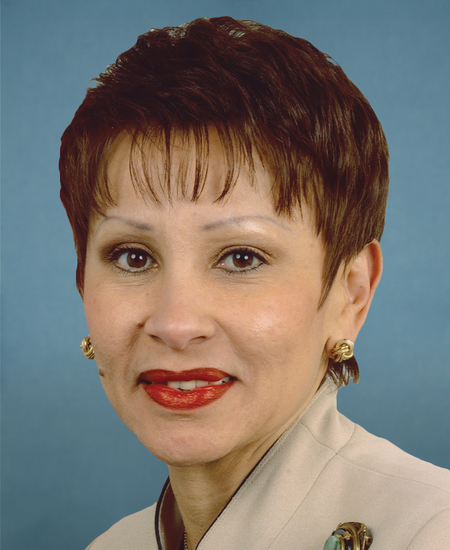
Rep. Nydia M. Velázquez
Sponsored bills
Mark Takai Atomic Veterans Healthcare Parity Act This bill includes veterans who participated in the cleanup of Enewetak Atoll in the Marshall Islands between January 1, 1977, and December 31, 1980, as radiation-exposed veterans for purposes of the Department of Veterans Affairs presumption of service-connection for specified cancers. Under a presumption of service-connection, specific conditions diagnosed in certain veterans are presumed to have been caused by the circumstances of their military service. Health care benefits and disability compensation may then be awarded.
This concurrent resolution (1) affirms, on the 400th anniversary of the arrival of the first slave ship, that the nation owes a debt of remembrance not only to those who lived through the injustices of slavery but also to their descendants; and (2) urges the establishment of a U.S. Commission on Truth, Racial Healing, and Transformation to properly acknowledge, memorialize, and be a catalyst for progress, including toward permanently eliminating persistent racial inequities.
This joint resolution proposes a constitutional amendment declaring that women shall have equal rights in the United States and every place subject to its jurisdiction. The amendment prohibits the United States or any state from denying or abridging equal rights under the law on account of sex.
This resolution expresses support for National Sexual Assault Awareness and Prevention Month.
This resolution condemns and denounces all forms of anti-Asian sentiment, including those related to COVID-19 (i.e., coronavirus disease 2019), and calls on federal law enforcement officials, working with state and local agencies, to take specified steps. The resolution calls on federal officials to expeditiously investigate and document all credible reports of hate crimes, harassment, bullying, and threats against the Asian American and Pacific Islander communities; the Attorney General to work with state and local agencies and Asian American and Pacific Islander community-based organizations to prevent discrimination and to expand culturally competent and linguistically appropriate education campaigns on public reporting of hate crimes; and the Department of Health and Human Services to issue guidance describing best practices to mitigate racially discriminatory language in describing the pandemic. The resolution recommits the United States to serving as a world leader in building more inclusive, diverse, and tolerant societies by (1) prioritizing language access and inclusivity in communication practices, and (2) combating misinformation and discrimination that put Asian Americans and Pacific Islanders at risk.
Universal Child Care and Early Learning Act This bill provides funds to the Department of Health and Human Services (HHS) for an affordable child care and early learning program. Children who are at least six weeks of age but not yet required to attend school may participate in the program regardless of family income, disability status, citizenship status, or employment of a family member. Under the program, HHS must support sponsors (e.g., states, local governments, tribal organizations, and nonprofit community organizations) that provide child care and early learning services for families. Families must pay a subsidized fee, based on their income, for the services. The fees are waived for children from families with incomes below 200% of the poverty line. The fees are capped at 7% of a family's income regardless of the family's income level.
Ghost Guns Are Guns Act This bill broadens the definition of firearm for purposes of federal firearms laws. Specifically, it includes as a firearm any combination of parts designed or intended to be used to convert a device into a firearm and from which a firearm may be readily assembled.
Ending Qualified Immunity Act This bill eliminates the defense of qualified immunity in civil actions for deprivation of rights. Qualified immunity is a judicially created doctrine that protects government employees or those acting with state authority from being held personally liable for constitutional violations. The bill provides that under the statute allowing a civil action alleging deprivation of rights under color of law, it shall not be a defense or immunity to any such action that (1) the defendant was acting in good faith or believed that his or her conduct was lawful at the time it was committed; (2) the rights, privileges, or immunities secured by the Constitution or federal laws were not clearly established at the time of their deprivation; or (3) the state of the law was such that the defendant could not reasonably have been expected to know whether his or her conduct was lawful.
Justice for Black Farmers Act of 2021 This bill directs the Department of Agriculture (USDA) to provide a variety of assistance to address historical discrimination and disparities in the agricultural sector. For example, the bill establishes an equity commission in USDA to examine discrimination by the agency against Black farmers and ranchers and recommend actions to end the systematic disparities in the treatment of Black farmers and ranchers. USDA must also establish a Farm Conservation Corps to provide young adults who are from socially disadvantaged groups with the skills necessary to pursue careers in farming and ranching. The bill provides funding for historically Black colleges and universities to commence and expand courses of study that are focused on careers in agriculture or related disciplines. The bill also increases the authorization of appropriations for a program to resolve issues relating to ownership and succession on farmland. Additionally, it expands credit assistance for socially disadvantaged farmers and ranchers. Further, the bill (1) establishes that a minimum of 50% of a covered packer's (not including a packer that owns only one livestock processing plant) daily volume of livestock slaughter must be purchased through spot market sales from nonaffiliated producers; (2) increases funding for the Local Agriculture Market Program; and (3) gives priority to socially disadvantaged farmers and ranchers for conservation technical assistance, the Conservation Stewardship Program, and the Rural Energy for America Program.