This resolution supports the designation of ALS Awareness Month. Amyotrophic lateral sclerosis (ALS) is a progressive neurodegenerative disease, also known as Lou Gehrig's disease, that affects nerve cells in the brain and spinal cord.
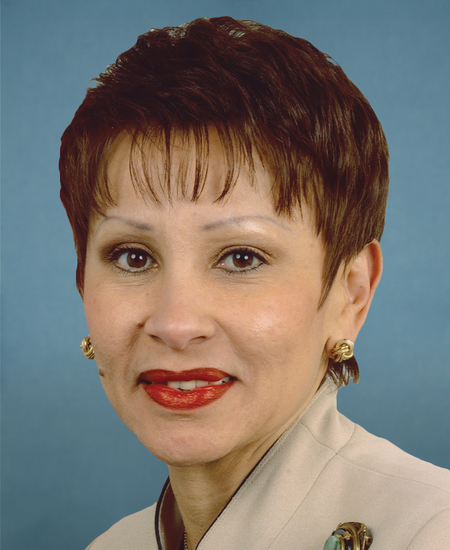
Rep. Nydia M. Velázquez
Sponsored bills
Trees for Residential Energy and Economic Savings Act of 2021 or the TREES Act of 2021 This bill directs the Department of Energy (DOE) to establish a grant program for states, local governments, Indian tribes, and other entities to facilitate tree planting projects that reduce residential energy consumption. Under the program, DOE may award grants to facilitate the planting of at least 300,000 trees annually in residential neighborhoods.
John Lewis Every Child Deserves a Family Act This bill prohibits discrimination on the basis of sexual orientation, gender identity, marital status, or religion in the provision of child welfare programs and services by entities receiving federal funding. The Department of Health and Human Services (HHS) must provide technical assistance to help states follow this requirement, including (1) guidance for bringing state laws into compliance, (2) developing training to increase cultural competency related to social identity, and (3) training for judges and attorneys involved in child welfare cases, among other supports. Additionally, HHS must establish the National Resource Center on Safety, Well-Being, Placement Stability, and Permanency for LGBTQ Children and Youth Involved with Child Welfare Services to provide training, technical assistance, and guidance to applicable state and local agencies and service providers. Further, the Religious Freedom Restoration Act may not be the basis for challenging the application or enforcement of this bill. The Government Accountability Office must study and report on states' compliance with the requirements of the bill no later than three years after enactment.

Keeping All Students Safe Act This bill prohibits the use of seclusion and limits the use of physical restraint in schools and Head Start programs that receive federal funding. Specifically, the bill prohibits the use of seclusion, which is the involuntary confinement of a student alone in a room or area from which the student is physically prevented from leaving. The term does not include a time out, which may involve separating the student from others in a non-locked setting. The bill prohibits the use of mechanical or chemical restraints or physical restraints that restrict breathing or are life threatening. The bill outlines the requirements for the use of physical restraint, including that the student's behavior must pose an imminent danger of serious physical injury to the student or other individual. Each state must ensure that a sufficient number of program personnel are trained and certified by a state-approved crisis intervention training program. Additionally, each program must establish procedures to follow after an incident involving physical restraint. Further, the bill establishes enforcement provisions, including a private right of action for a student who has been subjected to unlawful seclusion or restraint. The Department of Education and the Department of Health and Human Services must withhold payments from a program for unlawful seclusion or restraint. Finally, the bill requires each state educational agency (SEA) to establish, implement, and enforce policies and procedures required by the bill. It also creates a grant program to assist SEAs with these activities.
Safe Drinking Water in Public Playgrounds, Parks, and Libraries Act This bill requires the Environmental Protection Agency to establish a grant program to provide assistance to states and municipalities for the replacement of drinking water fountains that were manufactured prior to 2014 and are located in certain playgrounds, parks, or libraries.
Substance Use Disorder Workforce Act This bill increases the number of residency positions eligible for graduate medical education payments under Medicare for hospitals that have addiction or pain medicine programs, with an aggregate increase of 1,000 positions over a five-year period.
Territories Health Equity Act of 2021 This bill alters provisions relating to the treatment of U.S. territories under Medicaid, Medicare, and Medicare Advantage. For example, the bill eliminates Medicaid funding limitations for U.S. territories beginning in FY2022, exempts an individual from late-enrollment penalties for Medicare medical services if the individual resided in Puerto Rico as of the date of eligibility and the individual enrolls within five years of such date, and establishes minimum criteria for certain elements used in Medicare Advantage payment calculations for areas within U.S. territories. The bill also allows residents of U.S. territories who are unable to obtain health insurance through their employer or a health insurance exchange to instead obtain coverage that is at least as broad as the coverage available to Members of Congress and their staff through the District of Columbia exchange.
Diversifying by Investing in Educators and Students to Improve Outcomes For Youth Act or the Diversify Act This bill revises the Teacher Education Assistance for College and Higher Education (TEACH) grant program. The TEACH program awards grants to undergraduate and graduate students who commit to teaching in a high-need field and in an elementary or secondary school that serves low-income students. First, the bill raises the maximum amount for TEACH grants. Second, the bill allows TEACH grants to cover the full cost of attendance. Currently, these grants may be used only for tuition, fees, and on-campus housing. The bill allows teaching in a high-need early childhood education program to count toward service requirements for the program. Next, the bill eliminates the process for converting a TEACH grant to a loan if a recipient does not complete the requirements of the program. Further, the bill prohibits the Department of Education (ED) from instituting or creating a monetary penalty for failure or refusal to complete the service requirement. In addition, the bill requires ED to send an electronic certificate to grant recipients who have completed their service requirement. The bill also exempts the TEACH program from sequestration, which is a process of automatic, usually across-the-board spending reductions under which budgetary resources are permanently cancelled to enforce specific budget policy goals.
Climate Risk Disclosure Act of 2021 This bill directs the Securities and Exchange Commission to require an issuer of securities to annually disclose information regarding climate change-related risks posed to the issuer, including an issuer's strategies and actions to mitigate these risks. Specifically, issuers must report their direct and indirect greenhouse-gas emissions and disclose their fossil fuel-related assets.
This resolution condemns the acts of gun violence that led to the tragic loss of eight lives in Georgia on March 16, 2021.