This resolution (1) commits to advancing policies that will end roadway fatalities by 2050, and (2) calls on Congress and the Department of Transportation to commit to working together to achieve zero roadway fatalities by the year 2050.
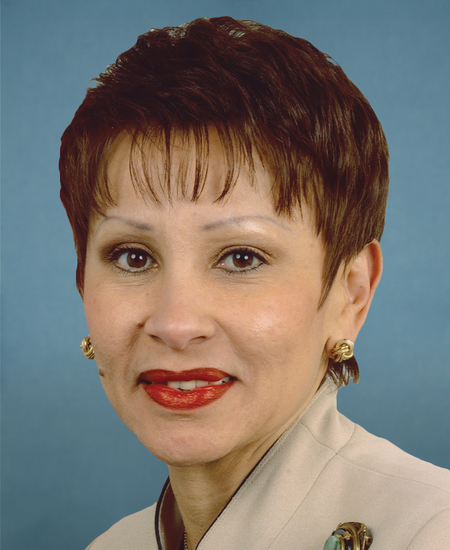
Rep. Nydia M. Velázquez
Sponsored bills
Saving America's Pollinators Act of 2021 This bill addresses the use of certain pesticides and the health and status of native bees and other pollinators. First, the bill requires the Environmental Protection Agency (EPA) to establish a Pollinator Protection Board to develop an independent review process for pesticides that pose a threat to pollinators and their habitats. All active ingredients and pesticide products that contain one or more specified neonicotinoid pesticides must be deemed to generally cause unreasonable adverse effects to the environment. Under the bill, the registration of all uses of neonicotinoid pesticides must be immediately and permanently canceled. The EPA must revoke any tolerance or exemption that allows the presence of a neonicotinoid pesticide, or any pesticide chemical residue that results from neonicotinoid pesticide use, in or on food. The continued sale or use of existing stocks of neonicotinoid pesticides is prohibited, and the EPA may not register any such pesticides under the Federal Insecticide, Fungicide and Rodenticide Act. The bill requires the Department of the Interior, the EPA, and the Department of Agriculture to coordinate monitoring activities and report on the health and population status of native bees and other pollinators. Finally, a state or federal agency may be granted an exemption to use neonicotinoid pesticides if the board votes that use of the pesticide is warranted (1) in an emergency situation to avert significant risk to threatened or endangered species, (2) to quarantine invasive species, or (3) to protect public health.
Closing the Meal Gap Act of 202 1 This bill revises the requirements for calculating Supplemental Nutrition Assistance Program (SNAP) benefits. The bill increases the minimum SNAP benefit and requires benefits to be calculated using the value of a low-cost food plan. The Department of Agriculture (USDA) must determine the requirements for the low-cost food plan, which is the diet required to feed a family of four, consisting of a man and a woman 19-50 years of age, a child 6-8 years of age, and a child 9-11 years of age. USDA must (1) reevaluate and publish the market baskets of the plan by January 1, 2027, and every five years thereafter, based on current food prices, food composition data, consumption patterns, and dietary guidance; and (2) make adjustments to the plan to account for household size, changes in the cost of the diet, and the costs of food in specified areas. The bill modifies the requirements for calculating household income to determine SNAP eligibility by (1) authorizing a standard medical expense deduction for households containing an elderly or disabled member, and (2) eliminating the cap on the excess shelter expense deduction. The bill eliminates certain work requirements for SNAP. The requirements apply to able-bodied adults who are ages 18-49 and have no dependent children. The bill allows Puerto Rico, American Samoa, and the Northern Mariana Islands to participate in SNAP. Currently, the three territories receive block grants instead of participating in SNAP.

Recognizing and Ensuring Taxpayer Access to Infrastructure Necessary for GPS and Satellite Communications Act of 2021 or the RETAIN GPS and Satellite Communications Act of 2021 This bill places conditions on entities that deploy commercial terrestrial operations in the 1525-1559 megahertz (MHz) band or the 1626.5-1660.6 MHz band of the electromagnetic spectrum. These frequency bands are traditionally used for satellite operations, including the global positioning system (GPS). On April 19, 2020, the Federal Communications Commission approved an application for a low-power 5G wireless network in such bands despite concerns about the network interfering with GPS and other operations on adjacent bands. In its application, the entity committed to update, repair, or replace federal devices, platforms, or systems affected by its operations. This bill requires an entity (including the previously approved entity) that deploys terrestrial operations in the designated bands to reimburse a federal agency or a person for certain costs if the entity's operations interfere with or otherwise affect the operations of the agency or person. These costs may include necessary upgrades, repairs, or replacements to satellite communication devices and related equipment, as well as expenses for engineering studies and labor. Reimbursable costs owed by the entity transfer to any assignee, successor, or purchaser of its license to deploy terrestrial operations in the designated bands. The bill also expressly authorizes federal agencies to directly accept from the entity reimbursements for incurred costs.
Securing Universal Communications Connectivity to Ensure Students Succeed Act or the SUCCESS Act This bill provides additional funding for the Emergency Connectivity Fund, which supports remote learning during the COVID-19 emergency period by covering reasonable costs of laptop and tablet computers, Wi-Fi hotspots, modems, routers, and broadband connectivity purchases for off-campus use by students, school staff, and library patrons.
This bill repeals the limitation on the amount of distilled spirits excise tax covered over (paid) to the treasuries of the U.S. Virgin Islands and the Commonwealth of Puerto Rico. The bill requires certain amounts of the excise tax paid to the treasury of Puerto Rico to be transferred to the Puerto Rico Conservation Trust Fund.
Universal School Meals Program Act of 2021 This bill revises requirements under the food and nutrition programs of the Department of Agriculture, such as the school lunch and breakfast programs. For example, the bill permanently provides free meals to all school children regardless of income. The bill increases the reimbursement rate for school food authorities participating in the food and nutrition programs. The bill also prohibits school food authorities from (1) physically segregating or otherwise discriminating against any child participating in the free breakfast program, or (2) overtly identifying a child participating in the program with a special token or announcement. Additionally, the bill expands the summer food service program by making all children eligible for participation in the program. Further, the bill revises eligibility determinations for measuring poverty to include runaway or homeless youth, foster children, migratory children, and children participating in specified programs (e.g., Head Start).
This resolution expresses support for the designation of Black Maternal Mental Health Awareness Week.
This resolution reaffirms the House of Representatives' commitment to media diversity and expresses its pledge to eliminate barriers to such diversity.
Energy Efficient Public Buildings Act of 2021 This bill requires the Department of Energy to provide grants to states, local governments, or nonprofit organizations for making energy improvements in (1) public libraries, (2) public hospitals, (3) community centers, or (4) state or local government buildings.