

Maddy summaryHJRES 53 proposes a constitutional amendment to ban slavery and involuntary servitude as a criminal punishment. Currently, the 13th Amendment to the U.S. Constitution permits such punishments for crimes, creating a legal loophole. If ratified by 3/4 of state legislatures, this amendment would eliminate that exception nationwide, making it unconstitutional to impose forced labor or slavery as part of criminal sentences. The change would directly affect all states' criminal justice systems, particularly prison labor practices, by prohibiting these punishments for any offense.
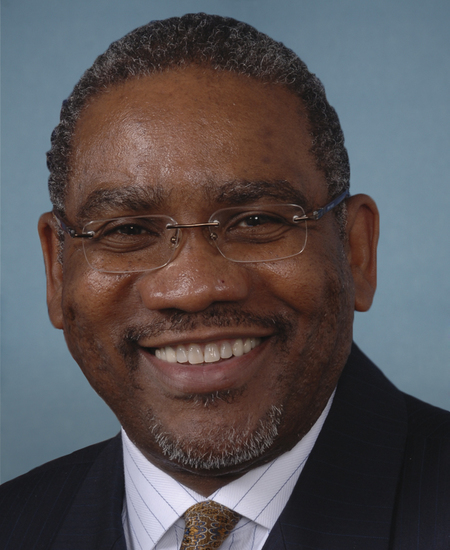
Rep. Gregory W. Meeks
Sponsored bills
This resolution expresses the sense of the House of Representatives that (1) lesbian, gay, bisexual, transgender, queer, intersex, and asexual (LGBTQIA+) rights are human rights and protected by the U.S. Constitution; (2) LGBTQIA+ Pride Month should be celebrated; and (3) all Americans should be treated equally regardless of sexual orientation or gender identity.
Maddy summaryHRES 1144 is a symbolic resolution designating June 3, 2022, as "National Gun Violence Awareness Day" and June 2022 as "National Gun Violence Awareness Month." It does not create new laws or policies but urges the public to wear orange, promote gun safety awareness, and hold community discussions about reducing gun violence during these dates. The resolution cites U.S. statistics on gun-related deaths and injuries as context for the designation. It directly affects the general public by encouraging voluntary observance and community engagement. The bill has no binding effect or funding provisions.
This resolution condemns racism and invidious discrimination as evil and antithetical to the U.S. Constitution and declares unconditional war on racism and invidious discrimination in America. (Invidious discrimination generally refers to discrimination based on a classification that is arbitrary or irrational and not related to a legitimate purpose.) The resolution also expresses the intention of the House of Representatives to pass legislation establishing a Cabinet-level Department of Reconciliation. The department shall be charged with developing and coordinating the implementation of a comprehensive national strategy to eliminate racism and invidious discrimination.
This resolution expresses support for (1) equal rights and protections for all people, regardless of actual or perceived sexual orientation or gender identity; and (2) the designation of LGBTQ Equality Day on June 26 to commemorate Supreme Court decisions handed down on that day in 2003, 2013, and 2015. The resolution also acknowledges the need for further legislation to ensure that people in the United States are free from all forms of discrimination on the basis of actual or perceived sexual orientation or gender identity.
This resolution expresses the sense of the House of Representatives that (1) lesbian, gay, bisexual, transgender, queer, intersex, and asexual (LGBTQIA+) rights are human rights and protected by the U.S. Constitution; (2) LGBTQIA+ Pride Month should be celebrated; and (3) all Americans should be treated equally regardless of sexual orientation or gender identity.
Aaron Salter, Jr., Responsible Body Armor Possession Act This bill establishes a federal statutory framework to restrict the purchase, ownership, or possession of enhanced body armor by civilians. The term enhanced body armor means body armor, including a helmet or shield, with a ballistic resistance that meets or exceeds the ballistic performance standard of Type III armor, as determined using the National Institute of Justice standard in effect at the time the person purchases, owns, or possesses the armor.
Stopping Harmful Image Exploitation and Limiting Distribution Act of 2022 or the SHIELD Act of 2022 This bill establishes a new criminal offense related to the distribution of intimate visual depictions. Specifically, it makes it a crime to knowingly distribute (or intentionally threaten to distribute) an intimate visual depiction of an individual (1) with knowledge of or reckless disregard for the individual's lack of consent and reasonable expectation of privacy, and (2) without a reasonable belief that distributing the depiction touches a matter of public concern. A violator is subject to criminal penalties—a fine, a prison term of up to two years for each individual victim depicted, or both.
Latonya Reeves Freedom Act of 2022 This bill prohibits government entities and insurance providers from denying community-based services to individuals with disabilities that require long-term service or support that would enable such individuals to live in the community and lead an independent life. Specifically, these entities may not discriminate against such individuals in the provision of community-based services by such actions as imposing prohibited eligibility criteria, cost caps, or waiting lists or failing to provide a specific community-based service. Additionally, community-based services must be offered to individuals with such disabilities prior to institutionalization. Institutionalized individuals must be notified regularly of community-based alternatives. The bill requires the Department of Justice to issue regulations requiring government entities and insurance providers to offer community-based long-term services to individuals with such disabilities who would otherwise qualify for institutional placement. Government entities must ensure sufficient availability of affordable, accessible, and integrated housing that is not a disability-specific residential setting or a setting where services are tied to tenancy. Regulations shall also (1) require government entities and insurance providers to perform self-evaluation on current services, policies, and practices and concerning compliance with requirements of this bill; and (2) require government entities to submit a transition plan. The bill provides funds for FY2022 for the Department of Health and Human Services to provide technical assistance with respect to transition plans. The bill allows civil actions by individuals subjected to, or about to be subjected to, a violation of its requirements.