

Saving America's Pollinators Act of 2021 This bill addresses the use of certain pesticides and the health and status of native bees and other pollinators. First, the bill requires the Environmental Protection Agency (EPA) to establish a Pollinator Protection Board to develop an independent review process for pesticides that pose a threat to pollinators and their habitats. All active ingredients and pesticide products that contain one or more specified neonicotinoid pesticides must be deemed to generally cause unreasonable adverse effects to the environment. Under the bill, the registration of all uses of neonicotinoid pesticides must be immediately and permanently canceled. The EPA must revoke any tolerance or exemption that allows the presence of a neonicotinoid pesticide, or any pesticide chemical residue that results from neonicotinoid pesticide use, in or on food. The continued sale or use of existing stocks of neonicotinoid pesticides is prohibited, and the EPA may not register any such pesticides under the Federal Insecticide, Fungicide and Rodenticide Act. The bill requires the Department of the Interior, the EPA, and the Department of Agriculture to coordinate monitoring activities and report on the health and population status of native bees and other pollinators. Finally, a state or federal agency may be granted an exemption to use neonicotinoid pesticides if the board votes that use of the pesticide is warranted (1) in an emergency situation to avert significant risk to threatened or endangered species, (2) to quarantine invasive species, or (3) to protect public health.
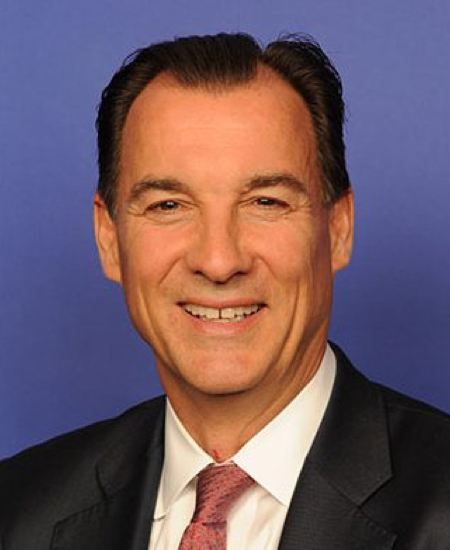
Rep. Thomas R. Suozzi
Sponsored bills
Veterans Service Organization Modernization Act of 2021 This bill requires the Department of Housing and Urban Development to provide competitive grants to veterans service organizations for repairs or rehabilitation of existing facilities and for modernization of technologies.
Close the Medigap Act of 2021 This bill (1) expands guaranteed issue rights with respect to Medigap policies (Medicare supplemental health insurance policies), (2) eliminates certain limitations on Medigap policies for newly eligible Medicare beneficiaries, and (3) modifies other provisions related to Medigap policies. (Guaranteed issue rights require that a policy be offered to any eligible applicant without regard to health status.)
Securing Universal Communications Connectivity to Ensure Students Succeed Act or the SUCCESS Act This bill provides additional funding for the Emergency Connectivity Fund, which supports remote learning during the COVID-19 emergency period by covering reasonable costs of laptop and tablet computers, Wi-Fi hotspots, modems, routers, and broadband connectivity purchases for off-campus use by students, school staff, and library patrons.
Passport Emergency Extension Act of 2021 This bill requires the Department of State to establish an expedited procedure for providing individuals who wish to use their U.S. passport that expired during the COVID-19 emergency (or that is scheduled to expire by March 31, 2022) with a marker to be affixed to such passport indicating a renewal or extension of validity through July 31, 2022.
ABLE Employment Flexibility Act This bill permits employers to make tax-exempts contributions to ABLE (Achieving Better Life Experience) accounts in lieu of making contributions to existing tax-exempt defined contribution retirement plans. An ABLE account is established to pay the expenses (e.g., food, education, housing, transportation, employment training and support, and health care expenses) of a designated beneficiary who is disabled.
School Milk Nutrition Act of 20 21 This bill revises requirements for milk provided by the National School Lunch Program of the Department of Agriculture. The bill permits schools participating in the program to offer students low-fat flavored milk.
This bill repeals the limitation on the amount of distilled spirits excise tax covered over (paid) to the treasuries of the U.S. Virgin Islands and the Commonwealth of Puerto Rico. The bill requires certain amounts of the excise tax paid to the treasury of Puerto Rico to be transferred to the Puerto Rico Conservation Trust Fund.
United States Call Center Worker and Consumer Protection Act of 2021 This bill establishes restrictions on businesses that relocate call centers or redirect customer service calls to locations outside the United States. Specifically, a business must notify the Department of Labor that it intends to move its customer service call center overseas and Labor must maintain a publicly available list of such businesses. Subject to narrow exceptions, a business appearing on such list is ineligible to receive federal grants or guaranteed loans for five years after the business is added to the list. Further, agencies must condition the awarding of government contracts on the requirement that any call center activity pursuant to the contract must be performed in the United States. Additionally, the bill requires call center employees to disclose their physical location at the beginning of each call initiated or received, unless all employees of the business participating in the communication are located in the United States, among other exceptions.
Averting Loss of Life and Injury by Expediting SIVs Act of 2021 or the Allies Act of 2021 This bill increases the number of special immigrant visas available to qualified Afghan nationals who worked for the U.S. government or the North Atlantic Treaty Organization (NATO) missions in Afghanistan. The bill also relaxes certain qualifications for such visas. Specifically, this bill makes available an additional 8,000 visas for principal aliens under this special visa program, to be available until all such visas have been issued. (The numerical limitations in this program apply only to the principal alien who applies for the visa, not to any accompanying spouse or child.) Under this bill, an alien may qualify based on a credible basis for concern about the possibility of an ongoing serious threat in Afghanistan due to their work with the U.S. government or a NATO mission, where currently the alien must have experienced such a threat. The bill also eliminates a requirement for each applicant to submit a credible sworn statement describing that threat. Furthermore, for an applicant qualifying for a visa by performing duties for U.S. military personnel stationed with a NATO mission, this bill eliminates a requirement that the duties performed qualify as sensitive and trusted duties. If an alien submits a visa application that included an accompanying spouse or child but the alien passes away before the application is granted, the surviving spouse or child shall remain eligible to receive a visa under that application. Currently, a surviving spouse or child retains eligibility only if the application was approved before the alien passed away.