

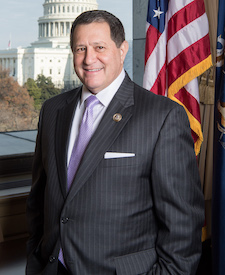
Photo of Joseph D. Morelle
D United States House · District 25 · New York On the 2026 ballot

Rep. Joseph D. Morelle

Compare
Total votes
2,837
all sessions
Attendance
98%
51 missed
Near the chamber average
With party
97%
of cast votes
Near the chamber average
Bipartisan score
2%
crosses aisle rarely
Near the chamber average
Sponsored
1,435
bills & resolutions
Near the chamber average
Committees
7
assignments
1,435 bills and resolutions

Sponsored bills

Total
1,435
Primary
110
Co-sponsor
1,325
This page
1,435
matching current filters
Co-sponsor HR 7257
In committee · Indiana House · Co-sponsor
GLRI Act of 2024

Maddy summaryHR 7257, the GLRI Act of 2024, reauthorizes federal funding for the Great Lakes Restoration Initiative. It specifically adds $500 million annually for fiscal years 2027 through 2031 to the existing program under the Federal Water Pollution Control Act. This funding directly supports ongoing environmental restoration projects in the Great Lakes region, including pollution cleanup, habitat restoration, and invasive species management. The bill extends current funding levels for the next five years without altering program requirements or eligibility.

In committee Feb 12, 2024 1 co-sponsor
Co-sponsor HR 7315
In committee · Indiana House · Co-sponsor
PATH Act

Maddy summaryThe PATH Act establishes a federal grant program to fund pre-apprenticeship programs in the building and construction trades. It provides 75% federal funding (up to $20 million annually) for nonprofit partnerships that develop training programs preparing underrepresented groups - including racial minorities, women, veterans, tribal members, and low-income individuals - from entering registered apprenticeships. Key requirements include curriculum aligned with industry standards, documented partnerships with apprenticeship sponsors, and activities like career exploration and skill assessments. Programs must track outcomes, such as participants entering registered apprenticeships, using performance metrics aligned with existing workforce laws.

In committee Feb 9, 2024 1 co-sponsor
Co-sponsor HR 7299
In committee · Indiana House · Co-sponsor
To authorize to be appropriated to the Secretary of Housing and Urban Affairs, $1,500,000,000 to carry out the HOME Investment Partnership Program, and for other purposes.

Maddy summaryThis bill authorizes $1.5 billion annually from 2024 to 2028 for the HOME Investment Partnership Program, which funds affordable housing initiatives by state and local governments. It also allocates an additional $500 million annually for the same period specifically to build or rehabilitate childcare facilities within housing projects supported by the program. The funding directly supports local housing authorities in developing and maintaining affordable housing with integrated childcare services.

In committee Feb 7, 2024 1 co-sponsor
Co-sponsor HR 7250
In committee · Indiana House · Co-sponsor
Strengthening Educator Workforce Data Act

Maddy summaryHR 7250, the Strengthening Educator Workforce Data Act, requires the U.S. Department of Education to collect and publish detailed data about public school teachers and principals. It mandates school districts to report specific metrics, including years of teaching/principal experience (broken into categories like "less than 1 year" or "15+ years"), certification status, subject-area expertise (e.g., math, special education), and demographic breakdowns by race, ethnicity, and gender. The data must be published in an accessible report with visualizations like graphs and made publicly available online. This law applies to all public elementary and secondary schools and aims to provide transparency on educator workforce composition without changing existing certification requirements.

In committee Feb 6, 2024 1 co-sponsor
Co-sponsor HRES 993
In committee · Indiana House · Co-sponsor
Supporting the goals and ideals of "Career and Technical Education Month".

Maddy summaryHRES 993 is a non-binding congressional resolution designating February as "Career and Technical Education (CTE) Month" to celebrate CTE programs nationwide. It supports CTE as a pathway preparing students for high-demand, skilled careers in fields like infrastructure and technology, recognizing that over 12 million students currently participate in CTE programs across high schools and colleges. The resolution encourages educators, counselors, and parents to promote CTE as a respected educational option, highlighting its role in reducing high school dropout rates and aligning student skills with workforce needs. It does not create new laws or allocate funding, but symbolically affirms bipartisan support for CTE, referencing the 1917 Smith-Hughes Act as foundational to current efforts.

In committee Feb 1, 2024 1 co-sponsor
Co-sponsor HR 7132
In committee · Indiana House · Co-sponsor
Housing Supply and Affordability Act

Maddy summaryHR 7132 creates a federal grant program to help state and local governments, tribes, and Native Hawaiian organizations develop and implement housing plans. Grants fund both planning (creating strategies) and implementation (putting strategies into action) to increase housing supply and affordability while avoiding displacement of current residents. At least 10% of funds must support rural communities, and recipients must report annually on progress and submit final evaluations after three years. The program requires comprehensive plans addressing housing needs, land use reforms, and community engagement to expand housing options.

In committee Jan 30, 2024 1 co-sponsor
Co-sponsor HR 7082
In committee · Indiana House · Co-sponsor
Complete Streets Act of 2024

Maddy summaryThe Complete Streets Act of 2024 requires states to establish programs that help local governments, transit agencies, and other eligible entities design and build transportation infrastructure accommodating all users, including pedestrians, cyclists, and public transit riders. States must provide technical assistance and grants for complete streets projects, with 5% of certain transportation funds allocated to these programs. The bill establishes design standards requiring features like protected bike lanes, accessible sidewalks, and appropriate lighting for all transportation projects, applying to new projects on Federal-aid highways within metropolitan areas. It mandates that states develop complete streets policies and prioritization plans to improve safety and accessibility, particularly in underserved communities, with compliance required by 2026 or 2029 for different project types.

In committee Jan 25, 2024 1 co-sponsor
Co-sponsor HR 7056
In committee · Indiana House · Co-sponsor
Access to Family Building Act

Maddy summaryHR 7056, the Access to Family Building Act, establishes federal rights for individuals to access assisted reproductive technology (ART) like IVF without unreasonable restrictions, directly affecting patients seeking fertility treatments and health care providers offering ART services. The bill prohibits states from imposing limitations on ART that are more burdensome than those for comparable medical procedures, fail to advance safety, or unduly restrict access, while allowing health and safety regulations that are necessary and least restrictive. It creates federal enforcement mechanisms, including lawsuits by the Attorney General or affected individuals to challenge violating state laws, and preempts conflicting state regulations. The bill explicitly preserves state authority over health/safety regulations and does not alter existing state insurance coverage laws for ART.

In committee Jan 19, 2024 1 co-sponsor
Co-sponsor HR 7039
In committee · Indiana House · Co-sponsor
Stronger Communities through Better Transit Act

Maddy summaryThe Stronger Communities through Better Transit Act establishes a new federal grant program to improve public transportation service. It provides funding to urban areas, states, and Indian tribes to cover up to 50% of public transit operating costs (up to 80% in persistent poverty areas and 100% for Indian tribes), with requirements to report on service frequency, access to jobs, and conduct community surveys. The program mandates that a majority of funds must benefit underserved communities and areas of persistent poverty, defined as census tracts with high poverty rates or minority populations. Recipients must maintain their transit funding levels and report on improvements in access to essential services. The bill authorizes $20 billion annually for fiscal years 2024-2027.

In committee Jan 18, 2024 1 co-sponsor
Co-sponsor HR 6053
In committee · Indiana House · Co-sponsor
Break Free From Plastic Pollution Act of 2023

Maddy summary# Summary of "Protecting Communities from Plastics Act" (Title II) This comprehensive legislation addresses the environmental, health, and environmental justice impacts of plastics production and use. Key provisions include: ## Environmental Justice Protections - Requires environmental justice assessments for permits of "covered facilities" (plastics manufacturing facilities) - Mandates consultation with "fenceline communities" (communities near facilities) including: * Prompt notification in multiple languages * Public hearings with translation services * Community benefit agreements - Establishes a 45-day waiting period before approving permits after public hearings ## Regulatory Requirements - Amends Clean Air Act to establish new source performance standards for plastics facilities - Requires continuous monitoring of air emissions (benzene, nitrogen oxides, etc.) - Amends Clean Water Act to prohibit discharge of plastic pellets in wastewater - Requires financial assurance for facility closure and emergency response - Prohibits new facility permits within 5 miles of community buildings (schools, hospitals, etc.) ## Research and Monitoring - Requires study of microplastics in food (including fish, meat, fruits, vegetables) - Mandates research on microplastics in human bodies (urine, breastmilk, stool) - Establishes a pilot program to test technologies for microplastic removal - Requires inventory of plastics manufacturing and distribution ## Additional Provisions - Temporary permitting moratorium on new plastics facilities (during "temporary pause period") - Requires listing of discarded polyvinyl chloride as hazardous waste - Limits National Recycling Strategy to exclude chemical recycling technologies - Creates grants to reduce single-use plastics in agricultural packaging - Requires biodegradable alternatives to plastic weed barriers The legislation aims to address the disproportionate environmental and health impacts of plastics production on vulnerable communities while establishing comprehensive regulatory frameworks for plastics manufacturing and disposal.

In committee Jan 18, 2024 1 co-sponsor
Showing 531 to 540 of 1,435 bills
Previous 1 … 53 54 55 … 144 Next