

Maddy summaryHR 2743 prohibits large financial institutions (over $100 billion in assets) from denying banking services to lawful businesses based on subjective political reasons, industry type, or reputational concerns. It requires these institutions to use objective, risk-based assessments for service decisions and provide written justifications for denials. The law applies to banks, credit unions, and payment networks, with civil penalties for violations including fines up to $10,000 per incident. It specifically ensures businesses operating legally under federal law receive fair access to financial services without discrimination. The bill mandates that denials be based on documented risk factors, not political bias or category-based exclusion.
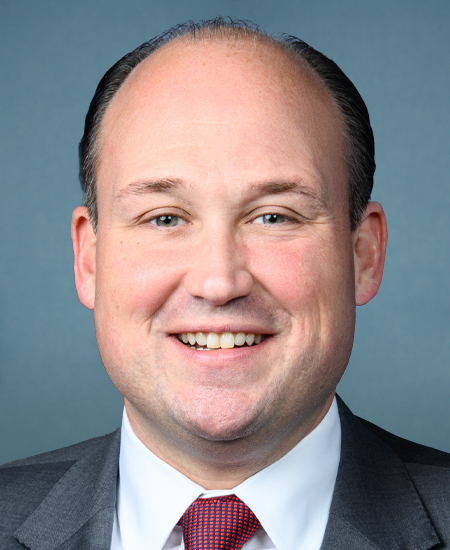
Rep. Nicholas A. Langworthy
Sponsored bills
American Innovation and R&D Competitiveness Act of 2023 This bill eliminates the five-year amortization requirement for research and experimental expenditures, thus allowing continued expensing of such expenditures in the taxable years in which they are incurred.
Maddy summaryHJRES 27 is a congressional resolution seeking to block a federal rule that redefined which waterways fall under the Clean Water Act's protections. It targets a rule submitted by the Army Corps of Engineers, Department of Defense, and Environmental Protection Agency (EPA) on January 18, 2023, which aimed to revise the "Waters of the United States" definition. The resolution would formally disapprove this rule under a specific federal procedure (Chapter 8 of Title 5), preventing it from taking effect. This would directly affect how federal agencies regulate pollution and development near water bodies, including wetlands and smaller streams.
Maddy summaryHR 2665 delays Medicaid payment reductions for safety net hospitals by two years, changing the effective date from 2024 to 2026 under Section 1923(f)(7)(A) of the Social Security Act. This bill directly affects hospitals that serve high numbers of low-income and uninsured patients, providing them with additional time before facing reduced federal Medicaid payments. The key mechanism is a technical amendment to existing law, postponing an already scheduled payment adjustment without altering funding levels or eligibility. As a procedural bill, it does not create new programs or change hospital requirements.
Protect Local Taxpayers Act of 2023 This bill specifies that, in order to receive certain Federal Medical Assistance Percentage (FMAP) increases under Medicaid, states with a local share requirement must agree to distribute funds to each locality in an amount that is proportional to the locality's Medicaid contributions.
Maddy summaryHR 2620, the Federal Firearms Licensee Protection Act of 2023, increases penalties for crimes targeting firearms licensees. It amends Section 924 of Title 18 to impose mandatory minimum sentences of 3 years for burglaries or 5 years for robberies committed at the business premises of licensed firearms dealers, manufacturers, or importers. The bill specifically targets violations of Section 922(u), which prohibits unauthorized access to these premises, and adds "attempts to do so" to the penalties. This directly affects licensed firearms businesses by strengthening legal protections against theft or violence at their locations. The law creates clearer, harsher consequences for crimes committed during burglaries or robberies at these specific business sites.
This resolution recognizes law enforcement agencies and officers for their tireless work to protect us and make our communities safer. It also condemns calls to defund, disband, dismantle, or abolish the police.
Infrastructure Expansion Act of 2023 This bill precludes absolute liability in any action against a property owner or contractor for certain federal infrastructure and transportation development projects for any injury associated with an elevation- or gravity-related risk occurring on those projects. This applies to federally owned or operated projects and to projects receiving federal financial assistance for infrastructure and transportation development. In any such claim, a state must apply a liability standard that considers the comparative negligence of the injured person when such negligence is a proximate cause of an injury, and state law would otherwise apply absolute liability as the basis for such claim. The bill applies to claims arising from projects in which a state or local government accepts federal financial assistance beginning on or after January 1, 2025.
Maddy summaryHR 2539 permanently extends the New Markets Tax Credit (NMTC) program, which incentivizes private investment in low-income communities. The bill directly affects community development financial institutions (CDFIs) and investors who fund projects in designated low-income areas by ensuring the credit remains available beyond 2025. Key provisions include automatically adjusting the credit amount annually for inflation starting in 2024 and clarifying that the credit can be used to offset alternative minimum tax liability. This maintains the program’s effectiveness in channeling capital to underserved neighborhoods without changing eligibility or funding levels.
Precision Agriculture Loan Program Act of 202 3 This bill establishes a loan program within the Farm Service Agency to assist agricultural producers in purchasing precision agriculture equipment and technology, such as geospatial mapping, data management and analytics software, and network connectivity products and solutions. Precision agriculture refers to managing, tracking, or reducing crop or livestock production inputs, including seed, feed, fertilizer, chemicals, water, and time, at a heightened level of spatial and temporal granularity to improve efficiencies, reduce waste, and maintain environmental quality.