

Maddy summaryHR 1351, the "Promoting American Patriotism In Our Schools Act," requires public elementary and secondary schools receiving federal education funds to implement specific patriotism-related practices. The bill mandates that all students, teachers, and staff recite the Pledge of Allegiance daily (with an exception for religious or personal reasons), prominently display the American flag in every classroom and gymnasium, and incorporate age-appropriate flag history and significance into civics or history curricula. Schools must annually certify compliance with these requirements to state education agencies, which then report to the federal government. This bill directly affects all public K-12 schools receiving funds under the Elementary and Secondary Education Act.
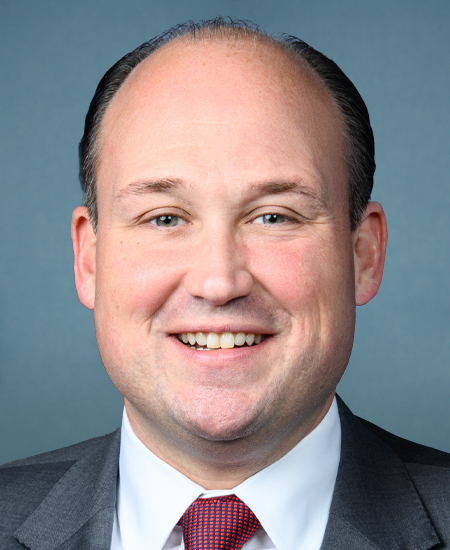
Rep. Nicholas A. Langworthy
Sponsored bills
Fighting Trade Cheats Act of 2025 This bill increases penalties for, and establishes additional enforcement mechanisms related to, fraudulent and grossly negligent violations of U.S. customs laws. Specifically, the bill increases the maximum civil penalty for a fraudulent violation to three times the domestic value of the merchandise. (Currently, the maximum penalty is the domestic value of the merchandise.) It prohibits a person who commits a fraudulent violation from importing merchandise into the United States for a five-year period. Additionally, the bill increases the maximum civil penalty for a grossly negligent violation to the lesser of (1) 3 times the domestic value of the merchandise; or (2) 10 times the lawful duties, taxes, and fees. (Currently, the maximum penalty is the lesser of the domestic value of the merchandise or four times the lawful duties, taxes, and fees.) It prohibits a person who commits a grossly negligent violation from importing merchandise into the United States for a two-year period. Further, the bill applies these importation bans to an affiliated person (e.g., a family member or employee) of the person who committed the fraudulent or grossly negligent violation. The bill establishes a private right of action for an interested party (e.g., a manufacturer) affected by customs fraud or grossly negligent violations. The bill prohibits any person (or an affiliated person) who commits a fraudulent or grossly negligent violation from participating in the U.S. Customs and Border Protection's Importer of Record program, and further requires revocation of their importer of record numbers.
Maddy summaryHR 35, the Agent Raul Gonzalez Officer Safety Act, creates a new federal crime for operating a motor vehicle while intentionally fleeing U.S. Border Patrol agents or assisting law enforcement officers within 100 miles of the U.S. border. It imposes penalties of up to 2 years in prison for the basic offense, 5-20 years if serious injury occurs, and 10 years to life if death results. The bill also makes individuals convicted of this crime inadmissible to the U.S., deportable, and ineligible for immigration relief like asylum. Additionally, it requires annual reports from the Attorney General and Homeland Security Secretary detailing arrests, charges, and penalties related to this offense.
United States-Israel Defense Partnership Act of 2025 This bill requires or authorizes certain actions to increase defense-related cooperation between the United States and Israel. Specifically, the bill requires the Department of Defense (DOD) to establish a cooperative program, with the concurrence of Israel's Ministry of Defense (MOD), to develop and deploy advanced technologies for countering unmanned systems that threaten the United States and Israel; establish in Israel an office of the Defense Innovation Unit (an organization that focuses on rapidly fielding and scaling commercial technology across the U.S. military); and seek to engage Israel's MOD on the ascension of Israel into the national technology and industrial base (currently defined in law as the persons and organizations engaged in research, development, production, integration, services, or information technology activities conducted within the United States, the United Kingdom, Australia, New Zealand, and Canada). The bill authorizes DOD, upon request of Israel's MOD, to jointly conduct research, development, test, and evaluation (RDT&E) of emerging technologies such as artificial intelligence and robotics to meet defense challenges. Additionally, the bill extends the authority for DOD to (1) carry out RDT&E on a joint basis with Israel to establish anti-tunnel and counter unmanned aerial systems capabilities through 2028, and (2) transfer defense articles intended for use as reserve stocks for Israel through January 1, 2029.
Alternatives to Prevent Addiction In the Nation Act or the Alternatives to PAIN Act This bill reduces cost-sharing and prohibits the imposition of certain utilization requirements under the Medicare prescription drug benefit for certain non-opioid pain management drugs. Specifically, the bill requires such drugs to be covered without a deductible and to be placed on the lowest cost-sharing tier (if any). The bill also prohibits the imposition of prior authorization requirements (i.e., requiring prior approval from a plan) or step therapy requirements (i.e., requiring the use of alternative drugs before a drug is covered under a plan) with respect to such drugs.
Maddy summaryHR 1269, the Honoring Our Fallen Heroes Act of 2025, expands benefits for public safety officers (like police and firefighters) who develop certain cancers linked to their work. It adds 22 specific cancers - including lung, mesothelioma, and breast cancer - to the list of conditions presumed to be "exposure-related" and sustained in the line of duty. This presumption applies if the officer served at least 5 years, was diagnosed with the cancer within 15 years after last active duty, and the cancer directly caused death or permanent disability. The bill also establishes a process for adding new cancers every 3 years based on medical evidence from agencies like NIOSH, and allows claims to be filed within 3 years of the law's enactment.
Maddy summaryThe PANELS Act amends U.S. tax code provisions to exclude solar energy projects on prime or unique farmland from federal tax credits. Specifically, it revises Section 48 (energy property credits) and Section 45Y (clean electricity production credits) to require that solar facilities not be located on land designated as "prime farmland" or "unique farmland" under existing USDA definitions (7 CFR § 657). This directly affects solar developers seeking these tax benefits, as projects on such agricultural land will no longer qualify. The change applies to property placed in service after the bill’s enactment, aiming to protect high-quality farmland from being converted for solar development.
Maddy summaryHR 1256, the Long-Term Care Transparency Act, requires the federal Assistant Secretary to annually submit a consolidated report to Congress summarizing findings from state long-term care ombudsman programs. This report aggregates all state-level reports submitted under existing law and provides a summary of their key findings. The bill directly affects state ombudsman programs by requiring them to submit annual reports, and it affects Congress by mandating an annual summary of those reports for oversight purposes. This is a procedural requirement focused on transparency, not a change to long-term care services or regulations.
Maddy summaryHR 1217, the Orphan Well Grant Flexibility Act of 2025, amends federal grant rules for cleaning up orphaned oil and gas wells by removing the requirement for states to measure methane emissions as a condition for receiving funding. It allows states to use estimated data from well plugging projects (without needing to collect new monitoring data) for reporting purposes. The bill also mandates a National Academies study to analyze how well-plugging activities affect local economies, housing, and water quality in communities where many wells are cleaned up, requiring input from all U.S. regions and agencies like HUD. This study must be completed within 18 months after the final grant is awarded, using existing federal funding.
Maddy summaryHR 1195, the Protect Medicaid Act, prohibits federal Medicaid funds from covering administrative costs related to health benefits provided to unauthorized immigrants who lack lawful immigration status and are ineligible for Medicaid. This directly affects states that currently provide such benefits, requiring them to separate these administrative costs from general Medicaid program expenses. The bill adds a new provision to the Social Security Act clarifying that federal funds cannot be used for these specific administrative costs, while allowing funds for systems designed to enforce this rule. It also mandates an Inspector General report detailing how states separate costs, ensure compliance, finance these programs (e.g., through provider taxes), and the impact on drug pricing for this population.