

Rescue Endangered SIVs and Citizens and Urgently Evacuate to Safety Act of 2022 or the RESCUES Act of 2022 This bill requires reports on issues related to the evacuation of Afghanistan, specifically the evacuation of (1) U.S. nationals and lawful permanent residents, (2) nationals of Afghanistan who have received or applied for a special immigrant visa, and (3) nationals of Afghanistan who are eligible for certain levels of priority under the U.S. Refugee Admissions Program. The Department of State must report to Congress on State Department funding provided to nongovernmental entities for evacuating such individuals. The report must include funding provided from August 15, 2021, to the date that is 180 days after this bill's enactment. The State Department must also report to Congress on the State Department's methods to prevent waste, fraud, abuse, or diversion to unintended beneficiaries of funding provided to a nongovernmental entity for evacuating such individuals.
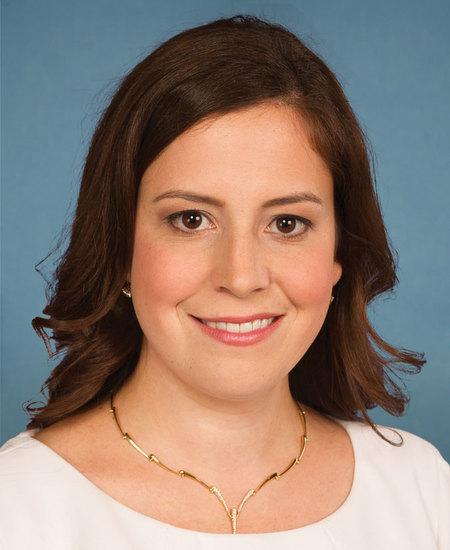
Rep. Elise M. Stefanik
Sponsored bills
VA Safe Holidays Act This bill requires the Department of Veterans Affairs (VA) to annually conduct outreach for a 10-week period starting on November 1 to veterans to promote the Veteran Identity Theft Helpline and identify other identity theft resources available to veterans and beneficiaries of VA programs. The VA must submit a plan to Congress detailing its efforts to promote identity theft awareness and to assist veterans and VA program beneficiaries who experience identity theft.
Accelerating Access to Critical Therapies for ALS Act This bill establishes grant programs to address neurodegenerative diseases, such as amyotrophic lateral sclerosis (also known as ALS or Lou Gehrig's disease), and contains other related provisions. The Department of Health and Human Services (HHS) shall award grants to eligible entities for scientific research utilizing data from expanded access to investigational ALS treatments for individuals who are not otherwise eligible for clinical trials. The Food and Drug Administration (FDA) shall award grants to public and private entities to cover the costs of research and development of drugs that diagnose or treat ALS and other rare neurodegenerative diseases. HHS shall also establish the Public-Private Partnership for Neurodegenerative Diseases between the National Institutes of Health, the FDA, and at least one eligible entity (generally, an institution of higher education or a nonprofit organization). The partnership shall support the development and regulatory review of drugs that address ALS and other rare neurodegenerative diseases. The FDA shall publish on its website a five-year action plan for fostering the development of drugs that improve or extend the lives of people living with rare neurodegenerative diseases. The Government Accountability Office must report to Congress about the grants provided under this bill, including an analysis of the impact of such grants on research and development of treatments for ALS.
This concurrent resolution expresses the sense of Congress that tax-exempt fraternal benefit societies provide critical benefits to the people and communities of the United States and their work should continue to be promoted.
Protecting Our Democracy by Preventing Foreign Citizens from Voting Act This bill prohibits federal funds from being made available to state or local governments that allow noncitizens to vote in federal, state, or local elections.
This bill posthumously provides for the award of a Congressional Gold Medal in commemoration of the 13 service members who died on August 26, 2021, while stationed at Hamid Karzai International Airport in Afghanistan.
This bill requires that a discharge or dismissal of a member of the Armed Forces must be characterized as honorable in situations where the individual was discharged or dismissed solely for refusing to receive a COVID-19 vaccination. Such individuals may not be denied retired or retainer pay or any benefits through the Department of Defense or Department of Veterans Affairs solely on the basis that they refused to receive a COVID-19 vaccination.
Food Donation Improvement Act of 2021 This bill expands liability protections for the donation of food and grocery products. Specifically, the bill expands the liability protections to include donations of an apparently fit grocery product or apparently wholesome food for which the recipient is charged a good Samaritan reduced price that is no greater than the cost of handling, administering, and distributing the food or product; or that is donated directly to a needy individual by a retail grocer, wholesaler, agricultural producer, restaurant, caterer, school food authority, or institution of higher education. The Department of Agriculture must issue regulations that clarify the quality and labeling standards that food products donated under the Bill Emerson Good Samaritan Food Donation Act must meet to be eligible for liability protection.
Employer-Directed Skills Act This bill allows for an employer to sponsor skills development programs with partial federal reimbursement under the Workforce Innovation and Opportunity Act (WIOA). These new skills development programs are exempt from the program application and participant assessment requirements that typically apply to WIOA employment and training activities. However, these skills development programs must be conducted according to an employer-sponsored skills development agreement that includes, among other required provisions, a commitment by the employer to employ an individual upon successful completion of the program. The bill also requires the federal share of these skills development programs and the federal share of existing on-the-job training programs to be paid by reimbursement from employer-directed skills accounts that must be established by local one-stop operators.
Strategic Production Response Act This bill limits the drawdown of petroleum in the Strategic Petroleum Reserve until the Department of Energy develops a plan to increase the percentage of federal lands leased for oil and gas production.