

Maddy summaryThis symbolic House resolution expresses U.S. congressional support for Iranian protesters demanding democracy and human rights. It condemns the Iranian regime's violent suppression of protests, including killings, mass arrests, and internet restrictions, while urging the regime to release political prisoners and restore communication access. The resolution reaffirms the Iranian people's right to self-determination through free elections and echoes a 2023 resolution (HCR 7) that similarly praised protesters. As a non-binding expression of support, it does not impose new policies or alter U.S. government actions.
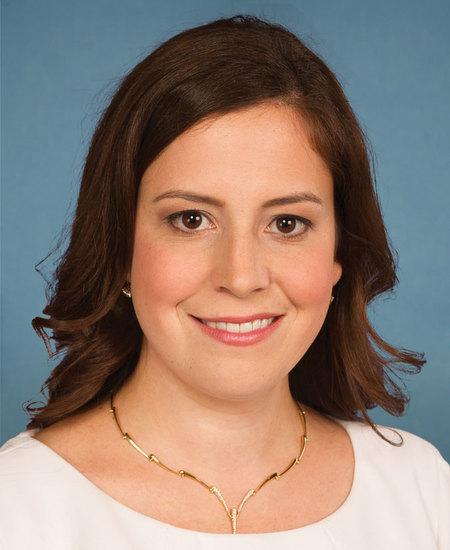
Rep. Elise M. Stefanik
Sponsored bills
Maddy summaryThis bill would increase the base pay for Federal Bureau of Prisons correctional officers by 35 percent, replacing their current base rate for all pay calculations (including retirement and locality adjustments). It applies to officers whose duties involve inmate custody, control, or direct custodial contact, including certain supervisory staff and lower-grade Bureau of Prisons employees with similar duties. The pay increase is capped at the Executive Schedule level V rate and would expire after five years unless a Department of Justice Inspector General review finds progress in reducing non-custodial staff use for custodial duties and excessive overtime. The review, required 180 days before expiration, would assess impacts on recruitment, retention, and institutional safety.
Maddy summaryThis bill amends the Fair Labor Standards Act to exclude the value of employer-provided child or dependent care services from overtime pay calculations. It directly affects employers who offer such care benefits, allowing them to exclude the cost of these services when determining overtime wages for eligible employees. The key change adds a new exclusion (paragraph (9)) to the overtime calculation rules, meaning the value of childcare or elder care provided by an employer is no longer counted toward an employee's regular rate for overtime purposes. The change applies to overtime pay required for workweeks beginning after the bill's enactment date.
Maddy summaryHR 909, the Crime Victims Fund Stabilization Act of 2025, modifies how funds from the False Claims Act are deposited into the Crime Victims Fund. It specifies that from 2025 through 2029, certain False Claims Act proceeds (specifically those for qui tam plaintiff payments and government damage reimbursements) cannot be deposited into the fund. This change directly affects the composition of the Crime Victims Fund by excluding these specific revenue streams during the specified period. The bill does not create new benefits or alter victim services; it only adjusts fund allocation rules for existing False Claims Act revenues.
Maddy summaryHR 4594, the Military Learning for Credit Act of 2025, allows veterans using GI Bill benefits (Chapters 30, 33, 34, or 35) to cover costs for certain exams that grant college credit. It specifically permits using educational assistance for DSST, CLEP, National Career Readiness Certificate exams, and portfolio assessments of military training, with a $500 per exam cap. Veterans’ GI Bill entitlement is charged based on the exam cost relative to their monthly benefit rate, but this does not reduce benefits from the Department of Defense Tuition Assistance Program. The bill directly affects veterans seeking to convert military experience into college credits through approved programs.
Essential Caregivers Act of 2025 This bill prohibits certain health care facilities from limiting the access of essential caregivers to residents of those facilities, including during designated emergency periods. Specifically, the bill generally prohibits Medicare skilled nursing facilities, Medicaid nursing facilities, Medicaid intermediate care facilities, and associated inpatient rehabilitation facilities from restricting the access of essential caregivers to residents of the facilities, including during emergency periods in which visitation rights are otherwise restricted. During emergency periods, facilities may restrict access for an initial period of up to seven days and for one additional maximum seven-day period (if the additional period is approved by the state health department). Facilities may restrict access for a total of 7 days (or 14 days with the approval of the state health department) during an emergency period. Essential caregivers must agree to comply with any safety protocols set by the facility, which may be no more stringent for caregivers compared to those for staff. Caregivers who fail to comply with these requirements may be denied access, subject to an appeals process.
Maddy summaryThis bill (HR 6694) designates the U.S. Postal Service facility at 130 North Winton Road in Rochester, New York, as the "Lieutenant James N. Lyons Post Office." It updates all official federal references to the location to reflect this new name. The change is purely ceremonial and affects how the post office is identified in government documents and records.
Miracle on Ice Congressional Gold Medal Act This act provides for the award of Congressional Gold Medals to the members of the 1980 U.S. Olympic men's ice hockey team in recognition of the team's achievement at the 1980 Winter Olympic Games.
Maddy summarySammy's Law requires large social media platforms (those with over 100 million monthly users or $1 billion in annual revenue) to create real-time tools allowing parents or third-party safety software providers to help protect children under 17 from online harms. Platforms must provide secure access to children's account data for safety software providers that register with the Federal Trade Commission and meet strict security and privacy requirements. Third-party providers can only use the data to address specific risks like cyberbullying, trafficking, or abuse, and must delete data after 14 days unless needed for a safety concern. The law creates a federal standard that prevents states from making their own rules about this type of platform access.
Maddy summaryThe Safeguarding US Rulemaking Act (HR 6581) would amend federal rulemaking procedures to bar foreign governments designated as "foreign adversaries" by the Secretary of Commerce, and their nationals or entities, from submitting public comments or petitions during rule development. This change applies to all federal agencies when creating new regulations under standard rulemaking processes. The bill adds a new provision requiring that only U.S. citizens and entities, and foreign entities not from designated adversary countries, may participate in public input phases. As a result, non-adversary foreign entities would still be permitted to provide input, while designated foreign adversaries would be excluded.