

Conrad State 30 and Physician Access Reauthorization Act This bill modifies the Conrad 30 Waiver program, which incentivizes qualified foreign physicians to serve in underserved communities. It also extends statutory authority for the program for three years from this bill's enactment. Aliens coming to the United States under a J-1 nonimmigrant visa to receive medical training typically must leave the country and reside for two years abroad before being eligible to apply for an immigrant visa or permanent residence. The Conrad program waives this requirement for individuals who meet certain qualifications, including serving for a number of years at a health care facility in an underserved area. The bill increases the number of waivers that a state may obtain each fiscal year from 30 to 35 if a certain number of waivers were used the previous year, and provides for further adjustments depending on demand. An alien physician may be employed at an academic medical center to meet the Conrad program's employment requirements if the alien's work is in the public interest, even if the medical center is not in an underserved area. Employment contracts for alien physicians under the Conrad program shall contain certain information, such as the maximum number of on-call hours per week the physician shall have to work. Certain alien physicians (along with the physician's spouse and children) shall be exempt from the direct annual numerical limits on immigration, including those physicians that have met certain requirements related to visas for physicians to serve in underserved areas.
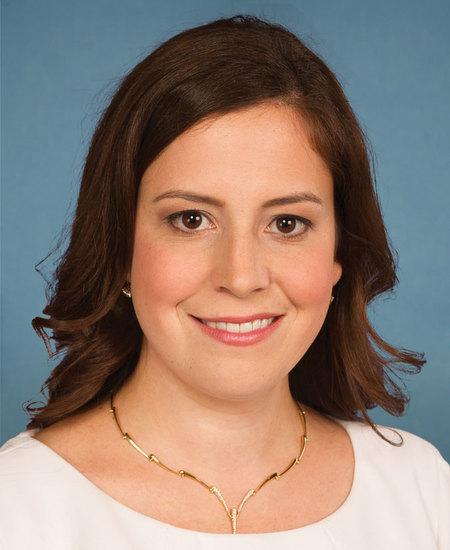
Rep. Elise M. Stefanik
Sponsored bills
Protecting Access for Hunters and Anglers Act of 2022 This bill bars the Department of the Interior and the Department of Agriculture from prohibiting or regulating the use of lead ammunition or tackle on federal land or water that is under the jurisdiction of such departments and made available for hunting or fishing. The bill makes exceptions for specified existing regulations and where the applicable department determines that a decline in wildlife population at the specific unit of federal land or water is primarily caused by the use of lead in ammunition or tackle, based on the field data from such unit, and the state approves the regulations.
Transparency And Production of American Energy Act or the TAP American Energy Act This bill modifies requirements related to the exploration and development of energy resources (e.g., oil, gas, and renewable energy projects). For example, it sets forth provisions to (1) resume sales of onshore and offshore oil and gas leases and restrict the President from imposing bans on or otherwise limiting energy leasing and mineral withdrawals without congressional approval, (2) set timeframes for and makes other changes to certain environmental requirements that apply to energy projects, and (3) address various aspects of permitting and regulating pipelines and energy infrastructure projects.
Foreign Adversary Communications Transparency Act This bill requires the Federal Communications Commission (FCC) to annually publish a list of entities that hold a license or other authorization granted by the FCC and have ties to specified foreign countries. An entity must be listed if China, Iran, North Korea, or Russia (or organizations subject to the jurisdictions of those governments) owns 10% or more of the entity.
Mahsa Amini Human rights and Security Accountability Act or the MAHSA Act This bill requires the President to impose property- and visa-blocking sanctions on certain persons (individuals and entities) affiliated with Iran. The President must make determinations about whether certain existing sanctions apply to specified persons and impose the applicable sanctions, including determinations concerning (1) the Supreme Leader of Iran and any official in the Office of the Supreme Leader of Iran, (2) the President of Iran and any official in the Office of the President of Iran, and (3) any entity overseen by the Office of the Supreme Leader of Iran which is complicit in supporting human rights abuses or terrorism.
Global Malnutrition Prevention and Treatment Act of 2021 This act sets out programs and otherwise directs the U.S. Agency for International Development (USAID) to carry out activities to prevent and treat malnutrition globally. Specifically, USAID may leverage resources to address malnutrition through the Global Nutrition Coordination Plan (an interagency effort to strengthen the impact of U.S. investments in nutrition) and its role on the board of directors of the U.S. International Development Finance Corporation. USAID must also select countries based on specified malnutrition-related indicators for purposes of targeting malnutrition prevention and treatment programs and update the selection within five years. Additionally, USAID may establish the Nutrition Leadership Council to coordinate federal government activities to prevent and treat malnutrition; and target resources and nutrition interventions to the populations most susceptible to severe malnutrition and otherwise support efforts to prevent and treat malnutrition globally. The act also requires USAID to provide to Congress an implementation plan and annual reports concerning its programs for treating and preventing malnutrition. The act's provisions terminate seven years after its enactment.
This resolution expresses the sense of the House of Representatives that the courts should find New York's Concealed Carry Improvement Act unconstitutional and that all states should pass legislation supporting Second Amendment rights.
Border Airport Enhancement Act of 2022 This bill waives the polygraph requirement for U.S. Customs and Border Protection agents for certain applicants who are law enforcement officers or members (or veterans) of the Armed Forces. The bill also requires the President to designate the Valley International Airport in Harlingen, TX, and the Plattsburgh International Airport in Plattsburgh, NY, as ports of entry.
Combating the Persecution of Religious Groups in China Act This bill expresses the sense of Congress that the United States should promote religious freedom in China and makes statements of policy related to such freedom. In particular, the bill states that it is U.S. policy to consider senior Chinese government officials who are responsible for the persecution of Christians or other religious minorities in China to have committed (1) a gross violation of internationally recognized human rights for the purpose of imposing certain sanctions, and (2) a particularly severe violation of religious freedom for the purpose of determining whether such an individual is admissible into the United States.
This bill designates the facility of the United States Postal Service located at 39 West Main Street, in Honeoye Falls, New York, as the CW4 Christian J. Koch Memorial Post Office.