Public Safety Enhancement Act of 2021 This bill reauthorizes through FY2026 the Community Oriented Policing Services (COPS) grant program. Additionally, the bill requires a certain amount of funds made available under the COPS grant program to be used for the hiring and retention of law enforcement officers.
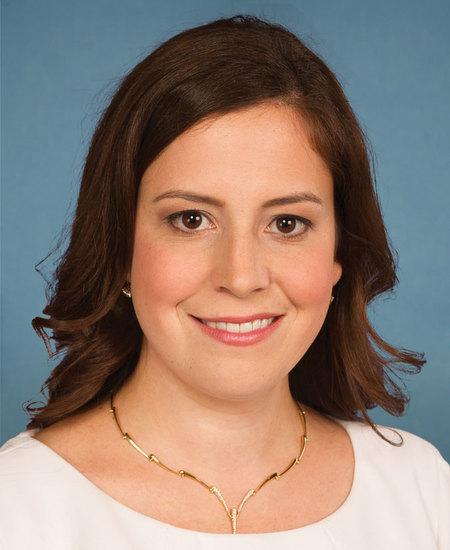
Rep. Elise M. Stefanik
Sponsored bills
Prison Camera Reform Act of 2021 This bill establishes various requirements to ensure that the security camera, radio, and public address systems used by the Bureau of Prisons (BOP) have the capabilities necessary to (1) ensure the health and safety of staff and inmates; and (2) ensure the documentation and accessibility of video evidence pertaining to misconduct, maltreatment, or criminal activity within correctional facilities. Among the requirements, the BOP must evaluate the systems currently in use at its facilities and implement a plan that addresses deficiencies in and makes upgrades to the systems.
Illegal Immigrant Payoff Prohibition Act This bill prohibits the payment of a settlement to an alien for a civil action brought against the United States in connection with the alien's inadmissibility to, or unlawful presence in, the United States.
Protect Communities from a Porous Border Act of 2021 This bill requires the Department of Homeland Security (DHS) to notify a state before placing an alien in that state and gives the state final authority to prohibit such a placement. At least 10 business days before placing (e.g., detaining or housing) such an individual in a state, DHS must provide certain information to that state, including (1) the individual's biographic and biometric information, including DNA; and (2) a certification that the biometric and biographic information has been checked in various law enforcement and counterterrorism databases. No federal court shall have jurisdiction to review (1) the requirements and procedures established under this bill, or (2) a decision by a state to prohibit the placement of such an individual in the state. The bill also prohibits any federal official from waiving any of the bill's requirements.
Stop Enabling Repeat Violence and Endangering Our Communities Act or the SERVE Our Communities Act This bill authorizes the Bureau of Justice Assistance to make grants to states and local governments for mentoring, transitional services, and training to help offenders successfully reintegrate back into the community after incarceration. To be eligible for a grant, a state or local government must take steps to prevent repeat offenses by violent offenders and allow a state court or magistrate to consider the danger an individual poses to the community when determining bail or pretrial release conditions.
Better Enforcement of Grievous Offenses by unNaturalized Emigrants Act or the BE GONE Act This bill expands, for immigration purposes, the definition of aggravated felony to include sexual abuse, sexual assault, and aggravated sexual violence. (Under current law, a conviction for an aggravated felony is grounds for deportation and may bar an individual from other immigration-related benefits.)
Care for Her Act This bill allows an eligible taxpayer to claim the Child Tax Credit for the tax year preceding the year the child is born. It also sets out other activities to support parents and pregnant women. Specifically, the bill establishes the Pregnancy Support Collaborative, which consists of representatives from the Department of Health and Human Services (HHS) and states that elect to participate. The collaborative must maintain a clearinghouse of information on providers of pregnancy and parenting supports and services. States must identify providers in their jurisdictions who meet applicable criteria for inclusion. In addition, the collaborative must share information about education and training opportunities for parents and pregnant women and identify successful programs (including workplace policies) to support them. Furthermore, the collaborative must award grants to states for local programs to improve maternal and infant health outcomes. If a community demonstrates that its program reduces Medicaid costs, it retains a portion of those savings. If approved by the collaborative, HHS must award grants to providers in the clearinghouse for mentoring and training pregnant women and new mothers and addressing gaps in the availability of maternity housing. Additionally, HHS may award grants for pregnancy and parenting supports and services. The Centers for Disease Control and Prevention and the Centers for Medicare & Medicaid Services must jointly maintain a database of de-identified epidemiological and Medicaid claims data to evaluate the effect of maternity homes on maternal and infant health outcomes.
Canadian Snowbird Visa Act This bill authorizes the Department of Homeland Security to admit into the United States qualifying Canadian citizens as long-term nonimmigrant visitors. A qualifying Canadian citizen is an individual who (1) is at least 50 years old, (2) maintains a Canadian residence, (3) owns a U.S. residence or has rented a U.S. accommodation for the duration of the individual's stay, (4) is not inadmissible or deportable, (5) will not engage in employment or labor for hire in the United States other than for a non-U.S.-based person or entity by whom the Canadian citizen was employed in Canada or for whom the Canadian citizen performed services in Canada, and (6) will not seek certain forms of assistance or benefits. A qualified individual may be admitted for up to 240 days during any single 365-day period. The spouse of such an individual may be admitted under the same terms, except that the spouse is not required to separately satisfy the requirement for owning or renting a residence in the United States. The bill grants an individual so admitted nonresident alien tax status.

Customs Business Fairness Act of 2021 This bill modifies the treatment of claims by customs brokers for unpaid customs duties in chapter 11 (reorganization) bankruptcy proceedings.
Protecting First Responders from Secondary Exposure Act of 2021 This bill expands the allowable uses of grant funds under the Comprehensive Opioid, Stimulant, and Substance Abuse Program administered by the Department of Justice. Specifically, the bill allows grants to be used for purchasing containment devices for first responders and training first responders on the use of containment devices to prevent secondary exposure to fentanyl and other potentially lethal substances.