

Maddy summaryHR 984, the Commitment to Veteran Support and Outreach Act, authorizes $50 million annually (2024-2028) for grants to states and tribes to improve outreach to veterans and their families. The bill provides funding to hire more county/Tribal veterans service officers, expand existing outreach programs, and ensure equitable access to benefits for vulnerable groups like American Indian veterans, elderly veterans, and women veterans. States and tribes must submit detailed plans, track how quickly veterans receive benefits, and report annually on progress toward outcome measures set by the Veterans Affairs Secretary. Grants must supplement, not replace, existing state/local funding and prioritize areas with critical officer shortages or high veteran suicide rates.
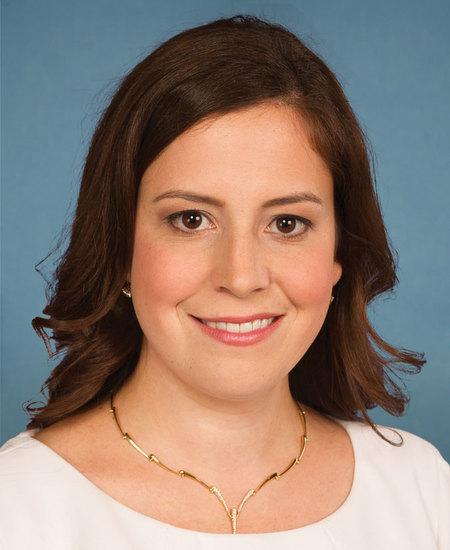
Rep. Elise M. Stefanik
Sponsored bills
Maddy summaryThis bill amends the Child Nutrition Act to require school food service training programs to be scheduled during regular paid work hours whenever possible. If training must occur outside work hours, schools must compensate staff for attending, explain the necessity, and not penalize staff for missing it. Training must also be offered in-person with hands-on components when appropriate. The law directly affects school food service workers and their employers, mandating specific scheduling and compensation practices for required training.
Maddy summaryHR 4865, the IDB Transparency Act, requires the U.S. Treasury Secretary to submit a detailed report within 180 days of enactment on China's influence at the Inter-American Development Bank (IDB). The report must include all projects funded by China or Chinese companies since 2009, assess risks like corruption or human rights issues, and analyze how China uses the IDB to advance its diplomatic and economic interests. It also mandates that the U.S. Executive Director at the IDB actively reduce China's influence by reviewing high-risk projects, voting against certain projects, and opposing China's increased shareholding. The U.S. must submit updated reports every two years for a decade, with summaries made public 60-90 days after submission.
Maddy summaryHR 4157, the "Not Just a Number Act," requires the Department of Veterans Affairs (VA) to produce annual reports on veteran suicide rates and their connection to VA healthcare and benefits. The reports must break down suicide rates by age, gender, and race, and examine how engagement with VA services (like Vet Centers, healthcare enrollment, benefits claims, and housing loans) correlates with suicide trends. The bill also mandates a VA toolkit for state/local coroners to improve veteran suicide death reporting, and a study on creating a dedicated VA suicide prevention office. These measures aim to standardize data collection and identify effective prevention strategies, directly affecting VA operations, congressional oversight, and veteran care systems.
Maddy summaryThis bill would prohibit government employees from directing or encouraging social media platforms to censor protected speech. It defines "covered information" to include phone calls, digital communications, photos, shopping history, location data, and other user information. The bill creates a private right of action for people affected by government interference with their speech, requires government agencies to report communications with platforms about content moderation, and terminates the Disinformation Governance Board. It directly affects government employees, social media platforms, and users whose speech might be impacted by government requests to moderate content.
Maddy summaryThis bill, HR 4562 (Ernest Peltz Accrued Veterans Benefits Act), clarifies how veterans' pension benefits are handled when a veteran dies. It directly affects veterans receiving pensions under existing ratings and their surviving beneficiaries. The key change amends Section 5112(b) of Title 38 to specify that pension payments continue through the month of the veteran's death, rather than stopping at the end of the prior month. This ensures survivors receive the full month's benefit for the month in which the veteran died, applying to payments made on or after the bill's enactment date.
Maddy summaryHR 4721, the Main Street Tax Certainty Act, makes a permanent the 20% tax deduction for eligible small business owners under Section 199A of the tax code. This provision directly affects pass-through business owners (like S-corps, partnerships, and sole proprietorships) who qualify for the deduction. The bill achieves this by removing the temporary expiration language (subsection (i)) from the existing tax code provision. The key change is ending the need for annual congressional extensions of this deduction, providing long-term tax certainty for small businesses.
Maddy summaryHRES 594 is a resolution recognizing the Older Americans Act of 1965 (OAA) nutrition program for its role in addressing hunger, malnutrition, and social isolation among seniors. The program provides meals, social interaction, and health checks to older adults (60+), particularly benefiting homebound individuals and those with chronic conditions. The resolution encourages Congress members to support local OAA programs by volunteering and advocating for sustained federal funding to meet growing demand. It emphasizes the program's proven cost-effectiveness in reducing Medicare/Medicaid costs through preventive health outcomes.
Maddy summaryHR 4660, the HALT Our Adversaries Act, restricts federal funding for universities and colleges that partner with certain Chinese or Russian entities linked to military activities. Specifically, it prohibits federal funds (excluding student aid under Title IV of the Higher Education Act) for institutions with contracts involving: (1) Chinese military-owned companies operating in the U.S., or (2) Chinese academic institutions tied to those companies or the Chinese military. Institutions violating these rules must disclose past partnerships and prove termination to regain eligibility. The bill targets academic partnerships deemed to pose national security risks by aligning with foreign military interests.
Maddy summaryThis bill requires the Committee on Foreign Investment in the United States (CFIUS) to review real estate transactions involving foreign adversaries (including China, Russia, Iran, and North Korea) near sensitive sites like military installations, ports, or critical infrastructure. It defines "elevated risk real estate transactions" as purchases or leases by foreign adversaries near such sites, creating a presumption that these deals pose unresolvable national security risks unless CFIUS explicitly approves them with evidence. The bill also adds food security considerations to CFIUS reviews and mandates declarations for these high-risk transactions. These changes aim to prevent foreign adversaries from gaining access to strategic U.S. land or infrastructure through real estate deals.