

Maddy summaryHR 6980, the DOCTORS Act, reallocates unused J-1 visa waivers that states did not use for foreign medical graduates. Each state must report unused waivers by September 30 annually, and the State Department will redistribute them equally over three years for the next fiscal year. Ten percent of redistributed waivers must support doctors working in facilities serving medically underserved communities. This directly affects state agencies managing visa waivers and impacts foreign doctors seeking permanent U.S. residency after training.
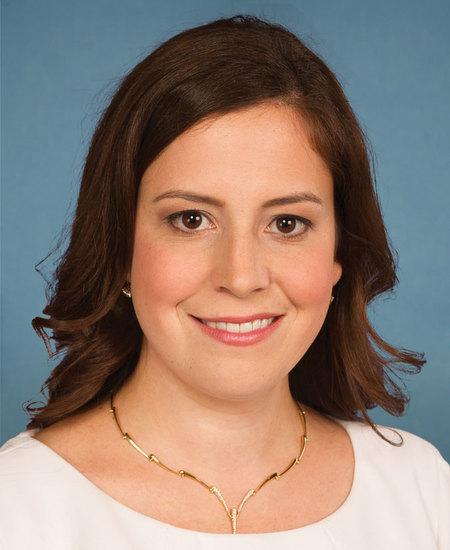
Rep. Elise M. Stefanik
Sponsored bills
Maddy summaryHRES 946 is a symbolic House resolution recognizing "Gold Shield Families" - defined as the families of fallen police officers, firefighters, EMTs, correction officers, emergency dispatchers, and emergency service providers who died in the line of duty. The resolution formally honors their sacrifices and resilience, affirming that their hardships should not be forgotten. It includes no new funding, regulations, or policy changes; instead, it serves as a commemorative gesture expressing national gratitude. The resolution directs that a copy be sent to the President and made public to publicly recognize these families' contributions.
Maddy summaryThis bill designates the U.S. Postal Service facility at 86 Main Street in Haverstraw, New York, as the "Paul Piperato Post Office Building." It updates all official references in federal law, maps, and documents to reflect this new name. The bill does not change postal services, funding, or affect any specific group of people; it solely modifies the facility's official designation. This is a routine naming resolution with no substantive policy provisions.
Maddy summaryThe Bipartisan Workforce Pell Act creates a new grant program providing financial aid to students enrolled in short-term, career-focused educational programs (150-600 clock hours, 8-15 weeks) that prepare students for high-demand jobs. To qualify, programs must meet specific standards including alignment with industry needs, minimum job placement rates of 70%, and median earnings that exceed local wage benchmarks. The bill requires institutions to collect and publicly report data on program outcomes including completion rates, job placement, and student earnings through the College Scorecard website. It also establishes new accreditation standards for agencies evaluating these workforce programs, with $40 million authorized for fiscal year 2025 and $30 million for each of the next four years.
Maddy summaryHR 1147, the Whole Milk for Healthy Kids Act of 2023, allows schools participating in the National School Lunch Program to offer whole milk as an option during lunch. It amends the school lunch law to explicitly permit schools to serve flavored and unflavored whole milk alongside reduced-fat, low-fat, and fat-free milk choices for students. The bill also requires the Secretary of Agriculture to adjust meal regulations to account for saturated fat from whole milk, ensuring it doesn't count against meal fat limits. This change directly affects participating schools and the students who receive school lunches, expanding their milk beverage options.
Maddy summaryThis House resolution (HRES 933) symbolically opposes New York’s Clean Slate Act, which automatically seals certain criminal records (misdemeanors after 3 years, some felonies after 8 years) for eligible individuals. It argues the law would prevent employers from accessing background checks during hiring, though the resolution itself has no legal effect. The resolution urges New York to prioritize crime prevention and public safety over this policy, citing concerns about employer access and recent crime statistics. (Note: This is a non-binding expression of opinion, not a legislative change.)
Maddy summaryHRES 927 is a symbolic resolution passed by the U.S. House of Representatives condemning antisemitism on college campuses and criticizing the testimony of three university presidents (Harvard’s Claudine Gay, MIT’s Sally Kornbluth, and Penn’s Elizabeth Magill) before the House Education Committee. It specifically addresses their evasive responses when asked whether calls for the genocide of Jews violate campus policies, noting their statements about "context" and lack of clear condemnation. The resolution does not create new laws or policies but formally expresses the House’s stance against antisemitism and holds university leadership accountable for their testimony. It directly affects the referenced university presidents and their institutions by publicly criticizing their handling of campus antisemitism.
Maddy summaryThis bill creates new rules for auditing firms used by U.S. companies. It defines a "compromised auditor" as an accounting branch or subsidiary controlled by a country identified as a U.S. national security threat (like those named in the Director of National Intelligence's annual report). The law prohibits trading in securities of U.S. companies headquartered in such "countries of concern" if they use a compromised auditor for their financial audits. This directly affects publicly traded companies that rely on auditing firms tied to designated threat countries.
Maddy summaryHR 6734 prohibits the use of federal funds to finalize, implement, or enforce the Bureau of Alcohol, Tobacco, Firearms, and Explosives' (ATF) proposed rule (2022R-17) defining "engaged in the business as a dealer in firearms." This bill directly affects the ATF by blocking funding for this specific regulatory rule, which was proposed in August 2023. The legislation does not create new requirements but prevents federal resources from being used to advance this particular ATF regulation.
Maddy summaryHR 6733, the American Investment Accountability Act, requires U.S. businesses to report certain investments to Congress. It targets "covered United States businesses" (non-small U.S. entities or foreign entities with significant U.S. ownership) making direct or portfolio investments exceeding specific thresholds ($5 million single transactions for direct investments, $10 million for portfolio) in "countries of concern" (China, Russia, Iran, North Korea, Cuba, Venezuela) or "covered entities" tied to those countries. The bill mandates quarterly reports from the Commerce Department (tracking direct investments by sector and location), Treasury (tracking portfolio investments), and the SEC (tracking corporate actions like spin-offs or mergers involving covered entities). These reports will detail investment values, locations, and transaction sizes, with data disaggregated by sector and U.S. state. The law focuses solely on transparency, requiring no new investment restrictions.