

Maddy summaryThe Stop the Doxx Act makes it a federal crime to publicly share personal information, such as home addresses or phone numbers, about law enforcement officers, prosecutors, judges, or their immediate family members with the intent to threaten or intimidate them. Under this law, individuals found guilty face prison sentences of up to 10 years for a first offense, with penalties increasing to 20 years for repeat offenses or up to 40 years if the act results in injury or death. The bill also allows victims to sue for damages and requires the Attorney General to create a free, annual training program to help these public servants protect their personal data online.
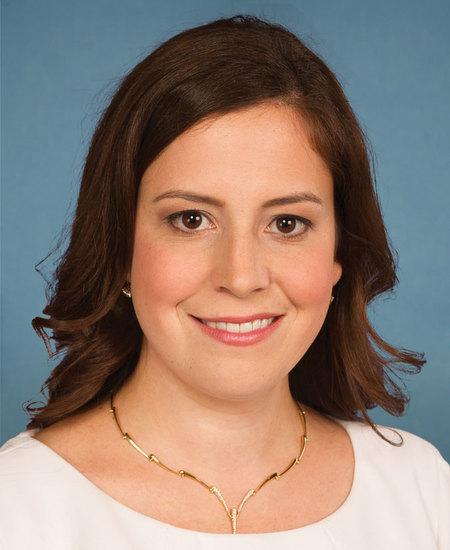
Rep. Elise M. Stefanik
Sponsored bills
This bill designates the facility of the United States Postal Service located at 5951 Riverdale Avenue in Bronx, New York, as the "Eliot L. Engel Post Office".
Maddy summaryThe Veterans’ Transition to Trucking Act of 2025 amends the GI Bill to allow the Secretary of Veterans Affairs to approve multi-state trucking apprenticeship programs for veterans using their educational benefits. This directly affects veterans seeking to transition into trucking careers and apprenticeship programs operating across multiple states. The key mechanism changes the law so the Secretary can act as a "State approving agency" for these programs, eliminating the need for separate state approvals. This streamlines access to trucking training without requiring veterans to navigate individual state requirements.
This bill designates the facility of the United States Postal Service located at 15422 NY 104 in Martville, New York, as the "Sergeant Staret J. Ingleston Memorial Post Office Building".
Maddy summaryThe Connected Vehicle Security Act of 2026 restricts the importation, sale, and manufacture of vehicles and related technology from specific countries, including China, Russia, Iran, and North Korea, to address national security concerns. The law defines prohibited items as connected vehicles, their software, and hardware components and sets different effective dates, with vehicle bans starting in 2027 and hardware restrictions beginning in 2030. A government official can grant exceptions for specific items after reviewing security risks and notifying Congress, while the agency must publish annual reports on enforcement actions and compliance.
Maddy summaryThe Guard the Skies Act allows the National Guard to protect specific facilities and assets from unmanned aircraft when requested by a state's chief executive officer. This law authorizes the Secretary of Defense to deploy National Guard members to take actions normally reserved for federal agencies, such as the Department of Transportation and the Federal Aviation Administration, during these security missions. The bill also adjusts existing rules to ensure that selected Reserve and Individual Ready Reserve members can be ordered to active duty specifically for these protection efforts. By clarifying the roles of the Department of Defense and other agencies, the legislation aims to streamline coordination for safeguarding critical infrastructure against drone threats.
Maddy summaryHR 5213, the "Keep Violent Criminals Off Our Streets Act," prohibits federal grants to states or local governments that have policies substantially limiting cash bail for individuals charged with specific violent or public disorder offenses. It directly affects state and local governments with bail policies allowing pretrial release for crimes like murder, rape, robbery, looting, or rioting. The bill amends federal law to block grant awards (under the Omnibus Crime Control Act) for any jurisdiction maintaining such bail policies for these covered offenses, starting in the fiscal year after enactment. This is a funding restriction, not a change to bail laws themselves.
Maddy summaryThis resolution expresses the sense of the House of Representatives that antisemitic rhetoric from specific online personalities, including Hasan Piker and Candace Owens, is dangerous and contributes to hatred. It urges social media platforms to enforce their policies against hate speech and calls on public officials to condemn such conduct without exception. The bill does not impose new laws or penalties but instead highlights specific instances of alleged hate speech to emphasize the need for responsibility among influencers and technology companies.
Maddy summaryHR 2424, the Modern, Clean, and Safe Trucks Act of 2025, repeals a 12% federal excise tax on new heavy trucks, tractors, and trailers. This tax currently adds significant costs - $7,000+ for trailers, $20,000+ for clean diesel trucks, and up to $50,000 for advanced technology trucks - discouraging replacement of older, less efficient vehicles. The bill directly affects truck manufacturers, dealers, and fleet operators by removing this cost barrier, making newer, cleaner models more affordable. It aims to accelerate the adoption of modern trucks with improved safety and environmental features, particularly benefiting electric and alternative-fuel vehicles that face higher upfront costs.
Maddy summaryThis bill requires states to implement an "Enhanced Income Verification Platform" within one year of enactment to verify income for federal benefit programs. It directly affects states administering programs like SNAP, Medicaid, or housing assistance, as they must use this platform to access comprehensive income data - including gig work, rental income, and bank transactions (with user permission) - to prevent improper payments. The platform uses real-time data matching to identify unreported income or inconsistencies, consolidating overlapping financial records. States must adopt this system to remain eligible for federal funds supporting these benefit programs. The law focuses on improving verification accuracy, not altering benefit eligibility or amounts.