This resolution expresses support for the designation of National Lyme and Tick-Borne Disease and Conditions Awareness Month.
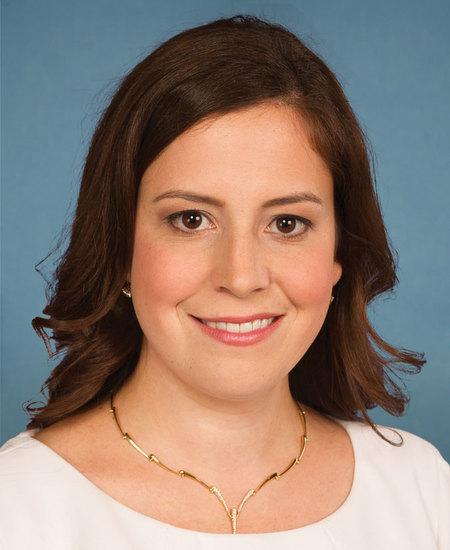
Rep. Elise M. Stefanik
Sponsored bills
Saving Gig Economy Taxpayers Act This bill modifies requirements for third party settlement organizations to eliminate their reporting requirement with respect to the transactions of their participating payees unless they have earned more than $20,000 on more than 200 separate transactions in an applicable tax period. A third party settlement organization is the central organization that has the contractual obligation to make payments to participating payees (generally, a merchant or business) in a third party payment network. This reverses a provision in the American Rescue Plan Act of 2021 that lowered the reporting threshold to $600 with no minimum on the number of transactions.
See the Crisis Act This bill limits international travel by the Vice President until after certain activities are undertaken regarding the southwest border. Specifically, the bill prohibits the obligation or expenditure of federal funds for the Vice President's travel expenses to travel outside of the United States until the Vice President (1) personally travels to at least one of several specified counties along the border to review the activities of federal agencies responsible for enforcing and implementing immigration laws, and (2) submits a report relating to the situation at the border.
Purple Heart Freedom to Work Act This bill increases the monthly income limit that is used to determine whether certain Purple Heart recipients are eligible for Social Security Disability Insurance (SSDI) benefits. Specifically, when making such determinations with respect to Purple Heart recipients who are entitled to SSDI benefits based on combat-related injuries, the Social Security Administration must use the limit that applies to individuals who are blind rather than the lower limit that applies to other SSDI recipients. In addition, the bill phases out SSDI benefits for these Purple Heart recipients, with benefits reduced by $1 for every $4 of earnings in excess of the limit.
Midwives for Maximizing Optimal Maternity Services Act of 2021 or the Midwives for MOMS Act of 2021 This bill establishes grants within the Health Resources and Services Administration (HRSA) for establishing or expanding midwifery programs at institutions of higher education and nursing schools. HRSA may prioritize funding for institutions that focus on increasing the number of midwife professionals from underrepresented groups and that promote practicing in areas with limited access to professional health care.
Surface Transportation Advanced through Reform, Technology, and Efficient Review Act 2.0 or the STARTER Act 2.0 This bill addresses provisions related to federal-aid highway, transit, highway safety, motor carrier, innovation, and resiliency programs of the Department of Transportation (DOT). It also sets forth requirements for the operation of railroad freight cars in the United States. For example, the bill extends FY2020 enacted levels through FY2026 for federal-aid highway, transit, and safety programs. DOT must provide competitive grants for projects to provide parking for commercial motor vehicles on the federal-aid highway system; establish a discretionary program to award competitive grants for eligible projects that encourage economic viability of the nation, a metropolitan area, or a region; create a public awareness campaign to reduce instances of driving while under the influence of prescription and over-the-counter medications; and promulgate regulations to implement an apprenticeship program for licensed commercial motor vehicle drivers under the age of 21. The bill also establishes new competitive grant programs to spur innovation of connected vehicle applications into operational deployments and to test the safe integration of automated driving system technologies into the on-road transportation system. Additionally, the bill addresses projects to improve the resiliency of federal-aid highways and bridges on and off the National Highway System. Further, the bill prohibits the operation of railroad freight cars in the United States that have been manufactured or assembled by certain foreign countries or that contain sensitive technology from such countries.
Helping American Victims Afflicted by Neurological Attacks Act of 2021 or the HAVANA Act of 2021 This bill specifically authorizes the Central Intelligence Agency, the Department of State, and other agencies to provide payments to agency personnel who incur brain injuries from hostilities while on assignment. Specifically, the bill allows agency personnel and their families to receive payments for brain injuries that are incurred (1) during a period of assignment to a foreign duty station; (2) in connection with war, insurgency, hostile acts, terrorist activity, or other agency-designated incidents; and (3) not as the result of willful misconduct. The bill's authority applies to injuries incurred before, on, or after the date of the bill's enactment. Agencies must submit classified reports on the bill's implementation, including the number of payments made and the amount of each payment. Since 2016, some intelligence, diplomatic, and other governmental personnel have reported experiencing unusual cognitive and neurological impairments while on assignment (particularly abroad), the source of which is currently under investigation. Symptoms were first reported by personnel stationed in Cuba and have since been collectively referred to as Havana Syndrome .

Ghost Army Congressional Gold Medal Act This bill directs the Speaker of the House of Representatives and the President pro tempore of the Senate to award a Congressional Gold Medal to the 23rd Headquarters Special Troops and the 3133d Signal Service Company, known as the Ghost Army , collectively, in recognition of its service during World War II.
This resolution expresses support for the designation of DIPG Awareness Day. DIPG is diffuse intrinsic pontine glioma, a terminal childhood brain cancer.
Prohibiting TSP Investment in China Act This bill limits the investments of funds under the Thrift Savings Plan. Specifically, it prohibits funds, including funds that are accessible through a mutual fund window, from investing in any entity that is based in China or any subsidiary of such an entity.