Protecting Life on College Campus Act of 2021 This bill prohibits the award of federal funds to an institution of higher education (IHE) that hosts or is affiliated with a school-based service site that provides abortion drugs or abortions to its students or to employees of the IHE or the site. An IHE that hosts or is affiliated with a site must, in order to remain eligible for federal funds, annually certify that the site does not provide abortion drugs or abortions to students or employees.
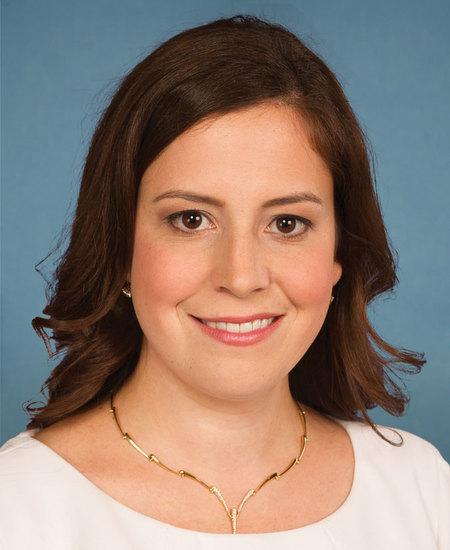
Rep. Elise M. Stefanik
Sponsored bills
Entrepreneurs Need Timely Replenishment (for) Eating Establishments Act or the ENTRÉE Act This bill provides FY2021 supplemental appropriations for the Restaurant Revitalization Fund and modifies requirements related to administration of the fund. The fund was established in response to COVID-19 to make grants to eligible food and beverage purveyors for covering specified costs such as payroll, operational expenses, and paid sick leave. The bill correspondingly rescinds unobligated amounts previously made available for the Economic Injury Disaster Loan Program and coronavirus state and local fiscal recovery funds. Further, the bill requires the Small Business Administration (SBA) to (1) review and process grant applications in the order in which they are received; (2) impose requirements on applicants that reduce waste, fraud, and abuse; and (3) submit and report monthly on an oversight and audit plan outlining the SBA's policies, procedures, and activities with respect to these grants.
Rural Forest Markets Act of 202 1 This bill directs the Department of Agriculture (USDA) to establish the Rural Forest Market Investment Program to guarantee investments to finance certain projects that will enable rural private forest landowners to participate in an innovative market for forest carbon or other products. In establishing the program, USDA must consider ways to ensure that the program minimizes disruptions to traditional forest products markets. Eligible projects are projects developed by a private entity or a publicly supported, charitable nonprofit organization engaged in the aggregation of sustainable forestry practices implemented by rural private forest landowners to facilitate the sale of credits in the voluntary carbon market or other environmental market using a methodology approved by a credible, third-party entity. USDA may guarantee up to $150 million with respect to each investment. Authority to carry out the program terminates on September 30, 2023.
Daniel J. Harvey Jr. and Adam Lambert Improving Servicemember Transition to Reduce Veteran Suicide Act This bill requires the Department of Defense (DOD) and the Department of Veterans Affairs (VA) to jointly implement a five-year pilot program to assess the feasibility and advisability of providing specified counseling and services as part of the Transition Assistance Program for members of the Armed Forces as a means of reducing the incidence of suicide among veterans. Specifically, the pilot program would involve a three-hour counseling module and the provision of contact information for a counseling or similar facility in the locality where the veteran intends to reside. Additionally, the participating veterans must submit medical records in connection with their service in the Armed Forces, regardless of whether they intend to file a claim for benefits for a service-connected disability. Under the program, a social worker or behavioral health coordinator from the VA must contact the veteran within 90 days after the member is discharged or released from service to schedule a follow-up appointment. At least 10 DOD Transition Assistance Centers must be jointly selected to carry out the pilot program.
This resolution expresses the sense of the House of Representatives that the Department of Homeland Security (DHS) provides essential protection for our country from foreign and domestic threats and that defunding DHS would be detrimental to our national security.
This resolution recognizes and expresses support for the efforts of democracy and human rights activists in Cuba.
Broadband Permitting Modernization Act This bill modifies, and requires reports about, permitting requirements for broadband activities on federal lands. Specifically, the Department of the Interior and the Department of Agriculture (USDA) must report on communication use authorizations (i.e., authorizations to modify or locate communications facilities on public land administered by Interior or National Forest System land). Among other topics, the report must assess barriers to reviewing the authorizations and describe the process for prioritizing reviews. Interior and USDA must also each establish an online portal to manage the Form 299 (used to apply for rights to install, modify, or maintain a communications facility on federal real property) approval process. The National Telecommunications and Information Administration must (1) report to Congress every 60 days on the status of the portals until they are established, and (2) publish links to each established portal on its website. The bill also authorizes the delegation of federal environmental compliance for certain broadband projects to states and Indian tribes. Interior and USDA must establish a voluntary program whereby states or Indian tribes may conduct (subject to specified terms) environmental reviews for broadband projects within an operational right-of-way (i.e., all real property interests acquired for the construction or operation of a project) on land managed by Interior, National Forest System land, or Indian land. USDA and Interior shall also establish broadband permit streamlining teams to coordinate and expedite permitting decisions for broadband projects.

Preserving Rules Ordered for The Entities Covered Through 340B Act of 2021 or the PROTECT 340B Act of 2021 This bill prohibits pharmacy benefit managers (PBMs) and health insurance plans from discriminating against health providers participating in the 340B drug pricing program, including pharmacies contracted with such providers to dispense 340B drugs. The 340B program allows certain providers to receive covered outpatient drugs at reduced prices from manufacturers. Specifically, PBMs and insurance plans may not reimburse 340B participants at a lower rate than other entities not participating in the program; impose differing terms (such as fees, charge-backs, or audits) on 340B participants; interfere with an individual's choice to receive drugs from a 340B participant; require 340B participants to identify which drugs fall within the program; or refuse to contract with a 340B participant on the basis that they utilize the program. Violations of this bill are subject to a civil penalty of not more than $5,000 per violation per day. These prohibitions also apply to prescription drug (Part D) sponsors under Medicare. The bill also provides for a process to prevent duplicate 340B drug discounts to states under Medicaid.
American Broadband Act This bill addresses broadband and other communications services. The bill limits applicable state and local regulatory authority. Limitations include setting (and providing statutory authority for) deadlines for reviews and decisions related to personal wireless and other telecommunication service facilities, as well as cable franchises and services. Further, a state or locality may not provide broadband services in areas with more than one other commercial provider. The bill exempts certain telecommunications infrastructure projects from environmental and historic preservation reviews, including projects carried out after a declared disaster or emergency (e.g., a wildfire). The bill also establishes a rebuttable presumption that a request for a review of the effects of deploying wireless service on historically, culturally, or religiously significant tribal or Native Hawaiian land is complete if the tribe or Native Hawaiian organization receives certain forms. The bill enhances criminal penalties for willful or malicious destruction of a communication facility. Furthermore, the General Services Administration must establish a common fee schedule for deploying wireless facilities that affect federal property. Additionally, the National Telecommunications and Information Administration must award grants for expanding high-speed broadband access, facilitate through an interagency strike force timely reviews of telecommunications-related requests that affect federal property (e.g., a request for an easement or right-of-way), and report on certain requests concerning communications facilities on federal real property. The bill also requires collaboration among federal agencies that support broadband deployment.