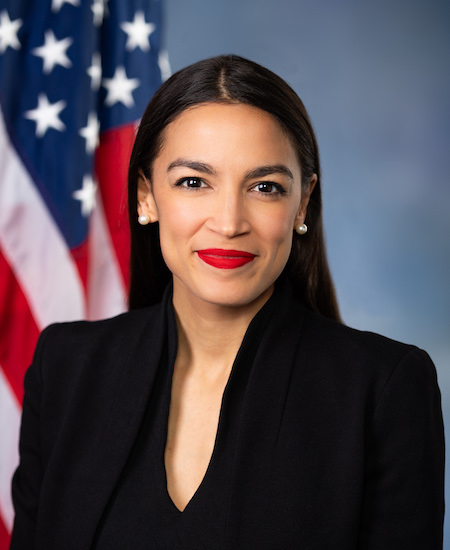
Photo of Alexandria Ocasio-Cortez
D United States House · District 14 · New York On the 2026 ballot

Rep. Alexandria Ocasio-Cortez

Compare
Total votes
2,837
all sessions
Attendance
98%
65 missed
Near the chamber average
With party
94%
of cast votes
Near the chamber average
Bipartisan score
3%
crosses aisle rarely
Near the chamber average
Sponsored
1,172
bills & resolutions
Near the chamber average
Committees
4
assignments
1,172 bills and resolutions

Sponsored bills

Total
1,172
Primary
40
Co-sponsor
1,132
This page
1,172
matching current filters
Co-sponsor HRES 685
In committee Sep 28, 2021 1 co-sponsor
Co-sponsor HR 5307
In committee · Indiana House · Co-sponsor
Keeping Renters Safe Act of 2021

Keeping Renters Safe Act of 2021 This bill expressly authorizes the Department of Health and Human Services (HHS) to place a moratorium on residential evictions to prevent the spread of communicable diseases. The bill also requires HHS to implement a moratorium nationwide to reduce the spread of COVID-19. This moratorium must remain in effect for at least 60 days following the termination of the COVID-19 public health emergency. Current law authorizes HHS to take measures to prevent the spread of communicable diseases. As part of the COVID-19 response, HHS delegated this authority to the Centers for Disease Control and Prevention (CDC), which then issued (and extended) several orders banning residential evictions. Whether these orders exceed the CDC's statutory and constitutional authority has been the subject of multiple legal challenges; the Supreme Court blocked enforcement of the most recent order on August 26, 2021.

In committee Sep 22, 2021 1 co-sponsor
Co-sponsor HCONRES 51
In committee · Indiana House · Co-sponsor
Marking the four-year anniversary of the devastation of Puerto Rico and the United States Virgin Islands by Hurricane Maria.

This concurrent resolution declares that Congress remains steadfast in its commitment to the people of Puerto Rico and the U.S. Virgin Islands to assist in restoring the islands to their full potential and that Congress will not abandon U.S. citizens living there or on the U.S. mainland in the aftermath of Hurricane Maria.

In committee Sep 20, 2021 1 co-sponsor
Primary HR 5285
In committee · Indiana House · Lead sponsor
Extend Unemployment Assistance Act of 2021

Extend Unemployment Assistance Act of 2021 This bill extends pandemic unemployment compensation provisions set to expire on September 6, 2021, until February 1, 2022. Extended provisions include benefits to covered individuals who are not eligible for regular unemployment compensation or traditional extended benefits, the $300 weekly benefit increase, waiting week benefits, and federal reimbursement of short-time compensation. The bill also increases the maximum duration of compensation from 79 weeks to 100 weeks.

In committee Sep 17, 2021 0 co-sponsors
Co-sponsor HR 5253
In committee · Indiana House · Co-sponsor
Fossil Free Finance Act

Fossil Free Finance Act This bill requires large bank holding companies to develop and implement emission reduction plans. Such a plan must include strategies for a company to equitably reduce and eventually eliminate financed greenhouse gas emissions by January 1, 2050, and to discontinue specified fossil fuel projects and financing. The bill also prohibits the use of carbon offsets in such a plan, sets forth technological requirements for reductions, and requires the prioritization of specified social impacts. Plans must be submitted to the Board of Governors of the Federal Reserve System for approval every two years.

In committee Sep 14, 2021 1 co-sponsor
Co-sponsor HR 4
Passed · Indiana House · Co-sponsor
John R. Lewis Voting Rights Advancement Act of 2021

John R. Lewis Voting Rights Advancement Act of 2021 This bill establishes new criteria for determining which states and political subdivisions must obtain preclearance before changes to voting practices may take effect. Preclearance is the process of receiving preapproval from the Department of Justice (DOJ) or the U.S. District Court for the District of Columbia before making legal changes that would affect voting rights. A state and all of its political subdivisions shall be subject to preclearance of voting practice changes for a 10-year period if 15 or more voting rights violations occurred in the state during the previous 25 years; 10 or more violations occurred during the previous 25 years, at least 1 of which was committed by the state itself; or 3 or more violations occurred during the previous 25 years and the state administers the elections. A political subdivision as a separate unit shall also be subject to preclearance for a 10-year period if three or more voting rights violations occurred there during the previous 25 years. States and political subdivisions that meet certain thresholds regarding minority groups must preclear covered practices before implementation, such as changes to methods of election and redistricting. Further, states and political subdivisions must notify the public of changes to voting practices. Next, the bill authorizes DOJ to require states or political subdivisions to provide certain documents or answers to questions for enforcing voting rights. The bill also outlines factors courts must consider when hearing challenges to voting practices, such as the extent of any history of official voting discrimination in the state or political subdivision.

Passed Sep 14, 2021 1 co-sponsor
Co-sponsor HRES 629
In committee · Indiana House · Co-sponsor
Acknowledging that in the aftermath of September 11, 2001, individuals experienced hate and were targeted by the government on account of their faith, race, national origin and immigration status, and suggesting various forms of relief to support those affected.

This resolution condemns racism, xenophobia, discrimination, scapegoating, and ethnic and religious bigotry. It acknowledges the climate of hate that Arab, Muslim, Middle Eastern, South Asian, and Sikh communities have experienced since September 11, 2001, and suggests specified relief to support those affected. Specifically, the resolution calls for the creation of an interagency task force to work with community-based organizations to review government policies that targeted such communities, investigate and document their impact, and dismantle those policies that continue to profile and target such communities; calls for hearings to explore the findings and recommendations of the task force; supports allocating resources to community-based organizations outside and independent of law enforcement that center the experiences and demands of Arab, Muslim, Middle Eastern, South Asian, and Sikh communities to support the needs of victims of hate and state violence and to create alternatives to law enforcement and transformative justice programs that focus on vulnerable populations within these communities; and calls on the Department of Health and Human Services, the National Institutes of Health, and the National Science Foundation to work together to study the impact of hate, government targeting, and profiling on physical and mental health.


In committee Sep 13, 2021 1 co-sponsor
Co-sponsor HR 4811
In committee · Indiana House · Co-sponsor
Medicare Negotiation and Competitive Licensing Act of 2021

Medicare Negotiation and Competitive Licensing Act of 2021 This bill establishes several requirements relating to the prices of prescription drugs. Specifically, the bill requires the Centers for Medicare & Medicaid Services (CMS) to negotiate with pharmaceutical companies regarding prices for drugs covered under Medicare. (Current law prohibits the CMS from doing so.) If the CMS is unable to negotiate the price of a drug, such drug is subject to competitive licensing in order to further its sale under health insurance programs, notwithstanding existing government-granted exclusivities. The negotiated prices also apply to other federal health care programs, private health insurance, and the uninsured; pharmacies that charge more than the negotiated price for uninsured individuals are subject to civil penalties. Manufacturers must also comply with specified reporting requirements relating to prices and licensing, subject to civil penalties. The bill also institutes an excise tax on drugs for which the price spikes beyond a certain limit, subject to specified exemptions, as well as on drugs for which the price exceeds the negotiated price.

In committee Sep 8, 2021 1 co-sponsor
Co-sponsor HR 5165
In committee · Indiana House · Co-sponsor
Improving Medicare Coverage Act

Improving Medicare Coverage Act This bill temporarily expands eligibility for Medicare. It also temporarily establishes a premium and cost-sharing assistance program for low-income beneficiaries. Specifically, the bill lowers the age of eligibility for Medicare from 65 to 60. The Centers for Medicare & Medicaid Services must establish procedures to provide for automatic enrollment of qualifying individuals. Enrollment must be completed within 11 months of the bill's enactment. The bill also establishes a program under Medicare to assist low-income Medicare beneficiaries with premiums, coinsurance, deductibles, and other costs. Currently, such assistance is provided through Medicare Savings Programs, which are administered by state Medicaid programs. The bill also establishes a related special enrollment period under Medicare, expands eligibility for assistance to beneficiaries with income up to 200% of the federal poverty line, and provides for joint eligibility determinations with respect to the bill's program and the low-income subsidy program under the Medicare prescription drug benefit. The bill's provisions generally take effect six months after the bill's enactment and terminate five years later.

In committee Sep 6, 2021 1 co-sponsor
Co-sponsor HRES 568
In committee · Indiana House · Co-sponsor
Expressing that the United States is obligated to permanently end the unhoused crisis by 2025 and uphold, protect, and enforce the civil and human rights of unhoused individuals, including the human rights to housing, universal health care, livable wages, education, employment opportunities, access to public facilities, free movement in public spaces, privacy, confidentiality, internet access, vote, freedom from harassment by law enforcement, private businesses, property owners, and housed residents, and equal rights to health care, legal representation, and social services without discrimination based on housing status.

This resolution urges the United States to protect the human rights of unhoused individuals, to establish regulations and enforcement tools to protect unhoused individuals from violations of civil and human rights, and to establish blanket legal protections for third parties providing goods or services to unhoused individuals. The resolution also urges the United States to establish a process to award appropriate damages, attorney's fees, and costs to a prevailing plaintiff in an action alleging a violation of the human and civil rights of unhoused individuals. Relatedly, the resolution urges the United States to allow the court in such an action to consider housing status and apply leniency in compiling records, receipts, and documentation from those plaintiffs. The resolution also expresses the intention of the House of Representatives to address the unhoused crisis in the United States by providing funding and imposing requirements on the Department of Housing and Urban Development and the Department of Health and Human Services.

In committee Aug 13, 2021 1 co-sponsor
Showing 981 to 990 of 1,172 bills
Previous 1 … 98 99 100 … 118 Next