This resolution expresses the policy of the United States for addressing and mitigating national security challenges, including the spread of infectious diseases and pandemics, the climate crisis, the proliferation and threat of the use of nuclear weapons, human rights violations, corruption, conflict, and violence, authoritarianism, gender, economic, and social inequality, and transnational White supremacist violence and racist nationalism.
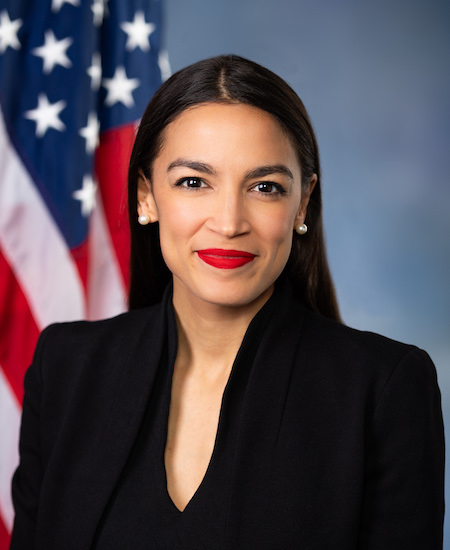
Rep. Alexandria Ocasio-Cortez
Sponsored bills
Climate Risk and Emergency Support In Livable Inclusive and Equitable Neighborhoods and Communities Everywhere Act or the Climate RESILIENCE Act This bill makes changes to the Robert T. Stafford Disaster Relief and Emergency Assistance Act to take into account climate change. The bill includes extreme temperature events, such as heat waves or freezes, within the scope of the act and defines resilience for purposes of disaster assistance and mitigation efforts. Federal and state preparedness and mitigation assistance may be used for reducing the impacts of extreme temperatures and improving air quality and mitigating against wildfire smoke.. The bill authorizes implementing predisaster hazard mitigation measures that will be cost-effective and equitable long-term and provide enhanced protection to the community. The Federal Emergency Management Agency (FEMA) must (1) provide technical assistance to underserved and disadvantaged communities for such measures; and (2) provide guidance to implement the latest published editions of relevant consensus-based codes, specifications, and standards that incorporate the latest hazard-resistant designs. The bill includes within the hazard mitigation program requirements the abatement of lead, mold, mildew, radon, asthma, and allergen triggers, or other pollutants and hazardous materials directly caused by a major disaster or emergency. FEMA must report to Congress regarding challenges posed by FEMA requirements for determining the cost-effectiveness of mitigation activities and how such requirements may disproportionately burden underserved or disadvantaged communities.
PrEP Access and Coverage Act This bill requires private health insurance plans to cover prescription drugs that prevent HIV, including related screenings, diagnostic procedures, administrative fees, and clinical follow-ups, without any cost-sharing obligation for the plan holder. Further, insurance plans must not impose any preauthorization requirement for this coverage. These coverage requirements also apply to public health insurance programs, including Medicare, Medicaid, and the Children's Health Insurance Program. Additionally, the bill prohibits denying, limiting, or qualifying coverage or increasing premiums for disability insurance, long-term care insurance, or life insurance policies based on an individual taking medication for HIV prevention. The bill further requires the Department of Health and Human Services to award grants to states, or directly to eligible local organizations, to provide uninsured individuals and underinsured individuals access to prescription drugs and related services that prevent HIV. The Centers for Disease Control and Prevention also must develop a public awareness campaign that focuses efforts in communities with a high need for HIV prevention treatment.
Future Generations Protection Act This bill prohibits (1) the emission of any greenhouse gas in any quantity from a new electric utility steam generating unit (i.e., certain power plants); (2) hydraulic fracturing on all onshore and offshore land in the United States; and (3) exports of domestically produced crude oil and natural gas, with specified exceptions.
Combating International Islamophobia Act This bill establishes within the Department of State the Office to Monitor and Combat Islamophobia and addresses related issues. The office shall monitor and combat acts of Islamophobia and Islamophobic incitement in foreign countries. The bill establishes the position of Special Envoy for Monitoring and Combating Islamophobia, who shall head the office. The bill also requires certain existing annual reports to Congress about human rights and religious freedom in foreign countries to include information about Islamophobia, such as information about (1) acts of physical violence or harassment of Muslim people, (2) instances of propaganda in government and nongovernment media that attempt to justify or promote hatred or incite violence against Muslim people, and (3) actions taken by a country's government to respond to such acts. The office shall coordinate and assist in preparing these portions of the reports. No funds made available pursuant to the bill may be used to promote or endorse a boycott, divestment, and sanctions movement ideology (i.e., economic measures against Israel or Israel-related individuals or organizations) or used to promote or endorse a Muslim ban.
Get Foreign Money Out of U.S. Elections Act This bill imposes prohibitions and requirements related to campaign contributions and expenditures from foreign sources. For example, the bill bans campaign contributions and expenditures by domestic business entities that are controlled, influenced, or owned by foreign nationals.
African American History Act This bill authorizes the National Museum of African American History and Culture to carry out educational programs and related activities. Such activities include developing and making available accurate, relevant, and accessible resources to promote the understanding of African American history; and expanding the collection acquisition and collection access processes, including conservation and digitization. The museum may also develop and maintain on its website content designated for educators, students, and families to improve their awareness and understanding of African American history.
End Polluter Welfare for Enhanced Oil Recovery Act of 2021 This bill eliminates the use of carbon oxide as a tertiary injectant. It also repeals the tax credit for enhanced oil recovery costs.
Protecting Our Democracy Act This bill addresses issues involving (1) abuses of presidential power; (2) checks and balances, accountability, and transparency; and (3) election integrity and security. Specifically, regarding abuses of presidential power, the bill requires the Department of Justice (DOJ) and the President to submit to Congress specified materials relating to certain pardons, prohibits presidential self-pardons, suspends the statute of limitations for federal offenses committed by a sitting President or Vice President, prohibits the acceptance of foreign or domestic emoluments, and sets forth provisions regarding Office of Government Ethics and Office of Special Counsel jurisdiction and enforcement authority. To address checks and balances, accountability, and transparency, the bill authorizes specified actions to enforce congressional subpoenas, imposes limits on presidential declarations of emergencies, requires DOJ to maintain a log of specified communications between it and the White House, requires cause for removal of inspectors general, increases whistleblower protections, and requires a candidate for President or Vice President to provide copies of tax returns for the 10 most recent taxable years to the Federal Election Commission. To address election integrity and security, the bill requires federal campaign reporting of foreign contacts, makes various changes to requirements concerning foreign donations to political campaigns and candidates and foreign contributions to online electioneering communications, prohibits distribution of materially deceptive audio or visual media prior to an election (i.e., deepfakes), and establishes a program to support states and localities transition to ranked choice voting systems.

Periodically Listing Updates to Management Act or the PLUM Act This bill replaces the congressional publication titled United States Government Policy and Supporting Positions , commonly known as the PLUM Book, with an online public directory. The PLUM Book contains personnel information for federal civil service leadership and support positions in the legislative and executive branches that may be subject to noncompetitive appointment, including heads of agencies and policy executives. The book is used to identify presidentially appointed positions and is published every four years (after each presidential election) by certain congressional committees. The bill requires the Office of Personnel Management (OPM) to publish the information contained in the PLUM Book on a public website in a format that is easily searchable and that otherwise meets certain data standards. Agencies must upload updated information to the website on a monthly basis; OPM must verify the accuracy of the information twice a year in coordination with the White House Office of Presidential Personnel. The bill terminates publication of the PLUM Book in its current form on January 1, 2024.