

Maddy summaryThis bill would provide federal grants to public housing agencies to modernize public housing through energy efficiency upgrades, infrastructure improvements, and renewable energy systems. It requires all public housing to become "zero-carbon homes" that produce enough renewable energy to meet their own consumption within 10 years. The bill includes specific requirements for workforce development, hiring from low- and very low-income communities (40% in year 1, 50% in year 2, 90% after that), and contracting with resident-owned businesses (20% in year 1, 30% in year 2, 50% after that). It also mandates resident and community engagement in planning, and requires public housing agencies to meet specific energy efficiency and water quality standards. The bill directly affects all public housing agencies managing housing for low- and very low-income residents across the United States, including tribal housing entities.
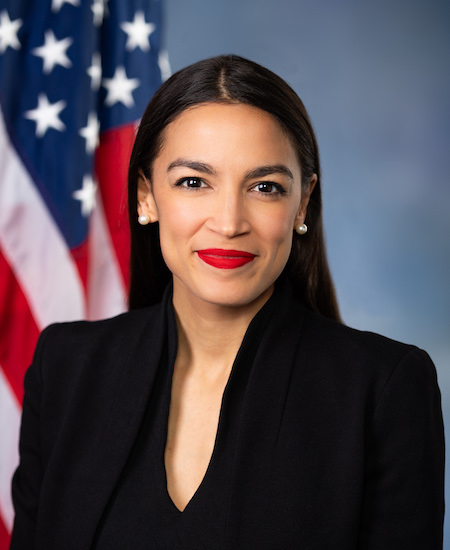
Rep. Alexandria Ocasio-Cortez
Sponsored bills
Maddy summaryThe PTO Act establishes a standard for paid annual leave, requiring most employers to provide employees with 1 hour of paid leave for every 25 hours worked, up to a maximum of 80 hours per 12-month period. It directly affects private sector employees and certain government workers, including those at the Government Accountability Office, Library of Congress, and federal agencies covered under the Congressional Accountability Act. The bill prohibits employers from interfering with employees' use of leave for any reason, requires clear notice of leave policies, and protects employees from retaliation for taking leave. It includes enforcement mechanisms through the Department of Labor, allowing employees to file complaints or lawsuits for violations of their leave rights. The Act takes effect 180 days after enactment, with specific provisions for collective bargaining agreements.
Maddy summaryHR 7763, the Living Wage for Musicians Act of 2024, establishes a new Artist Compensation Royalty Fund to provide payments to musicians based on streaming activity. Streaming platforms (service providers) must charge subscribers an additional $4-$10 fee per subscription (50% of the subscription fee, subject to min/max limits), with 10% of non-subscription revenue also contributed to the fund. Funds are distributed as follows: 90% to "featured artists" (e.g., lead singers) based on their share of qualifying streams, and 10% to "non-featured artists" (e.g., session musicians) via existing union funds. The bill directly affects streaming services (which collect the fee) and musicians (who receive payments based on verified streaming data).
Maddy summaryThis bill would create a new wealth tax on individuals with significant assets, targeting those with net assets exceeding $50 million. It would tax assets between $50 million and $1 billion at 2%, and assets above $1 billion at 3% (potentially increasing to 6% if certain health care legislation is enacted). The tax would apply to individuals, married couples treated as a single taxpayer, and certain trusts, with specific valuation and reporting requirements for assets. The bill also includes $70 billion in funding over 10 years for the IRS to enforce this new tax and related reporting requirements.
Maddy summaryHCONRES 99 is a symbolic congressional resolution honoring Wadee Alfayoumi, a 6-year-old Palestinian-American boy murdered in a hate crime on October 14, 2023, after being stabbed 26 times by a perpetrator who made anti-Muslim and anti-Palestinian remarks. The resolution recognizes Congress's condemnation of hate crimes, Islamophobia, and anti-Palestinian discrimination, while affirming the United States' "zero tolerance" for such violence. As a procedural resolution (not a law), it does not create new policies but formally honors Wadee and his family, emphasizing the need to reject dehumanizing rhetoric targeting religious or ethnic groups.
Maddy summaryThis bill clarifies that drug manufacturers must offer 340B discounted pricing for covered outpatient drugs regardless of where or how the drugs are dispensed - specifically including arrangements where covered entities (like community health centers, clinics, and hospitals) contract with pharmacies to dispense 340B drugs to patients. It explicitly prohibits manufacturers from imposing conditions on these arrangements, such as restricting delivery locations or requiring additional data. The bill also establishes civil penalties of up to $2 million per day for manufacturers violating these rules, with penalties assessed by the Secretary of Health and Human Services. This directly affects covered entities that rely on contract pharmacies to access specialty drugs for patients with conditions like cancer or multiple sclerosis, ensuring they can stretch scarce resources to provide comprehensive care.
Maddy summaryHR 7634, the Plastic Pellet Free Waters Act, prohibits plastic pellets and pre-production plastic materials from being discharged into water through wastewater, spills, or runoff from specific facilities. It directly affects plastic polymer production facilities, plastic molding and forming facilities, and any point source (like packaging or transport operations) handling plastic pellets. The bill requires the EPA to issue a final rule within 60 days of enactment banning these discharges and updating all relevant wastewater, stormwater, and performance standards in permits and regulations. This creates a legal requirement for facilities to prevent plastic pellet pollution in waterways, targeting a major source of ocean plastic pollution.
Maddy summaryThis concurrent resolution (HCONRES 97) recognizes the gender wage gap, noting that women working full-time earn 84 cents for every dollar earned by men. It highlights racial disparities (e.g., Latinas earn 57 cents, Black women 69 cents) and the economic impact of the gap, including $965 billion in annual lost wages for women. As a symbolic resolution, it does not create new laws or policies but formally acknowledges the issue and reaffirms Congress’s commitment to addressing wage inequality.
Maddy summaryThis bill establishes a Federal Advisory Panel to analyze climate change risks to federal retirement investments and advise on transitioning toward low-carbon portfolios. It directly affects the Federal Retirement Thrift Investment Board (which manages retirement funds for over 5 million federal employees) by requiring the panel to assess fossil fuel investments, examine other pension funds' climate strategies, and produce a report within one year. Key mechanisms include creating a new "Climate Choice Stock Index Fund" that excludes fossil fuel companies (if the Board determines fossil fuel investments aren't financially sound), and mandating annual climate cost reports from the Federal Reserve and SEC. The bill focuses on aligning retirement fund investments with climate risk management while maintaining financial responsibility, without mandating immediate divestment.
Maddy summaryThe American High-Speed Rail Act authorizes $35 billion annually for high-speed rail corridor development (with $3 billion for corridor planning), requiring at least 20% of project costs to come from non-Federal sources. It defines "high-speed rail" as services reaching 186+ mph and "higher-speed rail" as 110-186 mph, with no more than 20% of funds allocated to higher-speed rail projects. Key provisions include allowing advance acquisition of rail corridors before environmental reviews, creating tax exclusions for rail carriers selling property to high-speed rail projects, and requiring consideration of equity, sustainability, and economic development impacts in planning. The bill affects federal agencies, state and local governments, rail carriers, and communities along proposed rail corridors.