

New Era of Preventing End-Stage Kidney Disease Act This bill establishes regional centers of excellence, postgraduate fellowships, and training for health professionals relating to the diagnosis and treatment of rare kidney disease. It also requires the Department of Health and Human Services (HHS) to conduct various studies on rare kidney disease. Specifically, it authorizes the National Institute of Diabetes and Digestive and Kidney Diseases to award funding to public and private nonprofit entities for establishing regional centers of excellence that will increase public awareness, conduct research, and develop resources for diagnosing and treating rare kidney diseases. A center may receive such funding for up to five years, unless extended by the institute. The bill also requires health professions schools receiving a grant from the Health Resources and Services Administration (HRSA) Centers of Excellence program to award fellowships for training on preventing, diagnosing, and treating rare kidney disease in disproportionately impacted populations. Also, the bill expands the priorities of HRSA’s Primary Care Training and Enhancement program to include training for health care workers to care for individuals with kidney disease. Additionally, HHS must conduct several studies and report to Congress on topics such as treating rare kidney disease in disproportionately affected populations, eliminating the need for dialysis or kidney transplants, and increasing public awareness of rare kidney disease.
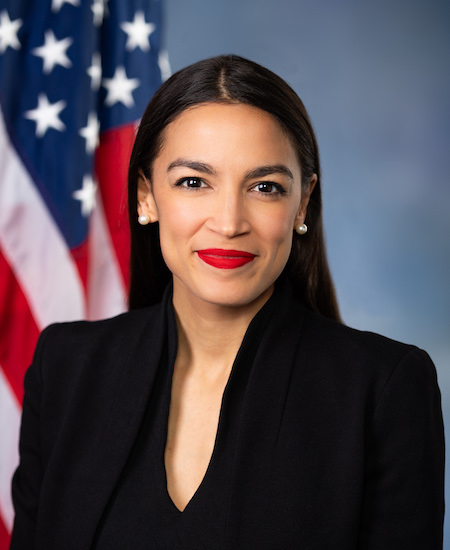
Rep. Alexandria Ocasio-Cortez
Sponsored bills
Maddy summaryThis resolution (HRES 146) is a formal, non-binding statement of recognition by the U.S. House of Representatives honoring the Harlem Renaissance - a pivotal cultural, social, and political movement in American history. It commemorates the movement's role in reshaping African American identity, advancing civil rights, and fostering artistic expression from the 1910s through the mid-1930s, highlighting contributions in literature, music, visual arts, and social thought. The resolution specifically recognizes figures like Langston Hughes, Duke Ellington, and organizations such as the NAACP, while supporting efforts to preserve Harlem's cultural legacy. It has no policy impact or direct effect on individuals or communities, serving solely as a symbolic tribute to historical significance.
Maddy summaryHR 1449, the Energy Resilient Communities Act, creates a federal grant program to fund clean energy microgrids that support critical community infrastructure like hospitals, schools, and emergency facilities. Eligible entities - including states, local governments, nonprofits, and tribal agencies - can apply for grants covering up to 90% of costs for technical assistance, community outreach, or microgrid projects in environmental justice communities. Key provisions prioritize projects that reduce emissions, lower energy costs for low-income residents, minimize land use impacts, and ensure 40% of construction labor comes from local residents meeting specific criteria (e.g., displaced workers, environmental justice community members). The program authorizes $1.5 billion over 10 years, with at least 10% reserved for community-owned microgrid projects, and requires annual reporting on project outcomes and labor practices.
Maddy summaryHR 1410 expands access to mental health care for 9/11 responders and survivors by allowing licensed mental health providers (not just physicians) to conduct initial health evaluations and certifications under the World Trade Center Health Program. It adjusts the program’s funding formula to account for changing enrollment numbers by linking annual funding to the previous year’s enrollment ratio, and clarifies that deceased individuals are excluded from enrollment counts. The bill also extends the timeframe for adding new health conditions to the program’s list and requires a 2028 report assessing long-term funding needs through 2090. These changes aim to streamline eligibility, improve care access, and ensure sustainable funding for the program.
Maddy summaryThis bill creates a new federal tax credit for family child care providers who operate from their primary residence. It allows eligible providers to claim up to $5,000 annually toward specific startup costs like licensing fees, supplies (diapers, toys), insurance, fencing, playground equipment, and required renovations. To qualify, providers must be licensed/registered, serve at least two non-family children, and operate from their home. The credit is limited to one year per provider (no repeat claims) and expires after seven years. It directly affects small-scale home-based child care operators seeking to establish or improve their licensed services.
Maddy summaryThis bill (HR 1314, TIPS Act) requires employers to pay tipped workers the standard federal minimum wage instead of the current lower rate (currently $2.13/hour), directly affecting workers in hospitality, food service, and similar roles. It also creates a new tax deduction for cash tips received in qualifying jobs (e.g., restaurants, hotels), allowing workers to deduct these tips from taxable income up to $112,500 in adjusted gross income. The deduction applies only to tips from unrelated customers without business ownership stakes, excluding credit card tips. The tax provisions take effect for 2026 tax years.
Maddy summaryHR 1330 establishes the Smithsonian National Museum of the American Latino, authorizing its location within the National Mall's "Reserve" area. The bill requires the Smithsonian Board to coordinate with federal agencies managing potential museum sites, including notifying relevant congressional committees before land transfers. It mandates that the museum's exhibits and programs accurately represent the diverse cultures, histories, and viewpoints of Hispanic and Latino communities in the U.S., seeking input from a broad range of community experts. The Smithsonian must also submit regular reports to Congress detailing compliance with these representation requirements.
Maddy summaryThe Office of Gun Violence Prevention Act of 2025 would create a new office within the Department of Justice to coordinate federal efforts on reducing gun violence. The office, led by a Director appointed by the Attorney General, would integrate existing DOJ programs, evaluate data gaps, and develop evidence-based recommendations for Congress and the President. It would also establish an advisory council including survivors of gun violence, public health officials, and community representatives to guide its work. The office would produce annual reports detailing gun violence trends and policy proposals, while collaborating with agencies like Health and Human Services and the FBI.
Maddy summaryThis bill proposes a constitutional amendment stating that only "natural persons" (living humans) have rights protected by the U.S. Constitution, explicitly denying constitutional rights to corporations, LLCs, and other artificial entities. It would require governments to regulate campaign contributions and spending to prevent money from influencing elections, banning the view that spending to influence elections constitutes protected speech under the First Amendment. The amendment would not affect the constitutional right to a free press. This change would directly impact how corporations and other non-human entities can legally challenge laws or regulations in court.
Maddy summaryThis bill restricts access to Treasury payment systems (including the Bureau of the Fiscal Service) to only Treasury employees with a "fully successful" performance rating and at least one year of civil service, or contractors/outsiders with security clearances, required privacy/cybersecurity training, ethics agreements, and no conflicts of interest. It treats non-government users accessing these systems as government employees for ethics rules and defines specific actions (like stopping payments) as "personal and substantial participation" in government matters. The Treasury Inspector General must investigate any unauthorized access within 30 days and report to Congress, detailing the breach, security risks, and any halted payments. The bill directly affects Treasury staff, contractors, and any external entities accessing federal payment systems.