

Maddy summaryThe Quiet Communities Act of 2025 reestablishes the Environmental Protection Agency’s Office of Noise Abatement and Control, which was defunded in 1982. This office will provide grants to states for local noise control programs, conduct national research on noise health impacts, develop public education materials, and create regional technical assistance centers. The bill authorizes $25 million annually (2026-2030) to fund these activities, directly supporting communities affected by noise pollution - particularly the estimated 28 million U.S. residents with hearing impairments linked to noise exposure. It emphasizes state/local solutions, market incentives, and coordination with other agencies to address noise from aircraft, traffic, and other sources.
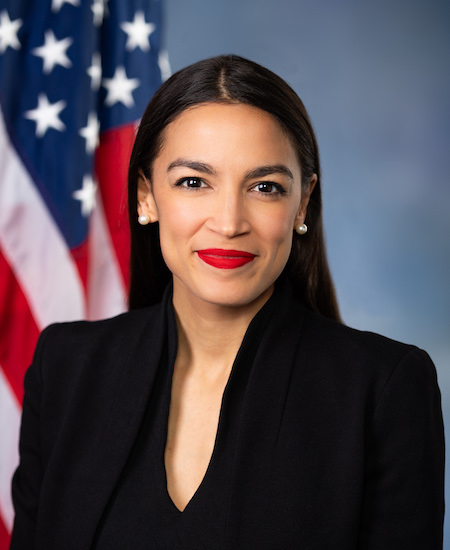
Rep. Alexandria Ocasio-Cortez
Sponsored bills
Maddy summaryHR 5124, "River's Law," amends federal child care safety rules for facilities receiving Child Care and Development Block Grant funding. The bill directly affects federally funded child care centers by requiring them to prohibit pools on their premises and install door and window alarms. Key provisions add specific safety standards to existing regulations: (1) banning pool construction/maintenance at child care sites, and (2) mandating alarms to prevent unsupervised access. These changes apply to all centers operating under the Child Care and Development Block Grant program.
Maddy summaryThis bill prohibits Members of Congress, their spouses, and dependent children from owning or trading certain investments, including stocks, commodities, and derivatives (referred to as "covered investments"). It requires affected individuals to divest these investments within 90-180 days, with specific exemptions for Treasury bonds, diversified mutual funds, small business interests, and family trusts meeting strict conditions. Violations incur penalties of 10% of the investment's value plus disgorgement of profits, paid directly to the U.S. Treasury. The law applies to all covered individuals during federal service, with exceptions for investments acquired through inheritance or occupational trading (e.g., a spouse’s finance job).
Maddy summaryHR 5088, the "Union Participation for All Act," repeals a provision in the 1959 Labor-Management Reporting and Disclosure Act (LMRDA) that barred individuals convicted of certain crimes (like bribery or fraud) from holding union leadership positions. This change directly affects union members with specific criminal convictions who previously could not serve in union offices. The bill removes Section 504 of the LMRDA, eliminating the ban on their eligibility for union leadership roles. It does not alter other union governance rules or create new requirements.
Maddy summaryHR 5048, the "Don’t STEAL Act," amends the Fair Labor Standards Act to ensure workers receive the highest wage promised in their contracts or collective bargaining agreements, whichever exceeds federal or state minimum wage requirements. It directly affects employees engaged in commerce or working for businesses involved in commerce, requiring employers to pay at least the higher of their agreed-upon wage or the legal minimum. The bill establishes criminal penalties for willful wage theft exceeding $1,000 (up to 5 years in prison) and civil penalties for all unpaid wages, with fines funding the Department of Labor’s Wage and Hour Division enforcement efforts. These changes apply to violations occurring 90 days after enactment.
Maddy summaryHR 4959, the "Land of the Free Act of 2025," repeals a specific deportation provision in immigration law. It removes Section 237(a)(4)(C) of the Immigration and Nationality Act (8 U.S.C. 1227(a)(4)(C)), which previously allowed non-citizens to be deported for engaging in "protected speech activities." This change directly affects non-citizens who might have faced deportation under that provision for exercising free speech rights. The bill makes a concrete policy change by eliminating this exception to deportation.
Maddy summaryHR 4966 prohibits grocery stores from selling items at "grossly excessive prices," defined as 120% or more above the average market price over the previous six months (with exceptions for unavoidable cost increases like supply chain issues). It bans using facial recognition or personal data to set different prices for individual customers (e.g., adjusting prices based on shopping history) and requires clear signage if facial recognition is used. Stores over 10,000 square feet must replace electronic shelf labels with physical price tags. The Federal Trade Commission enforces these rules, allowing consumers to seek $3,000 per violation or actual damages, with penalties for willful violations.
Maddy summaryThe Ending Trading and Holdings in Congressional Stocks (ETHICS) Act requires members of Congress, their spouses, and dependent children to divest or place most personal investments in qualified blind trusts. It bans the purchase of covered investments (including stocks, commodities, and derivatives) after enactment, with current members having 90 days to sell existing holdings and new members having 90 days after taking office to divest. The bill includes specific exceptions for diversified mutual funds, Treasury securities, and certain family business investments while establishing enforcement mechanisms including civil penalties of up to 10% of the value of noncompliant holdings. The law applies to members serving terms beginning after January 31, 2023, and mandates public online disclosure of financial information through updated government databases.
Maddy summaryThe Warehouse Worker Protection Act establishes new requirements for employers in warehouse facilities to protect workers from harmful quotas and workplace surveillance practices. It requires employers to provide written descriptions of quotas and workplace monitoring to workers, prohibits quotas that interfere with breaks, safety compliance, or anti-discrimination rights, and gives workers the right to access their work speed data. The bill creates a Fairness and Transparency Office within the Department of Labor to enforce these requirements and investigate violations, with enforcement also involving the Federal Trade Commission. Employers with more than 200 employees at covered warehouse facilities (including distribution centers, couriers, and warehouses) are directly affected by these new requirements, which include new protections against retaliation for workers who exercise these rights.
Maddy summaryThis bill adjusts health insurance subsidies by modifying the premium tax credit structure under the Internal Revenue Code. It replaces previous income thresholds with a sliding-scale formula, increasing subsidies for households earning between 150% and 400% of the federal poverty level - reducing their required premium payments as income rises within these tiers. The changes apply to tax years beginning after December 31, 2025, directly affecting middle-income individuals and families purchasing coverage through health insurance marketplaces. It also repeals specific provisions from a prior reconciliation law related to health care.