

Teaching Asian Pacific American History Act This bill requires entities (e.g., institutions of higher education, libraries, and museums), in order to be eligible for certain grants administered by the Department of Education (ED), to include Asian Pacific American history in their teaching of American history. It also requires Asian Pacific American history to be included in tests administered by the National Assessment of Educational Progress (NAEP). Specifically, the bill mandates the inclusion of Asian Pacific American history as a required component of American history for such entities to be eligible for American History and Civics Academies' competitive grants. These grants support the establishment of (1) Presidential Academies for Teachers of American History and Civics, which offer workshops to teachers of American history and civics to strengthen their knowledge and prepare them to teach in these subjects; and (2) Congressional Academies for Students of American History and Civics, which support high school students in developing an understanding of these subjects. (Currently, Asian Pacific American history is not a required component of American history for either academy.) In addition, ED must give priority to grant applicants that align their activities with programs and resources of the Smithsonian Institution's Asian Pacific American Center. The bill also requires the inclusion of Asian Pacific American history in tests administered by the NAEP, which measures student academic achievement in various subjects.
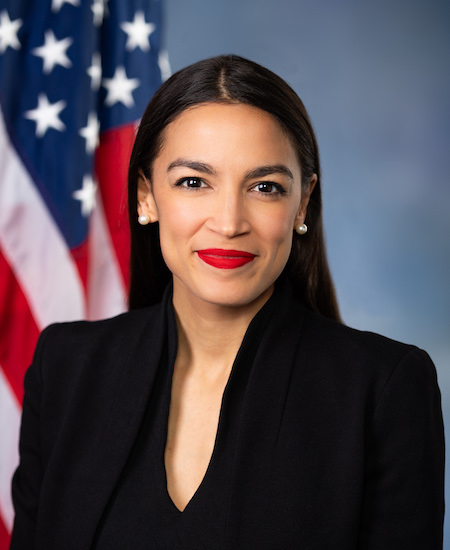
Rep. Alexandria Ocasio-Cortez
Sponsored bills
Water Affordability, Transparency, Equity, and Reliability Act of 2021 This bill increases funding for water infrastructure, including funding for several programs related to controlling water pollution or protecting drinking water. Specifically, it establishes a Water Affordability, Transparency, Equity, and Reliability Trust Fund. The fund may be used for specified grant programs. The bill increases the corporate income tax rate to 24.5% to provide revenues for the fund. In addition, the bill revises requirements concerning the clean water state revolving fund (SRF) and the drinking water SRF. It also creates or reauthorizes several grant programs for water infrastructure.
This resolution expresses the sense of the House of Representatives that blood donation policies should be grounded in science, minimize deferral periods, and allow donations by all those who can safely make them.
Public Servants Protection and Fairness Act of 2021 This bill establishes an alternative formula to calculate Social Security retirement benefits for those who receive pensions for certain non-covered employment. (The existing formula is known as the windfall elimination provision.) The alternative formula adjusts an individual's total lifetime earnings based on the proportion of covered earnings (i.e., earnings subject to Social Security payroll taxes). It applies to individuals who (1) first become eligible for benefits after 2022, (2) have earnings from non-covered service performed after 1977, and (3) have less than 30 years of coverage (i.e., years in which a beneficiary is considered to have contributed a substantial amount into the Social Security trust funds). Beneficiaries receive the higher benefit amount as calculated under the alternative method or the existing formula. In addition, the bill provides rebates for certain beneficiaries currently impacted by the existing formula. The Social Security Administration must include non-covered earnings in Social Security account statements, and the Government Accountability Office must study the availability of certain information related to retirement plans maintained by state and local governments.
Automatic Voter Registration Act This bill provides for automatic voter registration of individuals through state motor vehicle authorities. Specifically, the bill requires each state motor vehicle authority, upon receiving specified identifying information regarding an individual who requests services from the authority, to transmit the identifying information to the appropriate state election official. The state election official must then notify the individual that the individual shall be automatically registered to vote in federal elections unless the individual declines to be registered to vote, does not meet voter registration eligibility requirements, or is already registered to vote. The bill provides an individual with a 21-calendar day period to opt out of automatic voter registration. A state may only use identifying information regarding an individual's citizenship status for determining whether the individual is eligible to vote in federal elections.
Equitable Data Collection and Disclosure on COVID-19 Act of 2021 This bill expands data collection and reporting on demographic information and disparities related to COVID-19 (i.e., coronavirus disease 2019). During the COVID-19 emergency, the Centers for Disease Control and Prevention (CDC) and the Centers for Medicare & Medicaid Services must publish data on COVID-19 testing, treatment, vaccinations, and outcomes on the CDC website. They must update the data daily and disaggregate it by race, ethnicity, and other demographic factors. In addition, the Indian Health Service must consult with tribal nations about COVID-19 data collection and reporting. The Department of Health and Human Services must make a summary of final statistics related to COVID-19 publicly available and report specified information to Congress within 60 days of the end of the COVID-19 emergency. The bill also establishes the Commission on Ensuring Data for Health Equity. The commission must determine approaches to using data to reduce disparities in health outcomes, including specifically with respect to COVID-19. In addition, it must provide recommendations to improve demographic data collection and use in future public health emergencies.
Resident Physician Shortage Reduction Act of 2021 This bill increases the number of residency positions eligible for graduate medical education payments under Medicare for qualifying hospitals, including hospitals in rural areas and health professional shortage areas. Current law provides for an increase of up to 200 positions per fiscal year beginning in FY2023, with a total increase of 1,000 positions; each hospital may receive up to 25 additional positions. The bill provides for an additional increase of 2,000 positions per fiscal year from FY2023-FY2029; during this period, each hospital may receive up to 75 additional positions in total under the bill and current law. Additionally, one-third of the positions that are made available under the bill must be allocated to hospitals that are already operating above applicable resident limits. The bill also requires the Government Accountability Office to report on strategies to increase the diversity of the health professional workforce, including with respect to representation from rural, low-income, and minority communities.
This bill requires the Joint Committee on the Library to enter into an agreement to obtain a statue of Shirley Chisholm, the first African American woman elected to Congress. The committee shall place the statue in a permanent public location in the U.S. Capitol.
Emmett Till and Mamie Till-Mobley Congressional Gold Medal Act of 2021 This bill provides for the posthumous presentation of a Congressional Gold Medal in commemoration of Emmett Till and Mamie Till-Mobley. After the award the medal shall be given to the National Museum of African American History and Culture.
This joint resolution eliminates the deadline for the ratification of the Equal Rights Amendment, which prohibits discrimination based on sex. The amendment was proposed to the states in House Joint Resolution 208 of the 92nd Congress, as agreed to in the Senate on March 22, 1972. The amendment shall be part of the Constitution whenever ratified by the legislatures of three-fourths of the states.