

Maddy summaryThis resolution (HRES 315) is a purely commemorative measure that formally recognizes the 159th anniversary of the Civil Rights Act of 1866. It acknowledges the historical significance of the 1866 Act as the first federal law defining citizenship and affirming equal legal protection for all Americans, regardless of race. The resolution highlights the Act's role as a foundational precedent for the Thirteenth and Fourteenth Amendments. As a ceremonial resolution, it has no legal effect or policy impact on any individuals or groups.
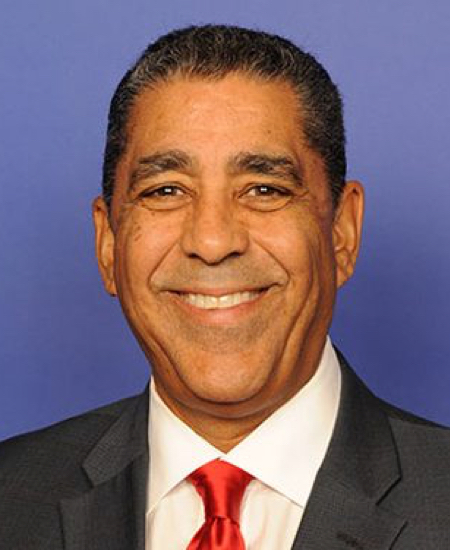
Rep. Adriano Espaillat
Sponsored bills
Maddy summaryThe American Family Act (HR 2763) establishes a new refundable child tax credit that provides monthly payments to eligible families with children. It would pay $300 per month for each child under age 6 and $360 per month (120% of $300) for each child age 6 or older, with income limits of $150,000 for joint filers and $112,500 for other filers. The bill creates a "period of presumptive eligibility" to determine eligibility for monthly payments, allowing families to receive advance payments based on information from previous tax returns. This would directly affect millions of families with children who meet the income requirements, providing more consistent financial support throughout the year rather than an annual tax credit.
Maddy summaryHR 2799, the Closing the Bump Stock Loophole Act of 2025, prohibits the sale, possession, and modification of devices that increase the firing rate of semi-automatic firearms to mimic machine guns (commonly called "bump stocks"). It specifically bans manual, power-driven, or electronic devices designed to speed up firing, as well as modified firearms that achieve this effect. Owners of pre-existing modified firearms must register them within 120 days of the law's enactment, with exemptions for government entities and firearms already lawfully modified and registered before the bill passes. The bill does not restrict standard semi-automatic firearms or require registration of unmodified guns.
Maddy summaryThe Raise the Wage Act of 2025 gradually increases the federal minimum wage from $9.50 to $17.00 per hour over six years, with annual adjustments based on median wage growth. It raises the base wage for tipped workers from $6.00 to $17.00 per hour, phasing out their separate minimum wage structure by 2029. The bill also eliminates special minimum wage certificates for disabled workers after 2029, requiring employers to pay the standard minimum wage. These changes apply to most covered workers, including tipped employees and those under 20, with specific transition timelines for each group.
Maddy summaryThis bill establishes federal minimum standards for collective bargaining rights for public employees and supervisors. The Federal Labor Relations Authority would determine if state laws provide these rights, and if not, would establish them for affected employees. The bill guarantees public employees the right to form unions, bargain collectively, and engage in concerted activities, while requiring public employers to recognize unions and put agreements in writing. It also prohibits strikes or lockouts that would disrupt emergency services. This would apply to public employees in states that don't meet the federal standards for collective bargaining rights.
Maddy summaryThis bill, HR 2253 (Puppy Protection Act of 2025), sets new federal standards for commercial dog dealers who sell puppies to the public. It requires specific housing sizes based on dog size (e.g., 12-30 square feet per dog), daily exercise in safe outdoor areas, clean water and nutritious food twice daily, and annual veterinary exams including dental checks. The bill also limits breeding frequency (max 2 litters in 25 months), sets age minimums for breeding (18 months for small dogs, 2 years for large dogs), and mandates health screenings to prevent genetic diseases. These requirements apply directly to commercial dealers, with final regulations to be issued within 18 months of enactment.
Maddy summaryThis bill, HR 2102 (Major Richard Star Act), allows veterans with combat-related disabilities to receive both full military retired pay and veterans' disability compensation simultaneously, without the previous offset that reduced retired pay. It directly affects veterans already eligible for both benefits due to combat-related injuries, removing the requirement that their retired pay be reduced by the disability compensation amount. The key provision amends Title 10 and Title 38 to eliminate the offset rule (sections 5304 and 5305 of Title 38) for these veterans. The change applies to payments starting after the bill’s enactment date, effective for all qualifying veterans. This is a policy change to increase financial support for affected veterans, not a new benefit.
Maddy summaryThe Protecting Data at the Border Act requires U.S. border agents to obtain a warrant based on probable cause before accessing the digital contents of electronic devices belonging to U.S. persons at the border. It prohibits denying entry or delaying entry based on a refusal to provide access credentials, digital content, or online account information, and limits border agents to four hours to determine if a U.S. person will voluntarily provide access. The bill mandates written consent with clear notice of rights for voluntary data access, requires destruction of improperly accessed data, and includes emergency exceptions for immediate threats to life, national security, or public safety. It also requires the Department of Homeland Security to report annually on how often border agents access digital data and under what circumstances.
Maddy summaryHR 2587, the Youth Mental Health Research Act, establishes a new NIH research initiative to coordinate studies on youth mental health across federal health institutes. It focuses on two key areas: researching community resilience and early intervention strategies for at-risk youth, and improving how mental health services are delivered in schools, communities, and other settings where young people spend time. The bill authorizes $100 million annually for fiscal years 2025 through 2030 to fund this research. This initiative directly supports future evidence-based approaches to youth mental health, without altering current services or directly affecting individuals.
Maddy summaryHR 2487, the Transgender Health Care Access Act, aims to improve access to gender-affirming care for transgender individuals by funding training and education for healthcare providers. The bill provides $10 million annually for medical schools to develop curricula on gender-affirming care and culturally competent treatment, and $15 million annually for grants to train medical residents, nurse practitioners, and community health centers serving transgender patients. It specifically targets rural providers through $5 million annually for collaborative networks to expand care in underserved areas. The legislation requires a report to Congress within two years detailing progress in improving health equity for transgender populations.