

Safe And Friendly for the Environment Streets Act or the SAFE Streets Act This bill revises the Highway Safety Improvement Program to create special rules for vulnerable road users. The bill defines vulnerable road user as a nonmotorist such as a pedestrian, pedalcylcist, bicyclist, other cyclist, or person on personal conveyance. Specifically, the bill requires states and metropolitan planning organizations (MPOs) with above the median rate of vulnerable road user fatalities and serious injuries to dedicate at least 75% of funds under the program for projects to improve safety for such users, and states and MPOs to create vulnerable road user safety assessments that include locations and corridors where serious injuries and fatalities occur and strategies to reduce safety risks for such users in the corridors.
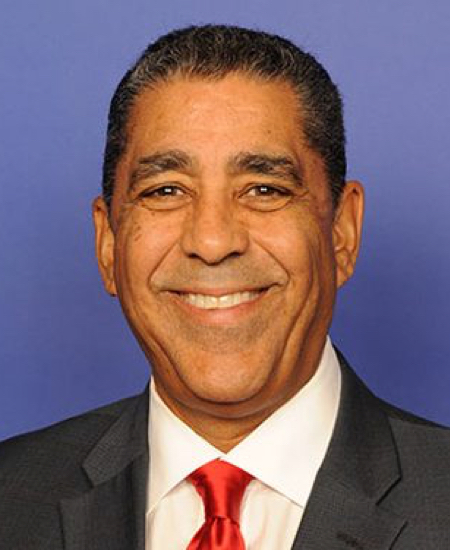
Rep. Adriano Espaillat
Sponsored bills
No Congressional Gun Loophole Act This bill prohibits the Capitol Police Board from allowing Members of Congress or their staff to carry firearms on the grounds of the U.S. Capitol or in its buildings. Members and their staff may store firearms in their cars in Capitol complex garages if their possession complies with the firearms laws of the District of Columbia and the firearms are locked with gun locks while on the complex. Current board regulations allow Members of Congress to keep firearms in their offices; the regulations also allow Members and their staff to transport unloaded and securely wrapped firearms within the Capitol grounds. Firearms are prohibited inside the chambers of the Senate and the House of Representatives, as well as in adjacent lobbies and cloakrooms, the galleries, the Marble Room of the Senate, and the Rayburn Room of the House, unless approved by the Sergeants at Arms for security purposes.
Transportation Alternatives Enhancements Act This bill revises the surface transportation block grant program (Transportation Alternatives Program) of the Department of Transportation (DOT). The bill requires DOT to set aside 10% of apportioned funds under the program each fiscal year for states, and allows states to allocate funds to counties, metropolitan planning organizations (MPOs), regional transportation planning organizations, and local governments. Funds may be used for certain projects or activities, including the construction, planning, and design of infrastructure-related projects and systems that will provide safe routes for nondrivers, such as children, older adults, and individuals with disabilities, to access daily needs. MPOs that serve an urbanized area with a population of 200,000 or fewer are eligible for funding under the program. The bill also adjusts funding limits for states to improve the ability of applicants to access funding in an efficient and expeditious manner.
Safe Routes to School Expansion Act This bill expands eligibility under the Highway Safety Improvement Program to include certain safety projects related to safe routes to school infrastructure improvements such as sidewalks, crosswalks, signage, bus stop shelters or protected waiting areas. The bill increases the federal share for the Department of Transportation (DOT) to fund improvements for pedestrian or bicyclist safety, safety of people with disabilities, and safe routes to school infrastructure. DOT must also carry out a safe routes to school program for the benefit of children in primary, middle, and high schools.
Homeownership for DREAMers Act This bill prohibits federal mortgage providers from limiting insurance eligibility on the basis of the mortgagor's participation in the Deferred Action for Childhood Arrivals Program.
Stop Subsidizing Multimillion Dollar Corporate Bonuses Act This bill extends the $1 million limit on the deductibility of executive compensation to all employees of publicly traded corporations.
USPS Fairness Act This bill repeals the requirement that the U.S. Postal Service annually prepay future retirement health benefits.
Coronavirus Unemployment Benefits Tax Relief Act This bill excludes from gross income, for income tax purposes, up to $10,200 of unemployment compensation received by an individual in a taxable year beginning in 2020.
Anti-Racism in Public Health Act of 2021 This bill establishes within the Centers for Disease Control and Prevention (CDC) a National Center on Antiracism and Health and a law enforcement violence prevention program. Among other activities, the new center must declare racism a public health crisis, collect and analyze data, and administer research and grant programs to address racism and its impact on health and well-being. Additionally, the bill specifically directs the CDC's National Center for Injury Prevention and Control, in coordination with the Department of Justice and other relevant stakeholders, to carry out the law enforcement violence prevention program by conducting research and supporting other activities pertaining to law enforcement violence and public health.
Emergency Water is a Human Right Act This bill creates a grant program, administered by the Department of Health and Human Services, to provide funds to states and Indian tribes to assist low-income households that pay a high proportion of household income for drinking water and wastewater services. Further, any entity receiving financial assistance under this grant program must ensure that no home energy service or public water system service is or remains disconnected or interrupted during the COVID-19 (i.e., coronavirus disease 2019) public health emergency.