

Puppies Assisting Wounded Servicemembers for Veterans Therapy Act or the PAWS for Veterans Therapy Act This bill implements a program and a policy related to service dog therapy for veterans. Specifically, the bill requires the Department of Veterans Affairs (VA) to implement a five-year pilot program to provide canine training to eligible veterans diagnosed with post-traumatic stress disorder as an element of a complementary and integrative health program. Eligible veterans are those who are enrolled in the VA health care system and have been recommended for participation by a qualified mental health care provider or clinical team. The VA must seek to enter agreements containing specified elements with accredited nongovernmental entities that have demonstrated ability to provide canine training. Veterans who participate in the program are authorized to adopt the dog they assisted in training if their health provider determines it is in the best interest of the veteran. The VA must establish processes to document and track the progress of participating veterans with respect to health benefits and improvements. The Government Accountability Office must brief Congress and submit a report on the program. The bill also authorizes the VA to provide service dogs to veterans with mental illnesses, regardless of whether they have a mobility impairment.
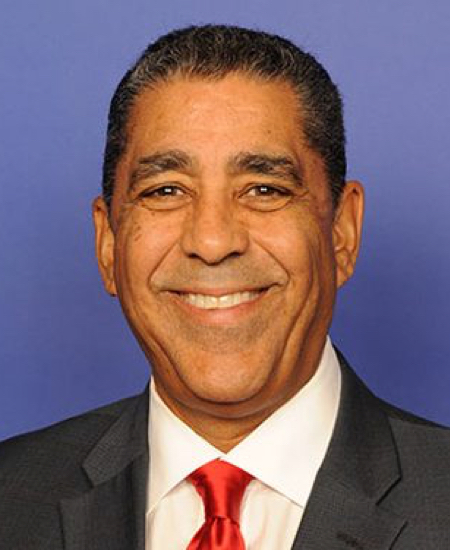
Rep. Adriano Espaillat
Sponsored bills
This resolution honors the late publisher John H. Johnson for the positive influence he had on his community and for his commitment to covering race relations.
No Federal Funding for Confederate Symbols Act This bill prohibits federal funds from being used for the creation, maintenance, or display of any Confederate symbol on federal public land or other federal property. An exception to such prohibition is provided (1) if the use of such funds is necessary to allow for the removal of the Confederate symbol to address public safety; or (2) in the case of a Confederate symbol created, maintained, or displayed in a museum or educational exhibit.
This resolution expresses the sense of the House of Representatives that policies concerning medication abortions should be grounded in science, be based on a review of medical evidence, and ensure equitable access for patients.
This resolution supports the designation of National Health Care Awareness Month.
Migratory Bird Protection Act of 2021 This bill prohibits the incidental taking (e.g., capturing or killing) of migratory birds by commercial activities unless the activity is authorized under a permit or is identified as posing de minimis risk to migratory birds. The U.S. Fish and Wildlife Service (USFWS) must regulate such incidental taking, including by (1) issuing general permits for certain industries, (2) creating a mitigation fee for any incidental taking of migratory birds, and (3) identifying categories of de minimis risk activities that are exempt from liability for the taking of migratory birds. In addition, the USFWS must establish and maintain a research program (1) to evaluate the impacts of commercial activities on birds, (2) to evaluate the effectiveness of best management practices and technologies to avoid or minimize such impacts, and (3) to develop new or improved best management practices and technologies.
This resolution supports (1) fair and equitable access to COVID-19 vaccines, and (2) investments in the vaccine supply chain and other efforts to meet global needs for vaccines.
Farm System Reform Act of 2021 This bill places a moratorium on large concentrated animal feeding operations; requires country-of-origin labeling for beef, pork, and dairy products; and otherwise revises provisions related to the marketing of livestock, poultry, and meat.
Bringing Enhanced Treatments and Therapies to ESRD Recipients Kidney Care Act or the BETTER Kidney Care Act This bill requires the Centers for Medicare & Medicaid Services (CMS) to establish a demonstration program for Medicare beneficiaries with end-stage renal disease (ESRD). Under the program, renal dialysis facilities, kidney disease specialists, physician practices, and other health care practitioners may form an organization that partners with certain health care entities to provide integrated care to beneficiaries with ESRD. Such care must include all covered Medicare benefits as well as transition services for transplantations, palliative care, and hospice. Each organization must have a minimum number or percentage of participating beneficiaries (350 or 60% of beneficiaries served at the organization's facilities) and must also comply with certain fiscal, governance, and quality of care requirements. Additionally, the Government Accountability Office must study certain data that is reported to the CMS regarding pediatric dialysis care, as well as the effects of race-based corrections to a specified kidney function test on referrals of ESRD patients for transplant evaluations.
Protecting Firefighters from Adverse Substances Act or the PFAS Act This bill requires the Department of Homeland Security (DHS) to develop guidance for firefighters and other emergency response personnel on training, education programs, and best practices to protect them from exposure to perfluoroalkyl and polyfluoroalkyl substances, commonly referred to as PFASs, from firefighting foam and to prevent the release of PFASs into the environment. These substances are man-made and may have adverse human health effects. A variety of products contain the compounds, such as nonstick cookware or weatherproof clothing. DHS shall make available a curriculum designed to reduce and eliminate exposure to PFAS from firefighting foam and personal protective equipment (PPE); prevent the release of PFAS from firefighting foam into the environment; and educate firefighters and other emergency response personnel on foams and non-foam alternatives, PPE, and other firefighting tools and equipment that do not contain PFAS. The U.S. Fire Administration shall make recommendations to DHS on the content of the curriculum. DHS must create an online public repository containing tools and best practices to reduce, limit, and prevent the release of and exposure to PFASs.