Protect Older Job Applicants Act of 2021 or the POJA Act of 2021 This bill prohibits employers from limiting, segregating, or classifying job applicants based on an applicant's age. It also requires the Equal Employment Opportunity Commission to study and report on claims received from job applicants involving age discrimination.
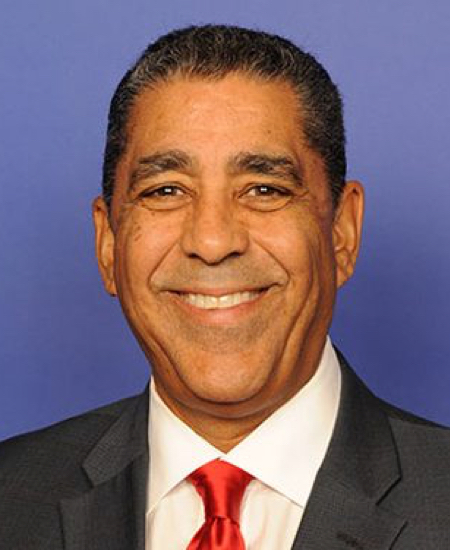
Rep. Adriano Espaillat
Sponsored bills
Mental Health Workforce and Language Access Act of 2021 This bill establishes within the Department of Health and Human Services (HHS) two demonstration programs to increase access to mental health services provided in languages other than English at federally qualified health centers (FQHCs). In carrying out the programs, HHS must give preference to FQHCs at which at least 20% of the patients are best served in a language other than English. First, HHS must provide National Health Service Corps (NHSC) loan repayments to mental health care providers who agree to serve their period of obligated service in an FQHC. HHS may provide enhanced payments to those who serve in an FQHC with non-English language needs. (The NHSC is a scholarship and student loan repayment program for eligible health care providers who agree to work in areas with a shortage of primary care, dental care, and mental health care providers.) Second, HHS must award grants to FQHCs for recruiting and retaining mental health care providers who are fluent in a language other than English.
Maddy summaryHRES 785 is a symbolic resolution designating November 8, 2021, as "National First-Generation College Celebration Day." It urges all Americans to celebrate this day, recognize the contributions of first-generation college students (those whose parents did not earn bachelor's degrees), and honor the Higher Education Act of 1965. The resolution highlights existing federal programs like TRIO and Pell Grants that support underrepresented students but does not create new laws or funding. As a non-binding resolution, it has no direct policy impact but aims to raise awareness about first-generation students' challenges and achievements.
Sarah Keys Evans Congressional Gold Medal Act This bill provides for the award of a Congressional Gold Medal to Sarah Keys Evans in recognition of her achievements relating to the desegregation of passengers on interstate buses in the 1950s.
Greyhound Protection Act of 2021 This bill modifies the federal criminal statute commonly known as the Wire Act. Currently, the Wire Act contains four prohibitions on the use of a wire transmission facility (e.g., the telephone or internet) for certain gambling activities. All four prohibitions apply to sports gambling. However, there have been conflicting interpretations of the applicability of the prohibitions to nonsports gambling (e.g., state lotteries). This bill amends the Wire Act to expressly state that the statute does not authorize the use of wire communications to gamble on commercial greyhound racing or permit the transport of animals for commercial dog racing or related activities.
Protecting Our Communities Act This expands the types of parts, weapons, and devices that are subject to regulation under federal firearms laws. The bill also establishes a notification requirement following a firearms-related background check that results in a denial. Specifically, the bill includes as a firearm any combination of parts designed or intended to be used to convert a device into a firearm and from which a firearm may be readily assembled; adds armor-piercing, concealable weapons to the list of firearms subject to regulation under federal firearms laws; and provides statutory authority for the regulation issued by the Bureau of Alcohol, Tobacco, Firearms and Explosives to classify bump-stock devices as machine guns for the purposes of federal firearms laws. Additionally, the bill requires the Department of Justice to notify state and local law enforcement authorities following a firearms-related background check that results in a denial.
Andrew Kearse Accountability for Denial of Medical Care Act of 2021 This bill establishes a new federal criminal offense for failing to obtain medical attention for an individual in federal custody who displays medical distress. Specifically, the bill requires federal law enforcement officers and the Bureau of Prisons' personnel to provide or obtain immediate medical attention for an individual in federal custody who displays medical distress. It criminalizes the negligent failure to obtain or provide such medical attention that results in unnecessary pain, injury, or death. A violator is subject to criminal penalties—a fine, a prison term of up to one year, or both.
Freedom for Families Act This bill prohibits using federal funds for facilities used to detain noncitizen families and addresses related issues. Specifically, no funds made available may be used to operate or construct a family detention center, whether operated by U.S. Immigration and Customs Enforcement or a contractor. This prohibition shall also apply to funds made available before this bill's enactment. Funds obligated to operate such centers must instead be used for implementing and developing nondetention programs that are community-based and consistent with international best practices. The Department of Homeland Security (DHS) may place an apprehended noncitizen family into such a nondetention program if DHS makes an individualized determination that doing so will facilitate the family's compliance with immigration laws. The programs must provide to participants a legal orientation and meaningful access to counsel.
Reinforcing Nicaragua's Adherence to Conditions for Electoral Reform Act of 2021 or the RENACER Act This bill establishes measures to monitor, report on, and address corruption and human rights abuses in Nicaragua. Specifically, the bill directs U.S. leadership at international financial institutions to advocate for oversight with respect to any loan or financial or technical assistance for projects in Nicaragua. The Department of State and the Department of the Treasury must establish a strategy to align diplomatic engagement with implementing sanctions to facilitate free, fair, and transparent elections in Nicaragua. Pursuant to this strategy, the President must prioritize implementing targeted sanctions on persons obstructing such elections. The State Department must also engage in diplomatic efforts with partner countries to impose targeted sanctions on such individuals. The bill adds Nicaragua to a list of countries whose citizens are subject to visa-blocking sanctions for knowingly engaging in (1) actions undermining democratic processes or institutions, or (2) significant corruption or obstruction of investigations into such corruption. Further, the bill requires the State Department to report on the involvement of President Daniel Ortega, members of his family, and senior government officials in significant acts of public corruption; Russian activities in Nicaragua; and gross human rights violations by the Ortega government against campesinos (i.e., natives of Latin American rural areas, especially Latin American Indian farmers or farm laborers) and indigenous communities. In addition, the State Department must report on obstacles to news and information about domestic and international affairs and submit a strategy for strengthening independent broadcasting, information distribution, and media platforms in Nicaragua.

Maddy summaryHR 5904, the Deepavali Day Act, would add "Deepavali Day" to the list of recognized days in federal law, specifically amending the U.S. Code section that lists federal holidays. It recognizes Deepavali - a festival celebrated by over six million Americans, including Hindu, Buddhist, Sikh, Jain, and Indo-Caribbean communities - as a day symbolizing the victory of light over darkness. The bill does not create a paid holiday or change government operations; it simply adds Deepavali Day to the existing federal holiday schedule. This recognition aligns with Congress's acknowledgment of Deepavali's cultural significance and its shared values with U.S. democratic principles.