

National Origin-Based Antidiscrimination for Nonimmigrants Act or the NO BAN Act This bill imposes limitations on the President's authority to suspend or restrict aliens from entering the United States. It also prohibits religious discrimination in various immigration-related decisions, such as whether to issue an immigrant or nonimmigrant visa, unless there is a statutory basis for such discrimination. The President may temporarily restrict the entry of any aliens or class of aliens after the Department of State determines that the restriction would address specific and credible facts that threaten U.S. interests such as public safety. The bill also imposes limitations on such restrictions, such as requiring the President, State Department, and the Department of Homeland Security (DHS) to (1) only issue a restriction when required to address a compelling government interest, and (2) narrowly tailor the suspension to use the least restrictive means to achieve such an interest. Before imposing a restriction, the State Department and DHS shall consult with Congress. The State Department and DHS shall report to Congress about the restriction within 48 hours of the restriction's imposition. If such a report is not made, the restriction shall immediately terminate. Individuals or entities present in the United States and unlawfully harmed by such a restriction may sue in federal court. The bill transfers the authority to suspend the entry of aliens traveling to the United States on a commercial airline that failed to comply with regulations related to detecting fraudulent travel documents from the Department of Justice to DHS.
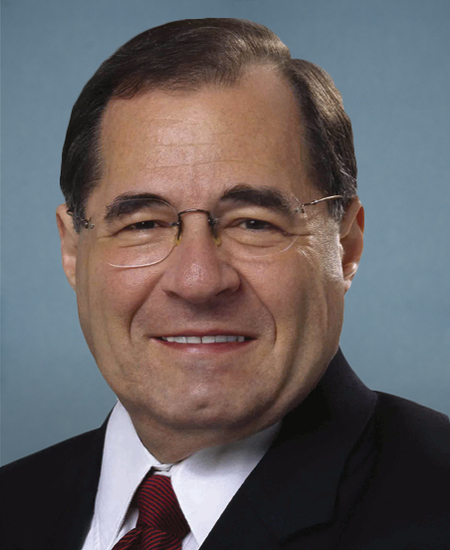
Rep. Jerrold Nadler
Sponsored bills
This bill provides for the presentation of a Congressional Gold Medal to the Freedom Riders, in recognition of their contribution to civil rights by fighting for equality in interstate travel.
Maddy summaryHR 922, the Period PROUD Act of 2025, allocates $1.9 billion annually (2025-2028) through the Social Services Block Grant Program, with $200 million specifically dedicated each year (2026-2029) to provide free menstrual products to low-income menstruating individuals. It requires states to distribute these funds to eligible nonprofits with experience in community distribution of basic needs, integrating the program with existing services like SNAP, Medicaid, and WIC. The bill mandates that funds supplement, not replace, other existing programs, prohibits limiting where products can be distributed, and caps administrative costs at 9% of allocated funds. States must report annually and an evaluation of the program’s effectiveness will be completed by 2031.
Maddy summaryHR 944, the Access to Counsel Act, requires U.S. immigration officials to provide certain immigrants a meaningful opportunity to consult with legal counsel during key immigration processes. It directly affects U.S. nationals, lawful permanent residents returning from travel, visa holders, refugees, asylees, and parolees subject to secondary or deferred inspection at ports of entry. The bill mandates that officials ensure access to counsel (including via phone) within one hour of inspection starting, allow counsel to present evidence, and accommodate in-person meetings when possible. It also requires officials to provide counsel access before accepting Form I-407 abandonment forms from lawful permanent residents, unless waived in writing. The law takes effect 180 days after enactment and preserves existing rights to counsel under other immigration laws.
Health Care Workforce Innovation Act of 2025 This bill establishes the Health Care Workforce Innovation Program within the Health Resources and Services Administration to provide grants to federally qualified health centers, rural health clinics, and post-secondary vocational programs for developing education and training for allied health professionals (e.g., professionals providing clinical or non-clinical support services, community health workers, and health education specialists). Specifically, grant recipients must use the funds to carry out innovative, community-based programs to train allied health professionals, with a focus on supporting rural and underserved areas. Grant recipients may use the funds to launch or expand health care professional partnerships (e.g., between a grant recipient and a school), establish apprenticeship or other career programs, or invest in training equipment, among other activities.
Maddy summaryHR 964, the Rosa Parks Day Act, would designate Rosa Parks Day as a legal public holiday for federal employees and institutions. The bill amends Title 5 of the U.S. Code to add "Rosa Parks Day" to the list of recognized federal holidays, following Thanksgiving Day. This change would establish a new annual observance on the day designated by the President, requiring federal offices to close and employees to receive paid time off. The bill directly affects federal operations and employees, creating a new standard for federal holiday observance.
Maddy summaryThis bill updates disaster assistance rules to clarify eligibility for specific housing types affected by disasters. It defines "residential common interest communities" (including condos, housing co-ops, and manufactured home communities) and requires the President to issue rules allowing debris removal from these properties when a state determines it threatens safety or recovery. It also expands repair funding eligibility for essential shared areas (like roofs, elevators, and utilities) in these communities, provided residents document their share of costs. The changes apply to disasters declared after the bill's enactment, directly affecting residents of these housing types who seek federal disaster aid.
Maddy summaryHR 897, the Aviation-Impacted Communities Act, makes communities located near airports but outside the current FAA noise standard (65 DNL) eligible for noise mitigation funding and establishes a process for these communities to formally seek designation. It requires the FAA to partner with the National Academy of Sciences to study aviation impacts at major airports, develop a diagnostic tool for community assessments, and create community boards to represent residents. These boards can request assessments, collaborate on action plans to address noise or emissions, and access grants for solutions like sound insulation, air filtration, or flight path changes. The bill authorizes $750 million for noise mitigation funding over 10 years, targeting residential areas, schools, hospitals, and other facilities affected by aircraft noise and emissions.
Medicare Patient Access and Practice Stabilization Act of 2025 This bill increases certain payment adjustments under the Medicare physician fee schedule for services furnished between April 1, 2025, and January 1, 2026.
American Music Fairness Act of 2025 This bill establishes that the copyright holder of a sound recording shall have the exclusive right to perform the sound recording through an audio transmission. (Currently, the public performance right only covers performances through a digital audio transmission in certain instances, which means that nonsubscription terrestrial radio stations generally do not have to get a license to publicly perform a copyright-protected sound recording.) Under the bill, a nonsubscription broadcast transmission must have a license to publicly perform such sound recordings. The Copyright Royalty Board must periodically determine the royalty rates for such a license. When determining the rates, the board must base its decision on certain information presented by the parties, including the radio stations' effect on other streams of revenue related to the sound recordings. Terrestrial broadcast stations (and the owners of such stations) that fall below certain revenue thresholds may pay certain flat fees, instead of the board-established rate, for a license to publicly perform copyright-protected sound recordings.