

Maddy summaryThis bill provides housing loans and education assistance to Black World War II veterans who were denied GI Bill benefits due to racial discrimination, or to their surviving spouses, children, or direct descendants. To qualify, applicants must certify they were denied benefits on racial grounds under the original 1944 GI Bill and apply within five years of the law's enactment. The Department of Veterans Affairs must implement these provisions within 90 days and report to Congress on participation and program costs. It specifically addresses documented historical discrimination where Black veterans were steered toward vocational training instead of college, with only 6% earning degrees compared to 19% of White veterans.
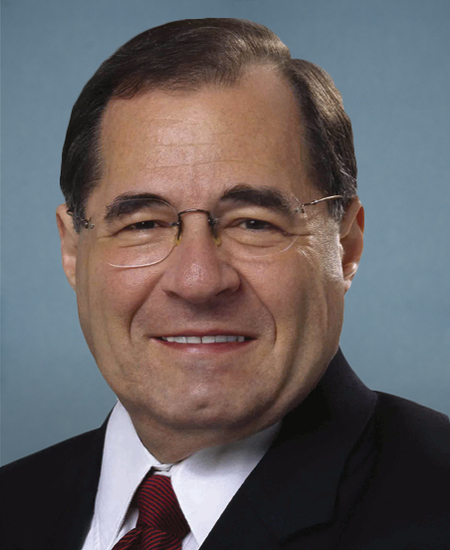
Rep. Jerrold Nadler
Sponsored bills
Maddy summaryThe Safer Skies Act of 2025 requires specific smaller airlines to adopt enhanced security screening protocols currently used by larger carriers. It mandates that "covered air carrier operations" - defined as airlines operating under certain FAA rules, offering individual seats with public schedules, using planes with more than nine passenger seats, and not using TSA checkpoints - to follow the Aircraft Operator Standard Security Program (49 CFR §1544.101(a)) within 360 days of the bill's enactment. The Transportation Security Administration must revise its rules to enforce this requirement. This directly affects regional and private charter airlines that currently skip TSA checkpoint screening but serve the public with scheduled passenger flights.
Maddy summaryThis bill would require federal firearms licensees to prohibit sales of specific high-capacity rifles and shotguns to people under 21. It targets semiautomatic centerfire rifles and shotguns capable of holding more than 5 rounds in their magazines, raising the age limit from 18 to 21 for these weapons. Exceptions apply for active military members and certain government employees authorized to carry firearms. The law directly affects gun retailers and individuals under 21 seeking to purchase these specific firearms. It modifies existing federal gun sale rules without changing age requirements for other firearms.
Maddy summaryHCONRES 21 is a symbolic House resolution recognizing the persistent gender wage gap in the U.S., where women earn significantly less than men for comparable work. It cites specific data showing women overall earn 75 cents and women of color earn even less (e.g., 58 cents for Latinas) per dollar earned by White, non-Hispanic men. The resolution does not create new laws or policies but formally acknowledges the economic impact of this disparity, including annual lost wages exceeding $994 million for full-time women workers. It also highlights designated Equal Pay Days for different demographic groups to underscore the varying timelines to close the gap.
Brake for Kids Act of 2025 This bill directs the Department of Transportation (DOT) to produce and distribute a national public safety campaign on the dangers of illegally passing stopped school buses. Specifically, the campaign must increase awareness and education about the issue through a variety of media, including television, radio, and social media advertising. DOT must use Infrastructure Investment and Jobs Act funds to produce and distribute the campaign.
Maddy summaryThe Children’s Health Protection Act of 2025 establishes a new Office of Children’s Health Protection within the Environmental Protection Agency (EPA), led by a Director appointed by the EPA Administrator. The Office will identify environmental health risks disproportionately affecting children, coordinate federal programs to address these risks, and develop resources for schools to implement environmental health programs. It will also work with a permanent advisory committee to advise on safe chemicals management, evaluate environmental contaminants linked to childhood disease, and support healthcare providers through pediatric environmental health specialty units. The bill authorizes $7.8 million annually for the Office and $13.2 million total for the program through 2030.
Maddy summaryThe Paycheck Fairness Act strengthens equal pay protections by expanding the definition of "sex" to include pregnancy, childbirth, sexual orientation, gender identity, and sex characteristics. It modifies employer defenses for pay disparities to require proof that any pay difference is job-related, not based on sex, and accounts for the entire pay gap. The bill prohibits employers from asking about salary history, enhances penalties for violations, and requires employers with 100+ employees to collect and report detailed pay data by race, sex, and job category. It also establishes training programs for employers on eliminating pay bias and creates a National Equal Pay Enforcement Task Force to coordinate enforcement efforts. This legislation directly affects employers, particularly those with 100+ employees, and aims to address pay disparities impacting women, people of color, and other underrepresented groups.
Maddy summaryH.J. Res. 80 would declare the Equal Rights Amendment (ERA) part of the U.S. Constitution, asserting it has been ratified by 38 states (three-fourths of the states) despite the original 1972 deadline. If passed, this resolution would formally establish the ERA as a constitutional amendment, requiring all federal and state laws to align with its gender equality protections. The bill does not create new laws but confirms the ERA's status as part of the Constitution, affecting how laws are interpreted and enforced. It is a procedural step to resolve the legal dispute over the ERA's validity after decades of debate.
Maddy summaryHRES 238 is a non-binding House resolution expressing the House's position that every person has the basic right to emergency health care, including abortion care during medical emergencies. It does not create new laws or alter existing regulations but formally states the House's view that abortion restrictions in emergencies endanger patients' health and lives. The resolution specifically highlights how current abortion bans put pregnant people at risk during life-threatening conditions like hemorrhage or infection, disproportionately impacting Black, Indigenous, people of color, immigrants, and low-income individuals. It serves as a symbolic statement opposing policies that restrict emergency reproductive care access.
Maddy summaryThe Air America Act of 2025 authorizes one-time payments of $40,000 to individuals who worked for Air America or its affiliated companies for at least five years during 1950-1976, or to their surviving spouses, children, or dependents. Additional payments of $8,000 per full year beyond five years are allowed. The program is capped at $60 million total funding, with claims required within two years of final regulations. Payments are a single lump sum with no ongoing benefits, and the bill explicitly states it does not create new entitlements beyond this one-time award.