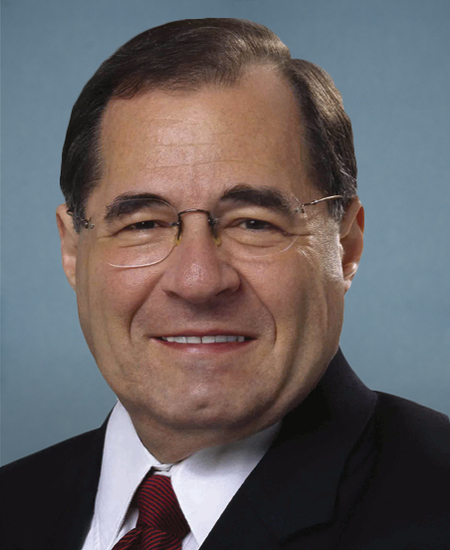
Photo of Jerrold Nadler
D United States House · District 12 · New York

Rep. Jerrold Nadler

Compare
Total votes
2,837
all sessions
Attendance
96%
126 missed
Lower than 94% of chamber peers
With party
98%
of cast votes
Higher than 87% of chamber peers
Bipartisan score
1%
crosses aisle rarely
Lower than 87% of chamber peers
Sponsored
1,725
bills & resolutions
Higher than 77% of chamber peers
Committees
6
assignments
1,725 bills and resolutions

Sponsored bills

Total
1,725
Primary
59
Co-sponsor
1,666
This page
1,725
matching current filters
Co-sponsor HR 3183
In committee · Indiana House · Co-sponsor
Metastatic Breast Cancer Access to Care Act

Metastatic Breast Cancer Access to Care Act This bill expedites payment of Social Security Disability Insurance (SSDI) benefits and eligibility for Medicare coverage for those with metastatic breast cancer (i.e., breast cancer that has spread to other sites in the body). Specifically, the bill eliminates the 5-month waiting period for SSDI benefits and the subsequent 24-month waiting period for Medicare coverage for individuals with metastatic breast cancer. Under current law, individuals generally must wait five months after the onset of disability to begin receiving SSDI benefits and an additional 24 months to become eligible for Medicare.

In committee May 13, 2021 1 co-sponsor
Co-sponsor HR 3224
In committee · Indiana House · Co-sponsor
I am Vanessa Guillén Act of 2021

I am Vanessa Guillén Act of 2021 This bill addresses the policies and procedures of the Department of Defense (DOD) for cases or allegations of sex-related offenses.

In committee May 13, 2021 1 co-sponsor
Co-sponsor HR 3216
In committee · Indiana House · Co-sponsor
To amend the Internal Revenue Code of 1986 to create parity for unmarried individuals and heads of household with respect to the temporary 2021 income phaseouts in the child tax credit.

This bill increases the applicable threshold amount for heads of household in 2021 to $150,000 for purposes of the income phaseout in the child tax credit (thus making it equal to the threshold amount for married individuals filing joint tax returns).

In committee May 13, 2021 1 co-sponsor
Co-sponsor HR 3139
In committee · Indiana House · Co-sponsor
PEAKER Act of 2021

Promoting Energy Alternatives is Key to Emission Reductions Act of 2021 or the PEAKER Act of 2021 This bill addresses the emissions from peaker plants and provides financial incentives for renewable energy to reduce the need for peaker plants. Peaker plants are defined as fossil fuel-fired power plants or units of power plants that are run primarily to meet peak electricity demand. In other words, peaker plants are run where there is above average energy demand, such as during extremely hot or cold weather. The bill establishes an additional investment tax credit for renewable energy generation and battery storage to replace the need for peaker plants in disadvantaged communities. In addition, the Department of Energy (DOE) must establish a grant program to provide up to $1 billion annually through FY2032 to eligible entities for clean energy projects. Specifically, grants must be awarded to assist eligible entities in carrying out (1) projects associated with the construction, installation, or acquisition of qualifying renewable energy facilities and qualifying energy storage facilities; or (2) community energy proposals or community energy studies to reduce or replace the need for peaker plants. Entities that are eligible to receive grants include state or local governments, nonprofit organizations, community-owned energy generation facilities or energy storage facilities located in disadvantaged communities, community-based energy cooperatives, or certain partnerships. DOE must also assess and report on the location of each peaker plant, the quantity and type of pollution each plant is producing, and related data as specified by the bill.

In committee May 13, 2021 1 co-sponsor
Co-sponsor HR 3149
In committee · Indiana House · Co-sponsor
HEAL for Immigrant Families Act of 2021

Health Equity and Access under the Law for Immigrant Women and Families Act of 2021 or the HEAL Immigrant Women and Families Act of 20 21 This bill extends Medicaid and Children's Health Insurance Program coverage to individuals lawfully present in the United States who otherwise meet eligibility requirements. Individuals granted federally authorized presence also are required to maintain minimum essential health insurance coverage and are eligible for health insurance exchanges, reduced cost sharing, premium subsidies, and premium tax credits.

In committee May 13, 2021 1 co-sponsor
Co-sponsor HR 3165
In committee · Indiana House · Co-sponsor
Nurse Staffing Standards for Hospital Patient Safety and Quality Care Act of 2021

Nurse Staffing Standards for Patient Safety and Quality Care Act of 2021 This bill requires hospitals to implement and submit to the Department of Health and Human Services (HHS) a staffing plan that complies with specified minimum nurse-to-patient ratios by unit. Hospitals must post a notice regarding nurse-to-patient ratios in each unit and maintain records of actual ratios for each shift in each unit. The bill also requires hospitals to follow certain procedures regarding how ratios are determined and other staff are prohibited from performing nurse functions unless specifically authorized within a state's scope of practice rules, among other requirements. HHS must adjust Medicare payments to hospitals to cover additional costs attributable to compliance with these ratios. Nurses may object to, or refuse to participate in, an assignment if it would violate minimum ratios or if they are not prepared by education or experience to fulfill the assignment without compromising the safety of a patient or jeopardizing their nurse's license. Hospitals may not (1) take adverse actions against a nurse based on the nurse's reasonable refusal to accept an assignment; or (2) discriminate against individuals for good faith complaints relating to the care, services, or conditions of the hospital or related facilities. HHS may impose civil monetary penalties on hospitals violating the ratio requirements and must publish the names of such hospitals. The bill provides stipends to the nurse workforce loan repayment and scholarship program and expands the nurse retention grant program to include nurse preceptorship and mentorship projects.

In committee May 13, 2021 1 co-sponsor
Co-sponsor HR 3116
In committee · Indiana House · Co-sponsor
COAST Anti-Drilling Act

Clean Ocean And Safe Tourism Anti-Drilling Act or the COAST Anti-Drilling Act This bill prohibits the Department of the Interior from authorizing the exploration, development, or production (i.e., offshore drilling) of oil or natural gas in specified planning areas of the Outer Continental Shelf along the Atlantic Coast, including the Straits of Florida.

In committee May 13, 2021 1 co-sponsor
Co-sponsor HR 958
Passed · Indiana House · Co-sponsor
Protecting Moms Who Served Act

Protecting Moms Who Served Act This bill requires the Department of Veterans Affairs (VA) to implement the maternity care coordination program. The VA must provide community maternity care providers (i.e., non-VA maternity care providers) with training and support with respect to the unique needs of pregnant and postpartum veterans, particularly regarding mental and behavioral health conditions in relation to the service of the veterans in the Armed Forces. Additionally, the Government Accountability Office must report on maternal mortality and severe maternal morbidity among pregnant and postpartum veterans, with a focus on racial and ethnic disparities in maternal health outcomes for veterans.

Passed May 13, 2021 1 co-sponsor
Co-sponsor HR 3097
In committee · Indiana House · Co-sponsor
Green Transportation Act

Green Transportation Act This bill incorporates greenhouse gas emission reduction in various transportation-related planning activities and programs. Specifically, states and metropolitan planning organizations must address greenhouse gas emission reductions and certain other issues (e.g., public health and climate change) in long-range and other planning related to highways and public transportation. The bill also makes reducing carbon dioxide and other greenhouse gas emissions from the transportation system a national goal of the Federal-aid Highway Program. The Department of Transportation (DOT) must establish applicable performance measures and standards related to that goal. Additionally, states and metropolitan planning organizations may use certain funding available through the National Highway Trust Fund to develop standardized models and methodologies to measure and monitor transportation-related greenhouse gas emissions. DOT must collect and organize such models and methodologies in a publicly available clearinghouse and report about them to Congress. Further, DOT must establish a program to fund projects that support the reduction of greenhouse gas emissions from the surface transportation system. As part of this program, DOT must annually evaluate carbon dioxide emissions on public roads and evaluate states' progress in reducing emissions.

In committee May 12, 2021 1 co-sponsor
Co-sponsor HR 1755
In committee · Indiana House · Co-sponsor
Northern Rockies Ecosystem Protection Act

Northern Rockies Ecosystem Protection Act This bill designates specified National Forest System lands, National Park System lands, and public lands in Idaho, Montana, Oregon, Washington, and Wyoming as wilderness and as components or additions to existing components of the National Wilderness Preservation System. The Department of the Interior and the Department of Agriculture (USDA) must accept donations of leases or permits authorizing grazing on specified public or National Forest System lands. The bill also designates (1) specified federal lands as biological connecting corridors and as special corridor management areas; (2) segments of specified rivers and creeks in Idaho, Montana, and Wyoming as components of the National Wild and Scenic Rivers System; and (3) specified areas as wildland recovery areas. USDA shall develop a wildland recovery plan for each recovery area. A panel of independent scientists shall study roadless lands greater than 1,000 acres that are within the National Forest System in the Wild Rockies bioregion in Idaho, Montana, Oregon, Washington, or Wyoming and that are not designated as components of the National Wilderness Preservation System for their role in maintaining biological diversity in the Northern Rockies and as part of the overall forest reserve system. Any new road construction or reconstruction or timber harvest is prohibited in those lands after the evaluation without an act of Congress. Oil or gas leasing, mining, or other development which impairs the natural and roadless qualities of the land is also prohibited.


In committee May 12, 2021 1 co-sponsor
Showing 1,521 to 1,530 of 1,725 bills