

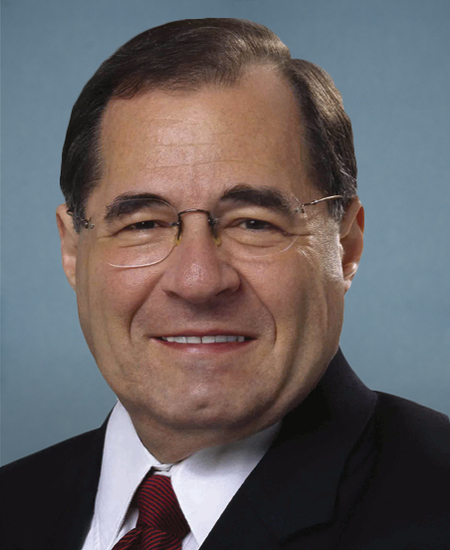
Photo of Jerrold Nadler
D United States House · District 12 · New York

Rep. Jerrold Nadler

Compare
Total votes
2,837
all sessions
Attendance
96%
126 missed
Lower than 94% of chamber peers
With party
98%
of cast votes
Higher than 87% of chamber peers
Bipartisan score
1%
crosses aisle rarely
Lower than 87% of chamber peers
Sponsored
1,725
bills & resolutions
Higher than 77% of chamber peers
Committees
6
assignments
1,725 bills and resolutions

Sponsored bills

Total
1,725
Primary
59
Co-sponsor
1,666
This page
1,725
matching current filters
Co-sponsor HR 6574
In committee · Indiana House · Co-sponsor
Loan Equity for Advanced Professionals Act

Maddy summaryThis bill increases federal student loan limits for graduate and professional students. Starting July 1, 2026, it sets a $50,000 annual limit and a $200,000 total aggregate limit (beyond undergraduate borrowing) for unsubsidized Federal Direct Stafford loans. These changes directly affect graduate and professional students pursuing advanced degrees who rely on federal loans for education costs. The provisions aim to provide higher borrowing capacity for these students' educational expenses under the Higher Education Act.

In committee Dec 10, 2025 1 co-sponsor
Co-sponsor HR 6565
In committee · Indiana House · Co-sponsor
Reuniting Families Act

Maddy summaryHR 6565, the Reuniting Families Act, would significantly reform family-based immigration by reclassifying spouses, permanent partners, and minor children of legal permanent residents as "immediate relatives," eliminating current visa backlogs for these family members. The bill creates a new legal definition of "permanent partner" to provide equal treatment for same-sex partners in immigration processes, expanding eligibility for family-based visas. It increases the worldwide level of family-sponsored immigrant visas and adjusts allocation numbers to reduce processing delays, while also providing specific relief for orphans, widows, widowers, and certain Filipino veterans. The bill also expands refugee family reunification provisions and increases diversity visa numbers from 55,000 to 80,000. These changes would directly affect family members seeking to reunite with U.S. citizens or legal permanent residents through family-based immigration pathways.

In committee Dec 10, 2025 1 co-sponsor
Co-sponsor HR 6438
In committee · Indiana House · Co-sponsor
ROBINHOOD Act

Maddy summaryThis bill imposes a 20% tax on certain loans secured by assets like stocks or business property for individuals earning over $400,000 annually (or $450,000 for joint returns). The tax applies to the borrowed amount each year and is paid directly by borrowers. It specifically excludes home mortgages, home equity loans, margin loans, and farmland-secured loans. The tax targets high-value lending outside standard residential financing, with new rules taking effect after the bill's enactment.

In committee Dec 4, 2025 1 co-sponsor
Co-sponsor HR 6397
In committee · Indiana House · Co-sponsor
Dignity for Detained Immigrants Act

Maddy summaryThe Dignity for Detained Immigrants Act establishes minimum standards for detention facilities operated by the Department of Homeland Security, requiring them to follow the American Bar Association's Civil Immigration Detention Standards. It mandates annual unannounced inspections by the DHS Inspector General, with penalties including fines for noncompliant private facilities and transfers of detainees from noncompliant facilities. The bill requires DHS to publicly report on facility compliance, phase out private detention facilities over three years, and prohibit solitary confinement. It also ensures detainees have access to legal orientation, counsel, and more frequent custody review hearings. The bill directly affects all individuals detained in DHS custody, including immigrants, asylum seekers, and refugees held in facilities operated by or contracted to DHS.

In committee Dec 4, 2025 1 co-sponsor
Co-sponsor HR 6390
In committee · Indiana House · Co-sponsor
Make Housing Affordable and Defend Democracy Act

Maddy summaryThis bill creates several tax credits to increase housing affordability for individuals and families. It establishes a first-time homebuyer credit of up to $25,000 (or $50,000 for first-generation homebuyers) for purchasing a principal residence, with income limits based on household size. It also creates a starter home construction credit for building homes under 1,200 square feet priced below 80% of local median home prices, and a renter tax credit for tenants paying more than 30% of their income in rent. Additionally, it provides a credit for converting non-residential buildings to affordable housing that meets specific income and rent restrictions. The bill includes provisions for inflation adjustments and reporting requirements for these tax credits.

In committee Dec 4, 2025 1 co-sponsor
Co-sponsor HRES 856
In committee · Indiana House · Co-sponsor
Expressing the sense of the House of Representatives that the United States Department of Agriculture should use its contingency funds and interchange authority to finance the supplemental nutrition assistance program.

Maddy summaryHRES 856 is a non-binding resolution expressing the House of Representatives' view that the U.S. Department of Agriculture (USDA) should use its existing contingency funds and interchange authority to fund the Supplemental Nutrition Assistance Program (SNAP) for November 2025. The resolution cites that the USDA holds over $5 billion in contingency funds set aside for emergencies and has legal authority under the Department of Agriculture Organic Act to transfer funds between nutrition programs to maintain SNAP benefits. This would directly support approximately 42 million people relying on SNAP, including 16 million children, 8 million seniors, 4 million people with disabilities, and 1.2 million veterans, preventing disruption during a potential funding gap. The resolution does not create new law but urges the administration to use existing resources to ensure continued food assistance.

In committee Dec 2, 2025 1 co-sponsor
Co-sponsor HR 1262
Passed · Indiana House · Co-sponsor
Mikaela Naylon Give Kids a Chance Act

Give Kids a Chance Act of 2025 This bill expands the Food and Drug Administration’s (FDA’s) authority with respect to research on rare pediatric diseases, including by permitting the FDA to take enforcement action against drug sponsors that fail to satisfy pediatric study requirements and by reauthorizing programs that support pediatric research.  Specifically, the bill modifies requirements relating to molecularly targeted pediatric cancer investigations to permit research on new drugs in combination with active ingredients that have already been approved, provided certain conditions are met; permits the FDA to take enforcement action against drug sponsors that fail to comply with pediatric study requirements, if such sponsors demonstrated a lack of due diligence in satisfying the requirement; renews the FDA’s authority to award priority review vouchers to sponsors of new products intended to treat rare pediatric diseases through September 30, 2029; and reauthorizes through FY2027 certain funding for the National Institutes of Health to support priority pediatric research.  The bill also provides statutory authority for the FDA’s interpretation of the orphan drug exclusivity period. The bill specifies, consistent with FDA regulations, that the seven-year market exclusivity period for drugs for rare diseases or conditions (i.e., orphan drugs) prohibits the approval of the same drug for the same approved use or indication with respect to the disease or condition. (In Catalyst Pharmaceuticals, Inc. v. Becerra , a court rejected the FDA’s interpretation and held that orphan drug exclusivity extends to all uses or indications for the disease or condition.)

Passed Dec 2, 2025 1 co-sponsor
Co-sponsor HR 6318
In committee · Indiana House · Co-sponsor
No GOUGE Act

Maddy summaryHR 6318, the No GOUGE Act, prohibits large businesses from excessively raising prices on goods affected by tariffs or planned tariffs (e.g., imports subject to new tariffs) for five years after the tariff takes effect. It specifically targets companies with over $100 million in U.S. revenue, banning price hikes that exceed the actual cost of the tariff plus legitimate operational expenses (excluding executive pay or stock buybacks). The Federal Trade Commission (FTC) enforces this by presuming violations if large firms (over $1 billion revenue) raise prices beyond pre-tariff averages during "tariff shock" periods, though companies can rebut this by proving costs were genuinely tied to the tariff. The law aims to prevent price gouging by ensuring tariff costs - not profit motives - drive price changes for consumers.

In committee Nov 28, 2025 1 co-sponsor
Co-sponsor HR 6268
In committee · Indiana House · Co-sponsor
LEAD Act of 2025

Maddy summaryHR 6268, the LEAD Act of 2025, requires the use of non-lead ammunition on all lands and waters managed by the U.S. Fish and Wildlife Service (USFWS), effective one year after enactment. It directly affects hunters and recreational shooters using USFWS lands, with exceptions for law enforcement, military personnel, and government officials performing official duties. The bill mandates the USFWS to establish a list of certified non-lead ammunition (defined as containing ≤1% lead by weight) and imposes civil penalties of up to $500 for first violations and $1,000-$5,000 for repeat offenses. This policy aims to protect wildlife, human health, and food safety by reducing lead exposure from spent ammunition, which the bill cites as a documented risk to ecosystems and consumers.

In committee Nov 21, 2025 1 co-sponsor
Co-sponsor HRES 899
In committee · Indiana House · Co-sponsor
Supporting the goals and principles of Transgender Day of Remembrance by recognizing the epidemic of violence toward transgender people and memorializing the lives lost this year.

Maddy summaryHRES 899 is a symbolic House resolution recognizing the Transgender Day of Remembrance and memorializing transgender people killed by violence in 2024-2025. It directly affects transgender individuals, particularly transgender women of color, by acknowledging the epidemic of violence against them - citing 27 U.S. victims (including names like Rick Alastor Newman and Kyla Jane Walker) and 241 global cases in 2025. The resolution’s key provisions include formally recognizing the violence epidemic, memorializing specific lives lost, and affirming the need for solutions to protect transgender people. It does not create new laws but expresses congressional support for addressing systemic violence and discrimination faced by transgender communities.

In committee Nov 20, 2025 1 co-sponsor
Showing 131 to 140 of 1,725 bills
Previous 1 … 13 14 15 … 173 Next