

Access to Birth Control Act This bill requires pharmacies to comply with certain rules related to ensuring access to contraceptives. Specifically, pharmacies must provide without delay a customer with any contraceptive or related medication that is in stock. If the contraceptive is not in stock, the pharmacy must immediately inform the customer and either order the contraceptive or refer the customer to a pharmacy that has it in stock. Laws in some states provide pharmacists with the right to refuse to dispense contraceptive-related drugs on religious or conscience grounds. Pharmacies may refuse to provide a contraceptive to a customer (1) if the customer lacks a valid prescription for a prescription contraceptive or is unable to pay for the contraceptive, or (2) based on a pharmacy employee's professional clinical judgment. The bill also establishes a private cause of action and civil monetary penalties for violations of the bill.
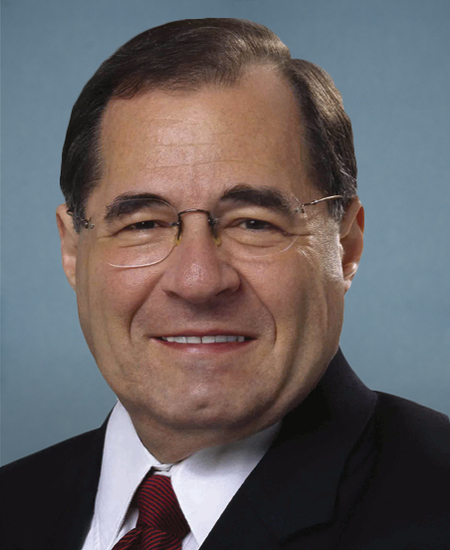
Rep. Jerrold Nadler
Sponsored bills
This resolution (1) censures Representative Paul Gosar for posting a certain video on his social media accounts that depicts violence against Representative Alexandria Ocasio-Cortez and President Joseph R. Biden , and (2) removes him from the Committee on Natural Resources and the Committee on Oversight and Reform.
Traveling Exotic Animal and Public Safety Protection Act of 2021 This bill prohibits the use of exotic or wild animals in performances of a traveling animal act, such as a circus, carnival, or parade. The prohibition does not apply to zoos, aquariums, research facilities, wildlife sanctuaries, and other entities. The prohibition also does not apply to domestic animals or farm animals.
Mental Health Workforce and Language Access Act of 2021 This bill establishes within the Department of Health and Human Services (HHS) two demonstration programs to increase access to mental health services provided in languages other than English at federally qualified health centers (FQHCs). In carrying out the programs, HHS must give preference to FQHCs at which at least 20% of the patients are best served in a language other than English. First, HHS must provide National Health Service Corps (NHSC) loan repayments to mental health care providers who agree to serve their period of obligated service in an FQHC. HHS may provide enhanced payments to those who serve in an FQHC with non-English language needs. (The NHSC is a scholarship and student loan repayment program for eligible health care providers who agree to work in areas with a shortage of primary care, dental care, and mental health care providers.) Second, HHS must award grants to FQHCs for recruiting and retaining mental health care providers who are fluent in a language other than English.
Honoring Our Promises through Expedition for Afghan SIVs Act of 2021 or the HOPE for Afghan SIVs Act of 2021 This bill authorizes the Department of State and the Department of Homeland Security (DHS) to postpone the medical exam requirement for qualifying citizens or nationals of Afghanistan seeking entry into the United States as special immigrants. Specifically, this bill applies to an existing program that provides special immigrant status to an individual (or the spouse or child of such an individual) who (1) faithfully performed sensitive and trusted duties for the U.S. government or the International Security Assistance Force in Afghanistan on or after October 7, 2001, and (2) has experienced or is experiencing an ongoing serious threat due to the performance of those duties. Under this bill, the State Department and DHS may jointly issue a blanket waiver of any requirement for such individuals to undergo a medical exam before admission into the United States. DHS shall ensure, to the greatest extent practicable, that individuals admitted under such a waiver undergo medical exams no later than 30 days after admission into the United States. Such an individual shall be admitted as a conditional permanent resident. DHS shall remove the conditions once the individual receives and passes a medical examination.
Maddy summaryHR 5904, the Deepavali Day Act, would add "Deepavali Day" to the list of recognized days in federal law, specifically amending the U.S. Code section that lists federal holidays. It recognizes Deepavali - a festival celebrated by over six million Americans, including Hindu, Buddhist, Sikh, Jain, and Indo-Caribbean communities - as a day symbolizing the victory of light over darkness. The bill does not create a paid holiday or change government operations; it simply adds Deepavali Day to the existing federal holiday schedule. This recognition aligns with Congress's acknowledgment of Deepavali's cultural significance and its shared values with U.S. democratic principles.
Ending the Monopoly of Power Over Workplace Harassment through Education and Reporting Act or the EMPOWER Act This bill makes it an unlawful labor practice for an employer to enter into, or attempt to enforce, a contract with an employee or job applicant that contains a nondisparagement or nondisclosure clause that covers workplace or sexual harassment, including retaliation for participating in a workplace harassment proceeding. The bill exempts certain settlement or separation agreements from such prohibition. The bill also requires the Securities and Exchange Commission to promulgate a regulation that requires any issuer of securities to submit a report for the most recent five-year period with respect to workplace and sexual harassment. The commission must provide for the development and dissemination of training programs and information regarding workplace and sexual harassment. The bill denies a tax deduction for amounts related to judgments and expenses in connection with litigation related to workplace or sexual harassment. It also excludes from gross income, for income tax purposes, any amount received in connection with a claim or settlement related to workplace or sexual harassment, or other unlawful discrimination.
Nondebtor Release Prohibition Act of 2021 This bill addresses the release by bankruptcy courts of creditor or other third-party claims against non-debtors. Complex bankruptcies may involve third-party claims against non-debtors associated with the debtor, such as the debtor's officers, directors, or employees. Currently, in carrying out a bankruptcy plan, bankruptcy courts may release non-debtors from liability (there is a split in the judicial circuits regarding this practice). The bill generally prohibits a bankruptcy court from (1) releasing or modifying a non-debtor's liability through the approval of a bankruptcy plan or through an order, or (2) enjoining a judicial proceeding or other act to collect or otherwise enforce such a claim or cause of action against a non-debtor. However, the bill provides for the release of such liability if express consent is given by the third party. The bill also generally limits an order or decree to temporarily enjoin a proceeding against a non-debtor to 90 days. Additionally, the bill gives appellate jurisdiction to the appropriate U.S. court of appeals regarding an order or decree to temporarily enjoin or stay a proceeding against a non-debtor in a Chapter 11 reorganization bankruptcy case. Currently, U.S. district courts have appellate jurisdiction for these matters. Upon request of an interested party, and after notice and a hearing, the court shall dismiss a Chapter 11 reorganization bankruptcy case if the debtor was involved in certain restructuring activity that (1) had the intent or foreseeable effect of separating a debtor's assets from a debtor's liabilities and the debtor assuming or retaining such liabilities, and (2) occurred in the 10-year period prior to the filing of the bankruptcy petition.
Pets Belong With Families Act This bill prohibits public housing agencies from imposing breed restrictions on pets owned by residents of public housing units. The bill continues to allow public housing agencies to prohibit ownership of dangerous animals in public housing, but prohibits classification as dangerous by breed and requires that any such classification be based on specific behaviors or actions of the animal.
Overseas Americans Financial Access Act This bill modifies tax reporting requirements that apply to foreign financial institutions and individuals with foreign financial assets to create exceptions for the foreign accounts of certain U.S. residents or citizens living abroad.