

Surface Transportation Advanced through Reform, Technology, and Efficient Review Act 2.0 or the STARTER Act 2.0 This bill addresses provisions related to federal-aid highway, transit, highway safety, motor carrier, innovation, and resiliency programs of the Department of Transportation (DOT). It also sets forth requirements for the operation of railroad freight cars in the United States. For example, the bill extends FY2020 enacted levels through FY2026 for federal-aid highway, transit, and safety programs. DOT must provide competitive grants for projects to provide parking for commercial motor vehicles on the federal-aid highway system; establish a discretionary program to award competitive grants for eligible projects that encourage economic viability of the nation, a metropolitan area, or a region; create a public awareness campaign to reduce instances of driving while under the influence of prescription and over-the-counter medications; and promulgate regulations to implement an apprenticeship program for licensed commercial motor vehicle drivers under the age of 21. The bill also establishes new competitive grant programs to spur innovation of connected vehicle applications into operational deployments and to test the safe integration of automated driving system technologies into the on-road transportation system. Additionally, the bill addresses projects to improve the resiliency of federal-aid highways and bridges on and off the National Highway System. Further, the bill prohibits the operation of railroad freight cars in the United States that have been manufactured or assembled by certain foreign countries or that contain sensitive technology from such countries.
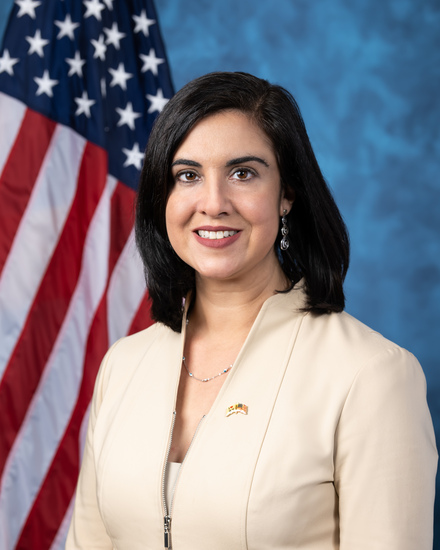
Rep. Nicole Malliotakis
Sponsored bills
This resolution reaffirms the importance to U.S. national interests of combating corruption, strengthening democratic institutions, and supporting judicial independence in El Salvador. Further, it urges El Salvador to respect its democratic institutions, including by strengthening government transparency, and to uphold human rights.
Ghost Army Congressional Gold Medal Act This bill directs the Speaker of the House of Representatives and the President pro tempore of the Senate to award a Congressional Gold Medal to the 23rd Headquarters Special Troops and the 3133d Signal Service Company, known as the Ghost Army , collectively, in recognition of its service during World War II.
Institutional Grants for New Infrastructure, Technology, and Education for HBCU Excellence Act or the IGNITE HBCU Excellence Act This bill establishes a grant program to support long-term improvements of historically Black colleges and universities (HBCUs) and graduate programs at HBCUs. Specifically, the bill requires the Department of Education (ED) to award grants to HBCUs to improve campus facilities. A recipient must use grant funds for certain activities, such as constructing or renovating facilities, carrying out major repairs, and strengthening the safety and security of a campus. Any new construction, modernization, or renovation projects must meet building code and energy and water conservation requirements. Further, HBCUs must seek to procure contracts from certain small businesses, including those owned and controlled by veterans and service-disabled veterans. The bill prohibits the use of grant funds for specified activities, including for the payment of routine and predictable maintenance costs, minor repairs, and utility bills. The Government Accountability Office must study the implementation of the grant program. The bill also requires ED to repay the outstanding balance of principal, interest, fees, and costs and any related reimbursements for certain capital financing loans.
Violence Against Women Extension Act of 2021 This bill reauthorizes for FY2022 various programs and activities authorized by the Violence Against Women Act of 1994 and subsequent legislation and administered by the Office on Violence Against Women within the Department of Justice.
National Lighthouse Museum Act This bill grants a federal charter to the National Lighthouse Museum.
Defending Our Defenders Act This bill establishes federal criminal offenses involving the murder of federal, state, or local law enforcement officers. Violators are subject to life in prison or death. The bill sets forth aggravating factors (e.g., intent to ambush or prior history of promoting violence against a law enforcement officer) to be considered in determining whether to impose the death penalty.
Iran Sanctions Relief Review Act of 2021 This bill restricts the President's authority to unilaterally undertake certain actions with respect to Iran and increases congressional oversight of those actions. Specifically, the President must report to Congress before terminating or waiving sanctions related to Iran or taking a licensing action that significantly alters U.S. foreign policy with respect to Iran. Each report must (1) describe the proposed action and its rationale, and (2) indicate whether or not the action is intended to significantly alter foreign policy concerning Iran. If the intention is to alter that policy, the report must provide additional information about the policy objectives and anticipated effects of the action. After the President submits a report, the bill provides Congress with a 30-day period to review it; this period is extended to 60 days for reports submitted between July 10 and September 7. During this period, Congress may enact a joint resolution approving or disapproving the action. During the review period, the President may not take the action unless Congress passes a joint resolution of approval; if Congress enacts a joint resolution of disapproval, the bill prohibits the President from taking the action. The bill also outlines procedures for the introduction and consideration of these types of joint resolutions.
STOP Straw Purchases Act This bill establishes new criminal offenses and penalties to deter straw purchases of firearms (i.e., firearm purchases from a licensed gun dealer by one person on behalf of another person). Current law prohibits and imposes penalties—a fine, a prison term of up to 10 years, or both—for making false statements in connection with the acquisition of a firearm from a federally licensed dealer. This bill increases the statutory maximum prison sentence—from 10 years to 25 years—for a violation by a person who is acting as a straw purchaser. Under this bill, a straw purchaser is a person who makes false statements involving deception about the identity of the actual buyer and knows or has reasonable cause to believe the actual buyer intends the firearm to be (1) used in a crime of violence or drug trafficking crime, or (2) transferred to a prohibited person. Additionally, the bill establishes new related criminal offenses. Specifically, it prohibits and imposes penalties for inducing another person, as a leader of a straw purchasing ring, to act as a straw purchaser in a continuing series of transactions from which the person obtains income or resources; or obtaining a firearm by inducing another person to act as a straw purchaser. Finally, the bill directs the Bureau of Alcohol, Tobacco, Firearms and Explosives to include in the Firearms Transaction Record form a statement outlining penalties for acting as a straw purchaser.
STOP II: Classrooms Over Conference Rooms Act This bill increases the authorization of appropriations for FY2022-FY2028 for the Secure Our Schools grant program. The program provides grants to states, local governments, and Indian tribes to improve security, including the placement and use of metal detectors and other deterrent measures, at schools and on school grounds. The bill requires any funds appropriated under the Consolidated Appropriations Act, 2021, which may be used for renting conference rooms in the District of Columbia with respect to the administration of federal education programs, to instead be used for the Secure Our Schools grant program.