

Maddy summaryHR 6815 creates a publicly available EPA tool to identify communities facing environmental burdens, such as poor air quality, climate risks, health issues, poverty, and racial disparities. The tool uses geospatial mapping to flag neighborhoods meeting specific thresholds across six categories of factors (e.g., asthma rates, proximity to pollution sources, unemployment). Federal agencies must adopt this tool within a year to prioritize funding and resources for affected communities. The EPA will update the tool annually based on public feedback and new data, with annual reports to Congress on changes in identified communities.
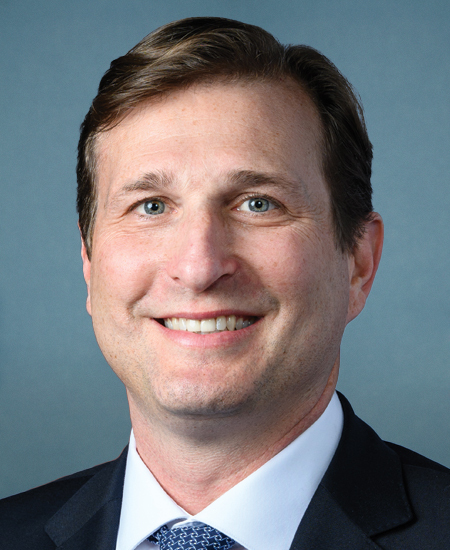
Rep. Daniel S. Goldman
Sponsored bills
Maddy summaryThis bill eliminates waiting periods for Social Security disability benefits and Medicare coverage for individuals diagnosed with young-onset Alzheimer's disease. It amends the Social Security Act to add "young-onset Alzheimer's" (as defined by the Social Security Commissioner) to the list of conditions qualifying for immediate disability benefits, removing a 5-month waiting period for applications filed after its enactment date. It also waives the standard 24-month waiting period for Medicare coverage when young-onset Alzheimer's is diagnosed, effective for benefits starting after the bill's enactment. These changes directly affect people with young-onset Alzheimer's seeking timely access to critical financial and health coverage.
Maddy summaryHR 6789, the Federal Prisons Naloxone Access Act of 2025, requires federal prisons to maintain naloxone kits in all correctional facilities, including medical units, staff areas, and common spaces where incarcerated people gather. The bill mandates annual training for staff and incarcerated individuals on opioid overdose recognition and kit use, ensures proper storage and expiration checks, and requires detailed documentation of each kit administration. It also prohibits holding incarcerated people liable for good-faith naloxone use during an overdose and requires annual reports to Congress on kit availability, overdose incidents, training, and expired kits. The law authorizes $6 million for 2026 and $2 million annually through 2028 for implementation, including kit purchases and training.
Maddy summaryHR 6818, the Part-Time Worker Bill of Rights Act, would expand rights for part-time workers by reducing eligibility requirements for family and medical leave from 12 months to 90 days of employment under the FMLA. The bill prohibits employers from discriminating against part-time workers based on hours worked, requiring equal treatment for benefits, promotions, and scheduling. It mandates that employers obtain written statements from employees about their desired work hours and prioritize offering available work hours to existing employees before hiring new external workers. The bill establishes enforcement mechanisms including civil penalties for violations and allows employees to file private lawsuits for damages, with the Secretary of Labor having investigative authority to ensure compliance. This legislation directly affects part-time workers and employers with more than 15 employees across both private and public sectors.
Maddy summaryThe Schedules That Work Act would require employers in retail, food service, hospitality, cleaning, and warehouse sectors to provide workers with 14 days' advance notice of their schedules and pay predictability wages for last-minute changes. It allows employees to request schedule changes related to caregiving responsibilities, health conditions, education, or other jobs, with employers required to engage in good-faith discussions about such requests. The bill prohibits retaliation against employees who request schedule changes and mandates written notice of schedule changes and predictability pay. It applies to employers with 15 or more employees in covered sectors, aiming to address widespread issues with unpredictable schedules that negatively impact workers' ability to care for family members, maintain housing stability, and access health care.
Maddy summaryThis bill amends a section of federal law to change the reference from "the White House" to "the People's White House" in a specific legal citation (Section 307104 of Title 54, U.S. Code). It is a purely procedural change to the text of the law, not a substantive policy shift. The bill does not alter historic preservation standards, protections, or funding for the White House grounds. It simply updates the formal name used within the legal code.
Maddy summaryHR 6767, the Health Equity and MENA Community Inclusion Act of 2025, amends federal health law to include Middle Eastern and North African (MENA) populations - such as Lebanese, Iranian, Egyptian, and Palestinian communities - within the definition of "racial and ethnic minority groups." This change directly affects approximately 3.5 million MENA individuals in the U.S., who have historically been excluded from federal health programs like the Office of Minority Health (OMH) due to data classification. The bill mandates the Department of Health and Human Services (HHS) to conduct a comprehensive health study, breaking down data by specific MENA subgroups to analyze disparities in areas like chronic disease, mental health, maternal outcomes, and access to care. HHS must also establish privacy safeguards for study participants and publish findings via a public online portal, enabling targeted health initiatives for MENA communities.
Maddy summaryThe UPLIFT Act creates a new federal tax credit for households with high residential energy costs. It allows individuals to claim up to $1,200 (or $2,400 for joint returns) annually for electricity, natural gas, or propane used in their primary U.S. home, but only when average energy prices exceed 102% of the prior year's level. The credit phases out for taxpayers earning over $75,000 (single) or $150,000 (joint), and refunds won't count as income for means-tested programs like SNAP. This directly affects renters and homeowners with qualifying energy expenses in their primary residence.
Maddy summaryHR 6769 establishes a federal grant program to fund the complete destruction of firearms by state, tribal, and local governments. Eligible entities must submit applications detailing how they will fully destroy all firearm parts (including frames, barrels, and accessories) and maintain records, with grants covering equipment, contracted services, and staff training. The program allocates $15 million annually from 2026-2031, requiring grantees to use no more than 10% of funds for administration and reserving one-third of funding for small urban or rural areas. All grant recipients must provide documented proof of destruction through written policies and verified records. This is a direct funding mechanism for firearm disposal, not a crime-reduction measure.
Maddy summaryHR 6731, the "Restore Trust in Government Act," requires Members of Congress, the President/Vice President, and their spouses or dependent children to divest certain financial investments during federal service. It defines "covered investments" broadly (including stocks, commodities, and derivatives) but excludes Treasury bonds, municipal bonds, family farm interests, and some Alaska Native Settlement stock. Covered individuals must sell holdings within 90-180 days of taking office or enacting the law, with limited exceptions for qualified blind trusts or spouses’ occupational trading. Violations incur a 10% fee on the investment value and require returning profits, paid to the Treasury. Ethics offices enforce these rules, publish penalty details, and issue divestiture certificates.