

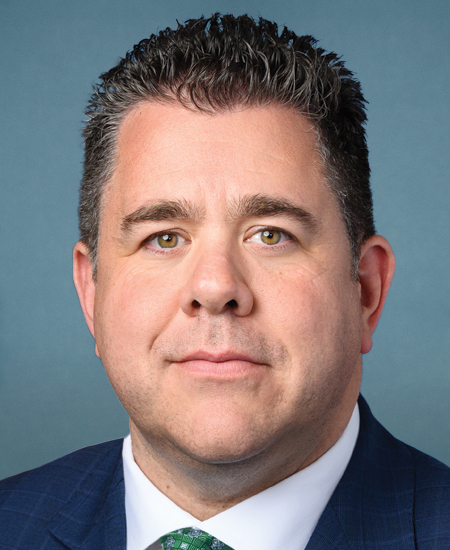
Photo of Nick LaLota
R United States House · District 1 · New York On the 2026 ballot

Rep. Nick LaLota

Compare
Total votes
1,879
all sessions
Attendance
98%
31 missed
Near the chamber average
With party
88%
of cast votes
Lower than 80% of chamber peers
Bipartisan score
6%
crosses aisle rarely
Higher than 79% of chamber peers
Sponsored
741
bills & resolutions
Near the chamber average
Committees
7
assignments
741 bills and resolutions

Sponsored bills

Total
741
Primary
57
Co-sponsor
684
This page
741
matching current filters
Co-sponsor HR 1121
In committee · Indiana House · Co-sponsor
No DeepSeek on Government Devices Act

Maddy summaryHR 1121, the "No DeepSeek on Government Devices Act," prohibits U.S. federal executive agencies from using the DeepSeek application (or any successor by High Flyer) on government information technology devices. It requires the Office of Management and Budget to develop removal standards within 60 days, directing agencies to remove the application while complying with existing security rules. Exceptions are permitted for national security, law enforcement, and security research activities, but agencies must document risk mitigation plans for any authorized use under these exceptions. The bill directly affects all executive agencies covered under federal information technology policies.

In committee Feb 7, 2025 1 co-sponsor
Co-sponsor HR 1065
In committee · Indiana House · Co-sponsor
Protect Our Letter Carriers Act of 2025

Protect Our Letter Carriers Act of 2025 This bill requires or authorizes certain actions related to the U.S. Postal Service (USPS). The bill requires the Department of Justice to appoint an assistant U.S. attorney in each judicial district to coordinate and supervise the investigation and prosecution of various crimes related to postal services (for example, assault on a postal service employee, breaking into a post office, or obstruction of mails). The bill also requires the U.S. Sentencing Commission to amend sentencing guidelines to provide that the assault or robbery of a postal employee shall be treated the same as the assault of a law enforcement officer. Additionally, the bill authorizes appropriations for the USPS to install high security collection boxes and replace older versions of the universal mailbox key with electronic versions.

In committee Feb 6, 2025 1 co-sponsor
Co-sponsor HR 1046
In committee · Indiana House · Co-sponsor
Marc Fischer Memorial Act

Maddy summaryHR 1046, the Marc Fischer Memorial Act, requires the Bureau of Prisons to implement digital mail scanning technology at all federal prisons to detect fentanyl and other synthetic drugs in inmate mail. It mandates a strategy within 90 days of an evaluation, including 100% scanning of all mail, digital copies of mail to inmates within 24 hours, and physical mail delivery within 30 days for non-contaminated items. The bill directly affects federal prison staff, inmates, and the Bureau of Prisons by aiming to reduce drug-related overdoses and alleviate staff workload tied to mail processing. Implementation must be completed within three years, with annual reports tracking detected drugs and strategy efficiency. The legislation focuses on concrete technological and procedural changes to enhance safety, referencing a successful pilot program at two facilities.

In committee Feb 6, 2025 1 co-sponsor
Co-sponsor HR 1102
In committee · Indiana House · Co-sponsor
Commission To Study the Potential of a National Museum of Italian American History and Culture Act

Maddy summaryHR 1102 establishes a commission to study the feasibility of creating a National Museum of Italian American History and Culture in Washington, D.C. The commission, composed of 8 members appointed by congressional leaders, will examine factors like location options, costs, fundraising potential, and impacts on existing museums, and must report back within 18 months. It will not create the museum itself but will develop recommendations for Congress on whether to proceed, with all funding coming from private sources - no federal funds may be used for the commission’s work. The bill focuses solely on the study process, not on building or operating the museum.

In committee Feb 6, 2025 1 co-sponsor
Co-sponsor HR 1007
In committee · Indiana House · Co-sponsor
Antisemitism Awareness Act of 2025

Maddy summaryHR 1007, the Antisemitism Awareness Act of 2025, clarifies how the Department of Education enforces Title VI of the Civil Rights Act of 1964 to address discrimination against Jewish individuals. It requires the Department to consider the International Holocaust Remembrance Alliance (IHRA) definition of antisemitism when investigating complaints involving discrimination based on actual or perceived Jewish ancestry or ethnic characteristics. This affects Jewish students and communities in K-12 schools and colleges receiving federal funding, as it ensures antisemitism is assessed under existing civil rights protections. The bill does not create new laws but specifies that the IHRA definition - already used by the Department since 2018 - must be applied in Title VI enforcement cases.

In committee Feb 5, 2025 1 co-sponsor
Primary HR 835
Passed · Indiana House · Lead sponsor
9/11 Memorial and Museum Act

Maddy summaryHR 835, the 9/11 Memorial and Museum Act, provides a one-time federal grant of $5-10 million to the National September 11 Memorial & Museum (operated by an IRS 501(c)(3) organization) for its operations, security, and maintenance. The bill requires the museum to offer free admission to veterans, first responders, and victims' families, plus weekly free public hours, and mandates annual financial audits and public reporting to Congress. Grant funds must be used to preserve the site, educate visitors, and increase access for economically disadvantaged groups. The funding is subject to annual appropriations and does not authorize ongoing federal support beyond the one-time grant.

Passed Feb 5, 2025 0 co-sponsors
Co-sponsor HR 928
In committee · Indiana House · Co-sponsor
Railway Safety Act of 2025

Railway Safety Act of 2025 This bill addresses safety requirements for rail carriers and trains transporting hazardous materials. Specifically, the Department of Transportation (DOT) must issue safety regulations for trains carrying hazardous materials to require that rail carriers or shippers (1) provide state emergency response commissioners with advance notice and information about the hazardous materials; (2) reduce blocked rail crossings; and (3) comply with certain requirements regarding train length and weight specifications, track standards, speed restrictions, and response plans. DOT must also establish requirements for wayside defect detectors. These are used by railway systems alongside the tracks to detect defects and failures (e.g., wheel bearing failures). Current federal regulations do not require their use, but federal guidance does address their placement and use. Under the bill, DOT must issue regulations establishing requirements for the installation, repair, testing, maintenance, and operation of wayside defect detectors for each rail carrier operating a train carrying hazardous materials. The bill also increases the maximum fines DOT may impose on rail carriers for violating safety regulations; requires DOT to update rail car inspection regulations and audit the federal inspection programs; establishes a statutory requirement for freight trains to have at least two crew members, with exceptions; phases out certain railroad tank cars by May 1, 2027; expands training for local first responders; imposes a new fee on certain rail carriers; and authorizes grants to improve railway safety.

In committee Feb 4, 2025 1 co-sponsor
Co-sponsor HR 929
In committee · Indiana House · Co-sponsor
Dr. Lorna Breen Health Care Provider Protection Reauthorization Act

Maddy summaryThis bill reauthorizes the Dr. Lorna Breen Health Care Provider Protection Act, extending mental health support programs for healthcare professionals through 2030 (previously ending in 2024). It requires funded programs to specifically address reducing administrative burdens on healthcare workers while continuing to promote access to mental health and substance use disorder services. The legislation directly affects healthcare providers across the U.S. who may access these federally supported resources. Key provisions include extending funding periods and mandating that grant recipients focus on easing workplace administrative tasks, alongside maintaining existing awareness initiatives. The bill does not create new programs but continues and refines existing mental health support for the healthcare workforce.

In committee Feb 4, 2025 1 co-sponsor
Primary HR 865
In committee · Indiana House · Lead sponsor
Service-Disabled Veteran Opportunities in Small Business Act

Maddy summaryThis bill requires federal agencies that haven't met a specific goal for awarding contracts to service-disabled veteran-owned small businesses to provide employee training on increasing such contracts. The Small Business Administration, working with the Office of Veterans Business Development, must issue guidance on best practices within 180 days and submit annual reports to Congress listing agencies that missed the target and detailing their training. It directly affects federal agencies with underperforming contracting records and aims to improve opportunities for service-disabled veteran-owned small businesses. The policy focuses on accountability through training, guidance, and reporting rather than altering existing contracting rules.

In committee Jan 31, 2025 0 co-sponsors
Co-sponsor HR 833
In committee · Indiana House · Co-sponsor
Educational Choice for Children Act of 2025

Maddy summaryHR 833 creates a federal tax credit for individuals and corporations that contribute to scholarship granting organizations (SGOs) providing scholarships for elementary and secondary education. The credit allows taxpayers to deduct up to 10% of their adjusted gross income or $5,000 (whichever is less) for contributions to SGOs serving students from households with income up to 300% of the area median income. The bill establishes a $10 billion annual cap on the tax credit program, requires SGOs to verify student eligibility and maintain separate accounts, and prohibits government control over SGOs or private schools. It ensures scholarships can be used at public, private, or religious schools without discrimination based on religious character. The tax credit would be available for contributions made after December 31, 2025, with annual volume cap increases based on usage.

In committee Jan 31, 2025 1 co-sponsor
Showing 321 to 330 of 741 bills
Previous 1 … 32 33 34 … 75 Next