USPS Fairness Act This bill repeals the requirement that the U.S. Postal Service annually prepay future retirement health benefits.
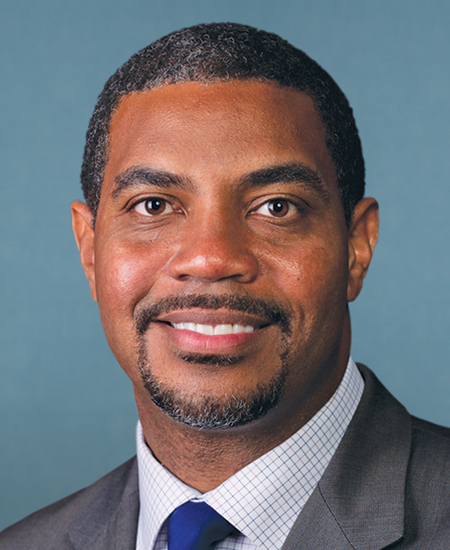
Rep. Steven Horsford
Sponsored bills
Emergency Water is a Human Right Act This bill creates a grant program, administered by the Department of Health and Human Services, to provide funds to states and Indian tribes to assist low-income households that pay a high proportion of household income for drinking water and wastewater services. Further, any entity receiving financial assistance under this grant program must ensure that no home energy service or public water system service is or remains disconnected or interrupted during the COVID-19 (i.e., coronavirus disease 2019) public health emergency.

This concurrent resolution recognizes the difficult challenges Black veterans faced when returning home after serving in the Armed Forces, their heroic military sacrifices, and their patriotism in fighting for equal rights and for the dignity of a people and a nation. The concurrent resolution also recognizes the need for the Department of Veterans Affairs to continue to work to eliminate any health and benefit disparities for minority veterans.
This concurrent resolution calls for the Citizens' Stamp Advisory Committee to recommend that the Postmaster General issue a commemorative postage stamp honoring the Buffalo Soldiers.
This resolution recognizes Black History Month as an important time to reflect on the significant contributions of African Americans in the history of the United States, including in the Armed Forces.
This resolution censures Representative Marjorie Taylor Greene and calls on her to resign from office.
This resolution mourns the death of U.S. Capitol Police Officer Brian D. Sicknick, and it honors his lifelong commitment to service and his selfless acts of heroism on January 6, 2021.
Relaunching America's Workforce Act This bill establishes several grant programs to address employment, the workforce, and education access in response to the COVID-19 national emergency. The Department of Labor must provide grants in response to the COVID-19 national emergency to provide training and employment for dislocated, unemployed, and underemployed workers; support youth employment; establish workforce information systems improvements; provide reentry employment opportunities for justice-involved youth and young adults; and create or expand apprenticeship programs. Programs directed towards assisting Native Americans and migrant and seasonal farmworkers may be extended. The Department of Education must provide grants to expand the capacity of adult education providers to prioritize serving adults with low-literacy or numeracy levels negatively impacted by the COVID-19 national emergency, and to improve or expand career and technical education programs and programs of study to respond to state and local needs as a result of the COVID-19 national emergency.
Woman on the Twenty Act of 2021 This bill bars the printing of any $20 note after December 31, 2024, which does not prominently feature a portrait of Harriet Tubman on the front face of the note. The Department of the Treasury shall release to the public the preliminary design of the $20 note prominently featuring a portrait of Harriet Tubman no later than December 31, 2022.
Keeping the Lights On Act of 2021 This bill allows an eligible employer a payroll tax credit equal to 50% of a limited amount of qualified fixed expenses paid by such employer in a calendar quarter. Qualified fixed expenses include a mortgage, rent, or a utility payment. An employer is eligible for such payroll credit if the employer was carrying on a trade or business that had not more than 1,500 full-time employees or not more than $41.5 million in gross receipts in 2019. The employer's business must have been suspended in a calendar quarter due to COVID-19 (i.e., coronavirus disease 2019) and have experienced a significant decline in gross receipts due to that pandemic. The credit may not be claimed by the federal government or by any state or tribal government, or by U.S. possessions, but may be claimed by tax-exempt organizations.