

Improving Medicare Coverage Act This bill temporarily expands eligibility for Medicare. It also temporarily establishes a premium and cost-sharing assistance program for low-income beneficiaries. Specifically, the bill lowers the age of eligibility for Medicare from 65 to 60. The Centers for Medicare & Medicaid Services must establish procedures to provide for automatic enrollment of qualifying individuals. Enrollment must be completed within 11 months of the bill's enactment. The bill also establishes a program under Medicare to assist low-income Medicare beneficiaries with premiums, coinsurance, deductibles, and other costs. Currently, such assistance is provided through Medicare Savings Programs, which are administered by state Medicaid programs. The bill also establishes a related special enrollment period under Medicare, expands eligibility for assistance to beneficiaries with income up to 200% of the federal poverty line, and provides for joint eligibility determinations with respect to the bill's program and the low-income subsidy program under the Medicare prescription drug benefit. The bill's provisions generally take effect six months after the bill's enactment and terminate five years later.
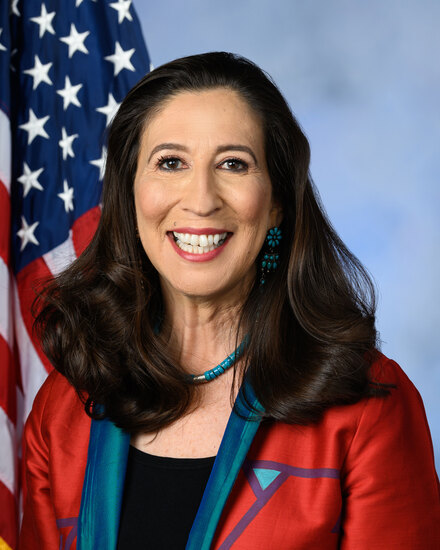
Rep. Teresa Leger Fernandez
Sponsored bills
Incentivizing Solar Deployment Act of 2021 This bill extends the tax credit for the production of electricity from solar energy.
Creative Economy Revitalization Act This bill requires the Department of Labor to award grants to government and nonprofit agencies to provide programs that employ individuals and provide public access to art or arts programming.
This concurrent resolution recognizes the disparity in wages paid to Black women and its impact on women, families, and the nation, and reaffirms Congress' support for ensuring equal pay and closing the gender wage gap.
Promoting Access to Diabetic Shoes Act This bill allows a nurse practitioner or physician assistant to fulfill documentation requirements for coverage, under Medicare, of special shoes for diabetic individuals. Under current law, such requirements may be satisfied only by a physician.
Partnerships for Energy Security and Innovation Act of 2021 This bill requires the Department of Energy (DOE) to establish the Foundation for Energy Security and Innovation. It also authorizes the establishment of the National Energy Technology Laboratory. The Foundation for Energy Security and Innovation, a nonprofit corporation, must support DOE's mission and increase private and philanthropic sector investments that support efforts concerning the development, deployment, and commercialization of innovative technologies that address crosscutting national energy challenges. The foundation may award fellowships and grants for activities relating to research, development, demonstration, maturation, or commercialization of energy and other technologies supported by DOE. In addition, the National Energy Technology Laboratory may establish a nongovernmental Federal Laboratory-Associated Foundation to advance U.S. energy security as specified by the bill.
Domestic Workers Bill of Rights Act This bill provides rights and protections for domestic workers (e.g., housekeepers, nannies, caretakers, personal assistants, and chauffeurs), including pay and leave rights, and health and safety protections. Specifically, the bill repeals the exemption of domestic live-in employees from certain minimum wage and maximum hour requirements. Employers must provide written notice of termination and provide at least 30 days of lodging and two weeks of severance pay to terminated live-in employees. Live-in employees also must be provided with reasonable access to telephone and internet service during their employment. The bill requires employers to provide domestic workers with a written agreement covering wages, sick leave, benefits, and other matters. Further, domestic workers may request and be granted changes to work schedules due to personal events. The bill also provides domestic workers with certain privacy rights, extends to domestic workers protections against discrimination in employment, and increases the federal medical assistance percentage (FMAP) for certain Medicaid-funded medical services provided by domestic workers. The Department of Labor must (1) award grants for a domestic worker national hotline for reporting emergencies, training on hazards facing domestic workers, and workforce investment activities for domestic workers; and (2) establish a Domestic Worker Wage and Standards Board to investigate standards in the domestic workers industry. Labor must publish online a document that describes the rights and protections for domestic workers under this bill.
Protecting Renters from Evictions Act of 2021 This bill extends through December 31, 2021, the order issued by the Centers for Disease Control and Prevention titled Temporary Halt in Residential Evictions To Prevent the Further Spread of COVID–19 and published on September 4, 2020.
Alexander Lofgren Veterans in Parks (VIP) Act This bill makes the America the Beautiful-National Parks and Federal Recreational Lands Pass available, without charge, to members of the Armed Forces, veterans, and Gold Star Families. The pass covers the entrance fee and standard amenity recreation fee for all federal recreational lands and waters.
This resolution (1) commits to advancing policies that will end roadway fatalities by 2050, and (2) calls on Congress and the Department of Transportation to commit to working together to achieve zero roadway fatalities by the year 2050.