

Ending Homelessness Act of 2021 This bill expands the housing choice voucher program and provides assistance to homeless individuals and families. Specifically, the bill provides FY2022-2025 funding for the expansion of the housing choice voucher program for certain extremely low income families. Furthermore, beginning in FY2026, the bill creates and funds an entitlement to housing choice vouchers for certain extremely low income families. Eligibility for the entitlement expands annually, extending to low-income families by FY2030. The bill also reduces the geographic area used to calculate an area's fair market rent for purposes of voucher payment standards and prohibits the use of criminal history in determining eligibility for certain housing assistance. Additionally, the bill prohibits housing discrimination on the basis of a renter's source of income or a renter's veteran status. The bill also provides additional FY2022-FY2026 funding for the Department of Housing and Urban Development (HUD) to assist the homeless, including to award emergency relief grants in jurisdictions with the highest need and award grants to provide outreach and coordinate services. Furthermore, the bill provides additional FY2022-FY2026 funding for the Housing Trust Fund, which provides affordable housing for extremely low-income and very low-income families. While this additional funding is available, HUD must ensure that priority for occupancy in assisted units is given to individuals and families who are homeless. Finally, the bill permanently reauthorizes certain homeless assistance grants and makes permanent the U.S. Interagency Council on Homelessness.
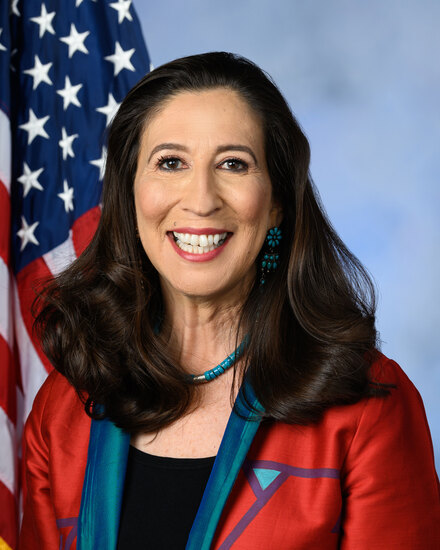
Rep. Teresa Leger Fernandez
Sponsored bills
Housing is Infrastructure Act of 2021 This bill generally addresses housing affordability and infrastructure. The bill authorizes the Department of Housing and Urban Development (HUD) to provide grants, programs, and other support related to public housing, affordable housing preservation and construction, and mortgage access. The bill also establishes and funds the National Investment Authority (NIA) which must design, finance, and implement a strategy of long-term national economic growth and development. The NIA must select projects that coordinate investment of public and private capital in equitable, inclusive, and sustainable growth of the economy. Furthermore, the bill establishes the National Infrastructure Bank (NIB) to implement the strategy by engaging in credit market activities that support public and private investment in critical public infrastructure projects. The bill gives the NIA bond issuing authority and authorizes the Board of Governors of the Federal Reserve System to purchase these bonds. The Federal Reserve must lend funds on a short-term basis upon the request of the NIB and other subsidiaries. Additionally, the Department of the Treasury must provide for a line of credit not to exceed 100% of the NIA's total assets. Finally, the bill (1) authorizes HUD to provide support for fair housing organizations, and (2) requires consultation with a fair housing enforcement organization as part of an application for certain housing grants or funds.
CARA 3.0 Act of 2021 This bill addresses substance use disorders by expanding access to treatment and recovery services, providing for housing protections, and requiring other activities. Specifically, the bill reauthorizes, establishes, and expands support for treatment and recovery services. This includes increasing access to treatment in the criminal justice system and other settings and for particular populations, such as pregnant and postpartum individuals and youth and young adults. Additionally, the bill expands Medicare and Medicaid coverage for treatment, including by expanding telehealth access to medication to treat substance use disorders. The bill also temporarily requires that non-opioid pain treatment options be reimbursed separately, instead of on a packaged basis, under Medicare. As a condition of receiving certain federal funding, states must mandate the use of prescription drug monitoring programs (PDMPs) by prescribers and dispensers and impose additional PDMP requirements. Moreover, prescribers of potentially addictive drugs must complete continuing education requirements. The bill also revises the registration process for providers who prescribe certain medications to treat substance use disorders, including by eliminating the provider's patient limit for such medications. In addition, the Substance Abuse and Mental Health Services Administration must carry out activities to promote access to high-quality recovery housing. The bill also sets out protections for individuals with substance use disorders who live in, or apply to live in, federally assisted housing. Furthermore, the bill requires other activities to address substance use, such as support for workforce education and training; public awareness campaigns and similar outreach; and research on prevention strategies, insurance coverage, and treatment modalities.
Preventing Election Subversion Act of 2021 This bill establishes certain federal criminal offenses related to voting and sets forth additional requirements for federal elections. The bill makes it a crime to (1) intimidate, threaten, coerce, or harass an election worker (i.e., an election official, a poll worker, or an election volunteer) with the intent to interfere with the official duties of, or retaliate against, the worker; or (2) publicly disclose restricted personal information about an election worker or an immediate family member with the intent to threaten or cause harm to the worker or the family member. In addition, the bill restricts the ability of a statewide election administrator to remove a local election administrator. A statewide election administrator may suspend, remove, or relieve the duties of a local election administrator only for inefficiency, neglect of duty, or malfeasance while in office. Further, the bill establishes certain requirements for challenging an individual's eligibility to register to vote or vote in federal elections. The bill also sets a minimum distance for poll observers.
Fair Representation Act This bill sets forth provisions related to ranked choice voting (a system in which voters rank candidates in order of preference) and congressional redistricting. Specifically, the bill requires (1) that ranked choice voting be used for all elections for Senators and Members of the House of Representatives, (2) that states entitled to six or more Representatives establish districts such that three to five Representatives are elected from each district, and (3) that states entitled to fewer than six Representatives elect all Representatives on an at-large basis. The bill also requires that congressional redistricting be conducted in accordance with a plan developed by (1) a state-established independent commission; or (2) if such a commission fails to enact a plan, a three-judge panel from a U.S. District Court. Further, the bill directs the Election Assistance Commission to make payments to states to implement ranked choice voting and carry out congressional redistricting.
Greater Leadership Overseas for the Benefit of Equality Act of 2021 or the GLOBE Act of 2021 This bill contains provisions related to (1) the protection of LGBTQI individuals globally; and (2) immigration protections for vulnerable individuals. The bill establishes (1) an interagency group to respond to urgent threats to LGBTQI people in foreign countries, and (2) a permanent Special Envoy for the Human Rights of LGBTQI Peoples in the Department of State. The President shall impose visa-blocking sanctions on foreign persons responsible for violating the human rights of individuals based on sexual orientation, gender identity, or sex characteristics. The State Department shall establish the Global Equality Fund to provide assistance to nongovernmental organizations working to advance and protect human rights. The U.S. Agency for International Development shall establish the LGBTQI Global Development Partnership to work with the private sector and nongovernmental organizations to support LGBTQI rights. The bill removes prohibitions against providing foreign assistance to nongovernmental organizations that offer certain medical services (e.g., abortion-related services) using non-U.S. government funds. The bill contains several immigration-related provisions, such as those establishing that persecution based on sexual orientation or gender identity may form the basis of an asylum request, allowing certain applicants to file asylum claims more than a year after their arrival in the United States, including a permanent partnership between two partners as a marriage for immigration law purposes, providing for free counsel in certain immigration proceedings, and granting U.S. citizenship to a child born abroad through assistive reproductive technology from a U.S. citizen who is the child's nonbiological parent.
Requirements, Expectations, and Standard Procedures for Effective Consultation with Tribes Act or the RESPECT Act This bill establishes tribal consultation procedures for federal agencies. Specifically, the bill requires federal agencies to consult with tribal governments (1) before undertaking any proposed federal activity or finalizing any federal regulatory action that may have a tribal impact, and (2) for all activities that would affect any part of federal land sharing a border with Indian land. Tribal impact refers to any federal action that may have an impact on tribal governments, including tribal cultural practices and tribal treaty-protected rights. Agencies must prepare tribal impact statements to identify potential tribal impacts of a proposed activity or action. Agencies must also make a good faith effort to identify areas that contain sacred sites important to tribal governments. The bill further outlines consultation requirements, including outreach and meeting arrangements. In general, the consultation shall conclude only upon the execution of a memorandum of agreement between the agency and the tribal government or the members of a designated tribal leader task force. Next, the bill requires agencies to take certain actions during the decision stage for a proposed activity (e.g., public comment) and for a regulatory action. Agencies must recognize and respect tribal self-government and sovereignty and grant tribal governments maximum discretion in the administration of federal statutes and regulations. Tribal governments may seek judicial review of a determination of an agency under this bill if the tribal government has exhausted all other administrative remedies.
Extreme Risk Protection Order Act of 2021 This bill establishes grants to support the implementation of extreme risk protection order laws at the state and local levels, extends federal firearms restrictions to individuals who are subject to extreme risk protection orders, and expands related data collection. Extreme risk protection order laws, or red flag laws, generally allow certain individuals (e.g., law enforcement officers or family members) to petition a court for a temporary order that prohibits an at-risk individual from purchasing and possessing firearms. Among its provisions, the bill directs the Office of Community Oriented Policing Services within the Department of Justice to establish a grant program to help states, local governments, Indian tribes, and other entities implement extreme risk protection order laws; extends federal restrictions on the receipt, possession, shipment, and transportation of firearms and ammunition to individuals who are subject to extreme risk protection orders; and requires the Federal Bureau of Investigation to compile (and later destroy) records from federal, tribal, and state courts and other agencies that identify individuals who are subject to extreme risk protection orders.
Original National Domestic Violence Awareness Month Resolution of 2022 This resolution supports the goals and ideals of National Domestic Violence Awareness Month. Further, it expresses the sense of the House of Representatives that Congress should continue to raise awareness of and support programs to end domestic violence.
Major Richard Star Act This bill provides that combat-disabled uniformed services retirees with fewer than 20 years of creditable service may concurrently receive, without reduction, veterans' disability compensation and retired pay or combat-related special compensation.