

Puerto Rico Status Act This bill provides for a plebiscite to be held on November 5, 2023, to resolve Puerto Rico's political status. Specifically, such plebiscite shall offer eligible voters a choice of independence, sovereignty in free association with the United States, or statehood. The Puerto Rico State Elections Commission shall carry out a nonpartisan voter education campaign through traditional paid media and make available at all voting locations voter education materials related to the plebiscites, and invite national and international election observers to ensure transparency and confidence in the electoral process. All voter educational materials and ballots used to carry out this bill shall be made available in English and Spanish. The bill sets forth transition and implementation provisions for each choice offered in the plebiscite.
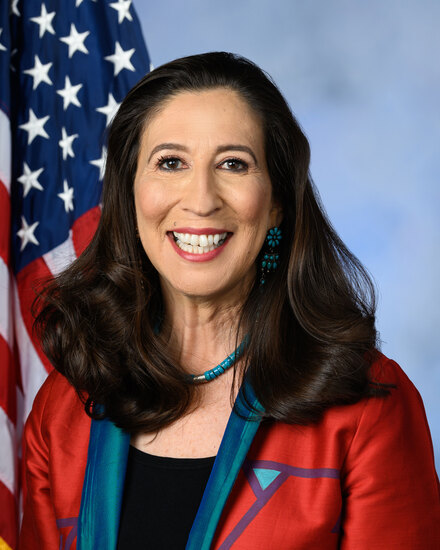
Rep. Teresa Leger Fernandez
Sponsored bills
Orphaned Well Cleanup and Jobs Act of 2021 This bill establishes incentives and requirements to permanently plug orphaned (i.e., abandoned) oil and gas wells and clean up pollution leaking from such wells. Specifically, the bill directs the Department of the Interior to establish grant programs to plug and clean up orphaned wells located on federal, state, tribal, and private land. Interior must also issue regulations that require each operator of an idled well on federal land to pay an annual, nonrefundable fee for each well. If the operator fails to pay the fee, then Interior may assess a civil penalty. Revenues generated from such fees must be used for activities related to cleaning up orphaned wells. Additionally, the bill requires the review of the adequacy of bonds or other financial arrangements for oil and gas development on public land leased from the federal government. Such bonds or financial arrangements are currently required to ensure developers have adequate financial resources to remediate and reclaim public land, water, or other resources after wells are abandoned or oil and gas development ceases.
VA Employee Fairness Act of 2021 This bill repeals provisions excluding any matter or question concerning professional conduct or competence; peer review; or the establishment, determination, or adjustment of employee compensation from the applicability of collective bargaining rights for Veterans Health Administration employees.
Maddy summaryHRES 1522 is a symbolic resolution condemning the November 19, 2022, mass shooting at Club Q, an LGBTQ+ nightclub in Colorado Springs that killed five people and injured 22. It honors the victims, offers condolences to their families, and expresses support for those impacted by the attack. The resolution also highlights the broader context of anti-LGBTQ+ violence and hate, including the Pulse nightclub tragedy, and calls for an end to anti-LGBTQ+ hate and violence. As a ceremonial resolution, it contains no new laws or funding but serves as a formal statement of solidarity with the LGBTQ+ community.
Ski Hill Resources for Economic Development Act or the SHRED Act This bill establishes the Ski Area Fee Retention Account. A specified portion of rental charges for ski area permits on a Forest Service unit shall be deposited in such account. Amounts in the fund shall be available to the unit for expenditure without further appropriation for ski area administration, improvements, visitor services, and wildfire preparedness. Funds may be reallocated only if the amounts collected exceed the reasonable needs of the unit.
Transparency in Energy Production Act of 2021 This bill requires certain disclosures by entities seeking a lease or holding a lease to develop renewable energy operations or fossil fuel operations on public lands or Indian lands or any operation using any right-of-way or special use permit that would cross public lands, Indian lands, or national forests that would facilitate fossil fuel development. The disclosures are those described in the Sustainability Accounting Standard for the Renewable Resources and Alternative Energy Sector or the Extractives and Mineral Processing Sector. Every two years, the Department of the Interior and the Department of Agriculture must report to Congress on such operations, including greenhouse gas emissions, air quality, water management, biodiversity impacts, production, and the number of sites. For renewable energy operations on public lands or Indian lands, the report must include greenhouse gas emissions that would result from the production of the same amount of energy using fossil fuels.
Bonding Reform and Taxpayer Protection Act of 2021 This bill revises bonding requirements for oil and gas development on public land leased from the federal government. Such bonds are required to ensure oil and gas developers have adequate financial resources for implementing reclamation plans to restore public land after oil and gas development (e.g., drilling operations) ceases. Specifically, the bill increases the bond amounts that oil and gas developers must provide prior to conducting surface-disturbing activities and requires such amounts to adjust at least once every three years for inflation. In addition, the bill sets fees to cover the cost for inspection and enforcement with respect to such leases. The bill also requires the Bureau of Land Management (BLM) and the U.S. Forest Service (USFS) to establish uniform standards for all interim and final reclamation plans. BLM and USFS may not release any bond amounts until the standards have been met by oil and gas developers and the inspection fees have been paid. Finally, the bill gives the U.S. Fish and Wildlife Service the authority to obtain and retain adequate financial assurances (e.g., bonds) from nonfederal entities to repair potential damages to resources of the National Wildlife Refuge System prior to the commencement of activities related to mineral development, such as oil and gas operations.
Respect for Marriage Act This act provides statutory authority for same-sex and interracial marriages. Specifically, the act replaces provisions that define, for purposes of federal law, marriage as between a man and a woman and spouse as a person of the opposite sex with provisions that recognize any marriage between two individuals that is valid under state law. (The Supreme Court held that the current provisions were unconstitutional in United States v. Windsor in 2013.) The act also replaces provisions that do not require states to recognize same-sex marriages from other states with provisions that prohibit the denial of full faith and credit or any right or claim relating to out-of-state marriages on the basis of sex, race, ethnicity, or national origin. (The Supreme Court held that state laws barring same-sex marriages were unconstitutional in Obergefell v. Hodges in 2015; the Court held that state laws barring interracial marriages were unconstitutional in Loving v. Virginia in 1967.) The act allows the Department of Justice to bring a civil action and establishes a private right of action for violations. The act does not (1) affect religious liberties or conscience protections that are available under the Constitution or federal law, (2) require religious organizations to provide goods or services to formally recognize or celebrate a marriage, (3) affect any benefits or rights that do not arise from a marriage, or (4) recognize under federal law any marriage between more than two individuals.
National Laboratory Biotechnology Research Act of 2022 This bill directs the Department of Energy (DOE) to establish a National Laboratory Biotechnology Program to integrate the resources of DOE, including the Office of Science, the Office of Intelligence and Counterintelligence, and the National Nuclear Security Administration, to provide research and development and response capabilities to respond to long-term biotechnology threats facing the United States, and any remaining threats posed by COVID-19. The Office of Science shall support research that harnesses the capabilities of the national laboratories to address advanced biological threats of national security significance. The Office of Science shall promote cooperative research and development activities under the program, including collaboration between appropriate industry and academic institutions to promote innovation and the creation of knowledge. No less frequently than biennially, DOE shall develop a strategic research plan under the program.
This concurrent resolution recognizes the disparity between wages paid to Latina women, and its impact on women, families, and the nation and reaffirms Congress' commitment to supporting equal pay and to narrowing the gender wage gap.