

Maddy summaryThe Downpayment Toward Equity Act of 2023 creates a federal program to provide down payment assistance to first-generation homebuyers, defined as individuals whose parents did not own a home. The program would provide grants to states (75% of funds) and eligible entities (25% on competitive basis) to help cover down payments, closing costs, and mortgage interest reductions, with maximum assistance of $20,000 or 10% of purchase price. To qualify, homebuyers must have household income up to 120-140% of median area income, be first-time homebuyers, and meet the "first-generation" definition. States must comply with fair housing requirements, and recipients must repay assistance if they don't occupy the home as their primary residence within five years, with exceptions for hardship.
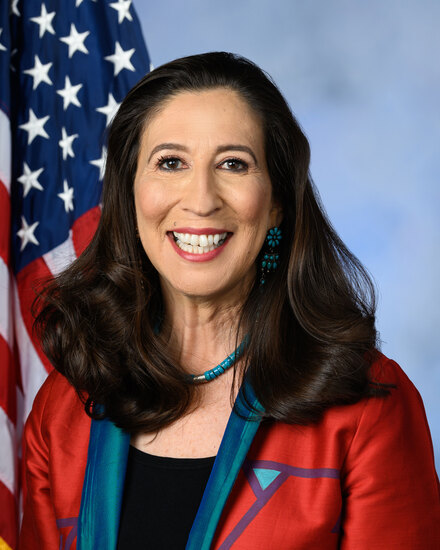
Rep. Teresa Leger Fernandez
Sponsored bills
Maddy summaryThe Equality Act (HR 15) would amend federal civil rights laws to explicitly prohibit discrimination based on sexual orientation and gender identity in public accommodations, housing, employment, credit, and jury service. It amends the Civil Rights Act of 1964 to include sexual orientation and gender identity as protected characteristics under existing sex discrimination provisions. The bill would require businesses, housing providers, employers, and government entities to provide equal access and services without regard to a person's sexual orientation or gender identity. It includes specific definitions for gender identity and sexual orientation to clarify protections across all covered areas. The law would apply to all entities covered by the Civil Rights Act of 1964, including those receiving federal funding.
Maddy summaryThis symbolic House Resolution (HRES 526) reaffirms U.S. commitment to refugee safety and well-being, introduced around World Refugee Day (June 20, 2023). It cites UNHCR data showing over 108 million displaced people globally and highlights historically low U.S. refugee admissions (11,411 in FY2021, 25,465 in FY2022). The resolution calls on U.S. officials to restore asylum protections, meet robust refugee admissions goals, support host countries, and advance refugee rights through international partnerships. It does not create new law but expresses bipartisan support for strengthening U.S. leadership in refugee protection.
Maddy summaryHR 4121, the Right to Contraception Act, establishes a federal statutory right for individuals to access contraceptives and contraception services without government restriction or coercion, directly affecting all people seeking reproductive care and health care providers. The bill prohibits state or federal laws that limit access to contraceptives (defined broadly to include devices, drugs, and fertility methods), prevent individuals from obtaining or using them, or allow providers to refuse services based on personal beliefs. It preempts conflicting state laws, requires any restrictions to be justified by "clear and convincing evidence" of advancing access with no less restrictive alternative, and allows private lawsuits to challenge violations. The Act applies nationwide to all health care providers and individuals, protecting access regardless of factors like race, income, or location.
Maddy summaryHR 4052, the National Infrastructure Bank Act of 2023, would establish a federally chartered National Infrastructure Bank to address the estimated $2.6 trillion infrastructure financing gap identified by the American Society of Civil Engineers. The bank would provide loans, loan guarantees, and blended financing for infrastructure projects in transportation, energy, environmental systems, broadband, and community development, with a total loan limit of $5 trillion. Projects must demonstrate public benefits including economic growth, job creation, environmental improvements, and community development, with priority given to disadvantaged communities and projects meeting specific criteria. The bank would be capitalized with up to $500 billion through the purchase of Treasury securities and other means, operating under a 25-member Board of Directors with oversight mechanisms to ensure accountability.
Maddy summaryHR 3946, the FASD Respect Act, establishes a new federal program within the Department of Health and Human Services (HHS) to address fetal alcohol spectrum disorders (FASD). The bill creates FASD Centers for Excellence to build state, tribal, and national capacity for prevention, identification, and support services - directly affecting individuals with FASD, their families, and healthcare providers. Key provisions include developing standardized diagnostic guidelines, expanding screening and training for medical professionals, creating a national resource directory for FASD services, and promoting culturally informed interventions. The program requires HHS to report to Congress on progress within four years. This legislation restructures existing HHS authority to focus comprehensively on FASD across the lifespan, replacing older terminology with consistent "FASD" references.
Maddy summaryThe American Dream and Promise Act of 2023 would create two pathways to permanent residency for certain immigrants. The "Dream Act" portion would provide conditional permanent resident status to individuals who entered the U.S. as children, have lived continuously in the U.S. since January 1, 2021, and meet educational requirements (such as completing high school, earning a degree, or enrolling in education programs). The "American Promise Act" portion would provide permanent residency to individuals eligible for Temporary Protected Status (TPS) or Deferred Enforced Departure (DED) as of specific dates (January 1, 2017, or January 20, 2021). The bill includes provisions for background checks, fee exemptions for low-income applicants, and processes for removing conditional status after meeting specific criteria like completing higher education or earning income.
Maddy summaryThe CARE Act of 2023 strengthens protections for child farmworkers by amending the Fair Labor Standards Act. It raises minimum age requirements (restricting 14-15 year olds to family farms outside school hours, and limiting 16-17 year olds to family farm work outside school hours), repeals a waiver allowing children in hand-harvest labor, and increases penalties for violations (up to $60,115 for serious injury or death). The bill requires employers to report work-related injuries or deaths of child farmworkers under 18 and mandates annual reports to Congress on child farmworker safety data. It also prohibits children under 18 from working as pesticide handlers, directly affecting an estimated 100,000+ child farmworkers in the U.S.
Maddy summaryThe GLOBE Act of 2023 requires the U.S. Department of State to document and report on violence and discrimination against LGBTQI people worldwide in annual country reports, with specific requirements to identify countries criminalizing LGBTQI status. It establishes a Special Envoy for LGBTQI Human Rights to coordinate U.S. government efforts internationally and creates targeted sanctions against foreign officials responsible for human rights violations against LGBTQI individuals, including denying visas and imposing financial penalties. The bill also includes provisions to improve U.S. foreign assistance programs to better support LGBTQI communities, reform immigration processes to better protect LGBTQI asylum seekers, and ensure inclusive policies in diplomatic and consular settings. These measures aim to advance LGBTQI rights globally through diplomatic, financial, and policy mechanisms.
Maddy summaryThis resolution designates May 5, 2023, as the "National Day of Awareness for Missing and Murdered Indigenous Women and Girls" to honor victims and support families. It asks the public to commemorate affected individuals and demonstrates solidarity with impacted communities. The bill also recommends the Justice Department commission a new study to update statistics on violence against Indigenous women, referencing the 2016 DOJ study that found 84.3% experienced violence in their lifetime. This symbolic measure aims to raise awareness and encourage federal action, without changing laws or allocating new funding.