

Maddy summaryThe Smithsonian American Women’s History Museum Act authorizes the creation of a new Smithsonian museum dedicated to women’s history, to be located within the National Mall Reserve in Washington, D.C. If the site is managed by another federal agency, the bill requires that agency to transfer the land after notifying Congress and relevant committees. The museum must ensure exhibits and programs accurately represent diverse women’s experiences by consulting a broad range of experts and community voices. The Smithsonian will submit biennial reports to Congress detailing how the museum meets these representation standards.
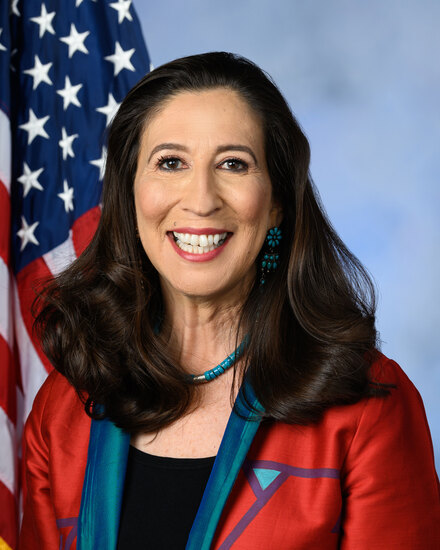
Rep. Teresa Leger Fernandez
Sponsored bills
Bridging Agency Data Gaps and Ensuring Safety for Native Communities Act or the BADGES for Native Communities Act This bill revises federal policies and procedures related to information sharing, reporting, and investigating cases of missing, unidentified, or murdered Indians. Among other elements, the bill requires the Department of Justice to (1) establish a grant program for specified entities (e.g., tribes) to implement changes to enhance their responses to missing person cases and death investigations of interest to tribes, and (2) work with the Department of Health and Human Services to ensure that federal training resources and culturally appropriate mental health and wellness programs are available to tribal and Bureau of Indian Affairs (BIA) law enforcement officers. The Department of the Interior must establish a five-year demonstration program for the purpose of conducting or adjudicating personnel background investigations for applicants for law enforcement positions in the BIA. The bill also requires the Government Accountability Office to conduct specified studies, including a study on the evidence collection, handling, response times, and processing procedures and practices of federal law enforcement agencies.
Maddy summaryThis bill provides additional funding to state agencies managing federal nutrition programs. It allocates 70% of new funds for the Commodity Supplemental Food Program, 20% for the Emergency Food Assistance Program, and 10% for the Seniors Farmers’ Market Nutrition Program to cover their administrative costs. The bill authorizes $1 million annually from 2026 through 2030 for these specific administrative expenses. It does not change program eligibility or benefits but ensures states have dedicated resources to operate existing nutrition assistance programs.
Maddy summaryThe Loan Forgiveness for Educators Act of 2026 expands existing federal student loan relief programs to offer full debt cancellation for teachers and early childhood educators who work in high-need schools or specific early childhood programs for five years. Under the bill, eligible educators can receive 100 percent forgiveness of their outstanding loans after completing five years of service, which may be consecutive or nonconsecutive, while also qualifying for monthly loan payments to be made by the government during their employment. The legislation defines "high need schools" as those with at least 30 percent of students from low-income families and includes various early childhood settings, while also extending benefits to parents who borrow PLUS loans for their qualifying children or who are educators themselves. To support implementation, the law requires the Department of Education to publish a list of eligible schools and programs, allows for self-certification in some early childhood roles, and ensures that educators who leave their positions early or are promoted within the same organization do not lose their eligibility for forgiveness.
Maddy summaryThe Protecting Our Democracy Act is a comprehensive legislative bill designed to prevent abuses of presidential power, restore checks and balances, and defend elections against foreign interference. Key provisions include prohibiting the President from granting self-pardons, requiring congressional oversight for pardons involving the President or their family, and banning the President from accepting payments from individuals who have received clemency. The bill also strengthens enforcement of the Hatch Act and ethics rules for political appointees, mandates greater transparency in presidential tax returns and campaign finances, and restricts the use of federal property for political conventions. Additionally, it expands reporting requirements for foreign contacts in federal campaigns and imposes stricter penalties for violations of election laws.
Maddy summaryThe Respect Tribal IDs Act requires the Department of Homeland Security to create and enforce annual training for immigration officers on how to properly identify and accept Native American tribal documents as proof of U.S. citizenship. This legislation directly affects federal immigration officials by mandating that they complete specific curricula developed in collaboration with the Bureau of Indian Affairs and Indian tribes. Key provisions include establishing a database of tribal document examples, incorporating scenario-based exercises, and ensuring officers understand the historical trust responsibility between the U.S. government and American Indians. Additionally, the bill defines which tribal documents, such as enrollment cards and certificates of degree of Indian blood, are considered valid proof of citizenship.
Maddy summaryThis resolution expresses support for designating May 5, 2026, as the National Day of Awareness for Missing and Murdered Indigenous Women and Girls. It calls on the public and organizations to honor the victims and show solidarity with their families. The bill also recommends that the Department of Justice commission a new study to gather updated statistics on the crisis, noting that previous data is nearly a decade old.
Maddy summaryThe Caja del Rio Protection Act establishes two new protected areas in New Mexico: the Caja del Rio Special Management Area within the Santa Fe National Forest and the Caja del Rio National Conservation Area managed by the Bureau of Land Management. These areas cover approximately 85,000 acres total and aim to conserve cultural, spiritual, ecological, and historical values while enhancing opportunities for local Indigenous tribes to participate in management. The bill restricts new road construction and limits motorized vehicle use to designated routes, requires the decommissioning of unauthorized roads, and withdraws the land from mining and mineral leasing operations. Additionally, the legislation facilitates a potential land swap where the federal government would transfer certain Bureau of Land Management parcels to the state in exchange for state trust land within the conservation boundary. The act also mandates the development of comprehensive management plans that incorporate Indigenous knowledge and ensure tribal access for traditional cultural and religious practices.
Maddy summaryThe No WAR Act prohibits Congress from using budget reconciliation procedures to fund military hostilities against Iran unless such actions are explicitly authorized by a formal declaration of war or a specific authorization for the use of military force. This legislation directly affects the legislative process by establishing a point of order that blocks any reconciliation bill attempting to provide budget authority for offensive military operations, strikes, or covert actions targeting Iranian military forces, territory, or government institutions. The bill also defines proxy forces as any foreign military or irregular groups operating with U.S. direction or material support, ensuring these entities are included in the restrictions on unauthorized funding. By amending the Congressional Budget and Impoundment Control Act, the measure aims to prevent the use of budgetary shortcuts to bypass the constitutional requirement for congressional approval before engaging in armed conflict with Iran.
Maddy summaryThis bill, titled the Protecting Human Rights and Public Health in Foreign Assistance Act, aims to cancel specific regulations issued by the Department of State. It directly affects the federal government by prohibiting any department or agency from enforcing, implementing, or proposing rules related to protecting life, combating discriminatory equity ideology, and combating gender ideology in foreign aid programs. The legislation treats these cancelled rules as if they never existed, effectively nullifying their impact on future foreign assistance policies.