

Maddy summaryHR 4179, the Reverse Transfer Efficiency Act of 2023, allows students to request their previous college coursework records be sent back to earlier institutions to apply toward completing a degree or recognized credential. It directly affects students who attended multiple colleges but didn’t finish a degree at their first school. The bill amends federal education privacy law to add a new provision (M), permitting institutions to share student records with prior schools *only* after the student provides written consent. This creates a clear process for students to use transferred credits toward a completed credential without requiring additional enrollment. The change simplifies a common barrier to degree completion for transfer students.
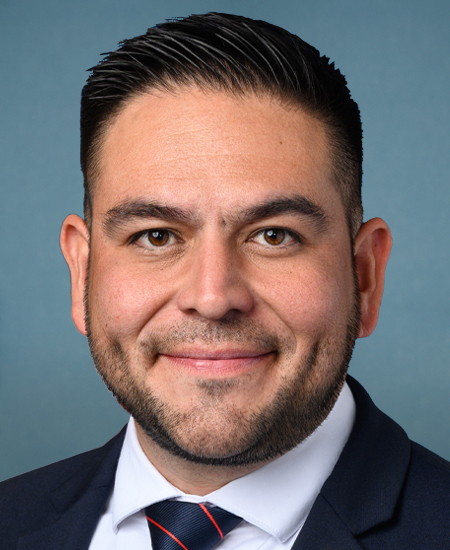
Rep. Gabe Vasquez
Sponsored bills
Tribal HUD-VASH Act of 2023 This bill provides statutory authority for the Tribal HUD-VASH program, which provides rental assistance and supportive services to Indian veterans who are homeless or at risk of homelessness and living in or near an area where a tribe or tribally designated housing entity provides assistance for affordable housing. The Department of Housing and Urban Development (HUD) may use up to 5% of rental assistance amounts under the HUD-VASH program, which provides housing assistance to homeless veterans, for the Tribal HUD-VASH program. The Tribal HUD-VASH program must be carried out by HUD in conjunction with the Department of Veterans Affairs. Under the program, grants must be made to entities eligible for housing assistance block grants. HUD may make renewal grants to entities that have received prior program grants.
Maddy summaryThe American Dream and Promise Act of 2023 would create two pathways to permanent residency for certain immigrants. The "Dream Act" portion would provide conditional permanent resident status to individuals who entered the U.S. as children, have lived continuously in the U.S. since January 1, 2021, and meet educational requirements (such as completing high school, earning a degree, or enrolling in education programs). The "American Promise Act" portion would provide permanent residency to individuals eligible for Temporary Protected Status (TPS) or Deferred Enforced Departure (DED) as of specific dates (January 1, 2017, or January 20, 2021). The bill includes provisions for background checks, fee exemptions for low-income applicants, and processes for removing conditional status after meeting specific criteria like completing higher education or earning income.
Maddy summaryThis bill increases per diem payments for homeless veterans receiving VA services. It raises the daily payment rate from $115 to $200 for certain housing-related services, including emergency responses. The change directly affects homeless veterans who qualify for these VA-funded housing supports. The key provision adjusts the payment rate in Section 2012(a)(2)(B) of the U.S. Code to provide higher funding for services assisting homeless veterans.
Maddy summaryHR 3850, the Pride In Mental Health Act of 2023, establishes a federal grant program to improve mental health and substance abuse services for LGBTQ+ youth (including nonbinary, intersex, and Two Spirit individuals). The bill directs the Health and Human Services Secretary to fund eligible organizations to provide trauma-informed care, cultural competency training for caregivers, school bullying prevention guidelines, and family support resources. It explicitly prohibits grant funds from being used for conversion therapy or advertising related to such therapy. The bill also requires data collection on LGBTQ+ youth mental health and a federal survey to measure psychological distress.
Maddy summaryThe American Family Act establishes a monthly child tax credit of $250 per month for each child under age 6 and $300 per month for each child aged 6-18, with income limits of $150,000 for joint filers and $112,500 for other filers. The credit is refundable, meaning it can be paid even if the taxpayer owes no income tax, and will be adjusted annually for inflation. The bill includes detailed rules for determining eligibility, including requirements that the child resides with the taxpayer for more than half the month and provisions to prevent fraud through recapture of improperly received payments. The credit will be paid monthly in advance rather than as a single annual payment, with specific mechanisms for calculating and distributing the payments.
Maddy summaryHR 698, the Assault Weapons Ban of 2023, prohibits the sale, manufacture, transfer, and possession of specific firearms and ammunition devices commonly referred to as "assault weapons" and "large capacity magazines" in interstate commerce. The bill defines "semiautomatic assault weapons" to include rifles like AR-15s and AK-47s, as well as firearms with specific features such as folding stocks, pistol grips, threaded barrels, and detachable magazines holding more than 15 rounds. It exempts law enforcement, military, antique firearms, and weapons already lawfully owned before the law's enactment (known as "grandfathered" weapons). The bill also requires new identification markings on these weapons and large capacity magazines, and adds background check requirements for transfers of grandfathered weapons.
Maddy summaryThis bill prohibits the Department of Veterans Affairs from changing its anesthesia care policies to allow nurse anesthetists (CRNAs) to provide anesthesia independently without a physician anesthesiologist. It specifically blocks implementation of a 2016 proposed rule that would have expanded CRNAs' authority in VA facilities. The law maintains current requirements that physician anesthesiologists must oversee or provide anesthesia care for veterans during surgical procedures. Emergency orders for veteran safety during surgery remain permitted under the bill's exception clause.
Maddy summaryHR 3216, the Rural Internet Improvement Act of 2023, updates the USDA's ReConnect Program to expand rural broadband access. It raises minimum speed requirements to 25 Mbps download and 3 Mbps upload for funded projects, simplifies application processes by reducing required data and allowing bond ratings instead of full financial documentation, and requires using FCC broadband maps to identify unserved areas. The bill affects rural broadband providers applying for grants, loans, or loan guarantees under the program by streamlining eligibility and reducing administrative burdens. It also mandates annual reports tracking funded locations, service speeds, and usage to ensure transparency.
Maddy summaryHR 3036, the Increased TSP Access Act of 2023, amends conservation program rules to expand access to third-party providers (TSPs) who offer technical assistance to farmers on conservation practices. It creates new pathways for non-Federal entities like agricultural cooperatives or professional associations to certify TSPs, streamlines certification processes (requiring Secretary review within 10 business days), and sets payment rates for TSPs equivalent to government-provided technical assistance. The bill mandates public reporting on certification numbers, payment details, and a target utilization rate for TSPs to improve conservation program delivery. It directly affects farmers participating in USDA conservation programs by increasing options for technical support and requiring transparency in how TSPs are certified and compensated.