

More Options to Develop and Enhance Remote Nutrition in WIC Act of 2025 or the MODERN WIC Act of 2025 This bill permanently allows individuals to remotely certify their eligibility for, and receive benefits through, the Special Supplemental Nutrition Program for Women, Infants, and Children (WIC). Specifically, the bill requires that a state agency allow an individual seeking a WIC certification, recertification, or a nutritional risk evaluation to do so by phone or through video teleconference, in addition to the in-person option. A state agency has 90 days to collect data for a nutritional risk evaluation for a remotely certified individual. Further, a state agency may consider an applicant who meets the income eligibility standards to be temporarily eligible on an interim basis to participate in the program and may certify the individual for immediate participation without waiting for a nutritional risk evaluation. The bill also allows states to provide benefits on WIC electronic benefit transfer cards through mail or remote issuance instead of requiring participants to pick up or reload benefits in person at a WIC office. Further, the Department of Agriculture must report to Congress about the use of remote technologies and other digital tools in the WIC program. Currently, individuals are generally required to be physically present to certify their WIC eligibility and receive benefits, with exceptions. The Food and Nutrition Service has temporarily waived these requirements and allowed remote certification and benefits using authorities that were provided by laws that were enacted to address COVID-19.
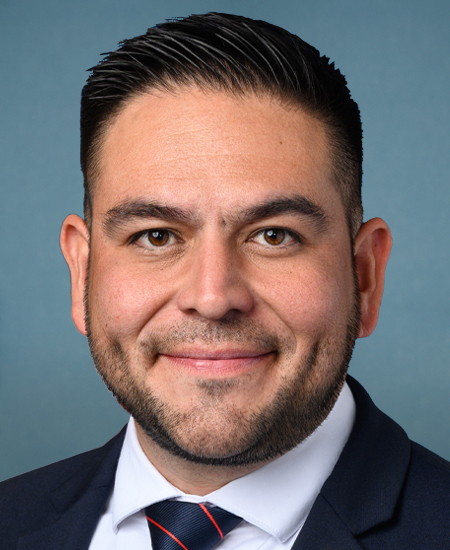
Rep. Gabe Vasquez
Sponsored bills
Maddy summaryHR 1505, the Public Safety Employer-Employee Cooperation Act, establishes federal standards for collective bargaining rights for public safety officers (including police, firefighters, and emergency medical personnel) in states that do not meet minimum requirements. The Federal Labor Relations Authority (FLRA) will determine after 180 days whether a state law "substantially provides" key rights, such as forming unions, negotiating wages/hours, and using binding arbitration to resolve disputes. If a state fails this assessment, federal bargaining rules apply within two years, but existing state laws with stronger protections remain valid. The bill explicitly respects state laws that exceed its standards and exempts small jurisdictions (under 5,000 population or 25 full-time employees).
Maddy summaryHR 1421, the "Make American Flags in America Act of 2025," requires all flags of the United States displayed on federal property or procured by federal agencies to be 100% manufactured in the United States. This directly affects federal agencies (including executive departments, military branches, and legislative/judicial offices) by banning the use of foreign-made flags for official displays or purchases. The bill sets a 90-day deadline for procurement changes and a two-year timeline for display requirements, while excluding private entities from these rules. It also mandates a Federal Trade Commission study on enforcing country-of-origin labeling for flags, with a report due within one year of enactment.
Maddy summaryHR 1410 expands access to mental health care for 9/11 responders and survivors by allowing licensed mental health providers (not just physicians) to conduct initial health evaluations and certifications under the World Trade Center Health Program. It adjusts the program’s funding formula to account for changing enrollment numbers by linking annual funding to the previous year’s enrollment ratio, and clarifies that deceased individuals are excluded from enrollment counts. The bill also extends the timeframe for adding new health conditions to the program’s list and requires a 2028 report assessing long-term funding needs through 2090. These changes aim to streamline eligibility, improve care access, and ensure sustainable funding for the program.
Maddy summaryHR 1444, the Zuni Indian Tribe Water Rights Settlement Act of 2025, establishes a settlement for the Zuni Tribe's water rights in the Zuni River Stream System by confirming the Tribe's water rights held in trust by the U.S. government. The bill creates a $655.5 million Trust Fund for water infrastructure development and management, plus $29.5 million for operation and maintenance, with funds to be used for projects like water treatment, irrigation systems, and watershed protection. It also protects approximately 217,000 acres of culturally significant land around Zuni Salt Lake by withdrawing Federal land from development and imposing management restrictions. The settlement ensures Tribal water rights cannot be forfeited for non-use and maintains existing water rights for individual allottees on Zuni Lands.
This concurrent resolution declares that Congress should not impose any new performance fee, tax, royalty, or other charge relating to the public performance of sound recordings on a local radio station for broadcasting sound recordings over the air, or on any business for such public performance of sound recordings.
Maddy summaryThis bill ratifies a water rights settlement agreement between the Navajo Nation, the State of New Mexico, and other parties for the Rio San José Stream System. It establishes a $223.27 million trust fund (with $200.27 million from federal funds) to support water infrastructure projects, water rights management, and environmental compliance on Navajo Nation lands. The agreement resolves longstanding water rights claims for the Navajo Nation, confirms their water rights in the Rio San José Stream System and Rio Puerco Basin, and includes protections for allottee water rights. The settlement becomes effective on the "Enforceability Date" after certain conditions are met, including court approval and fund deposits.
Maddy summaryThis bill (HR 1314, TIPS Act) requires employers to pay tipped workers the standard federal minimum wage instead of the current lower rate (currently $2.13/hour), directly affecting workers in hospitality, food service, and similar roles. It also creates a new tax deduction for cash tips received in qualifying jobs (e.g., restaurants, hotels), allowing workers to deduct these tips from taxable income up to $112,500 in adjusted gross income. The deduction applies only to tips from unrelated customers without business ownership stakes, excluding credit card tips. The tax provisions take effect for 2026 tax years.
Maddy summaryThe Ohkay Owingeh Rio Chama Water Rights Settlement Act of 2025 resolves water rights claims for the federally recognized Ohkay Owingeh Pueblo in New Mexico's Rio Chama Stream System. It establishes a $745 million Trust Fund to support water infrastructure, land acquisition, and management, with specific guidelines for how these funds can be used for projects like bosque restoration and water rights management. The bill includes a waiver of claims by the Pueblo in exchange for recognized water rights, while preserving certain environmental and cultural rights through specific reservations. The settlement becomes effective on an "Enforceability Date" when specific conditions are met, including court approval and fund deposits.
Border Enforcement, Security, and Trade Facilitation Act of 2025 or the BEST Facilitation Act This bill establishes a pilot program for positions within U.S. Customs and Border Protection (CBP) to review inspection images of vehicles and cargo entering or exiting the United States. Specifically, the bill establishes the position of image technician 1 within the CBP Office of Field Operations. An image technician must (1) review nonintrusive inspection images of vehicles and cargo entering or exiting the United States; (2) assess whether such vehicles and cargo contain contraband, illicit drugs, weapons, or persons seeking to unlawfully enter the United States; and (3) refer suspicious vehicles and cargo for further inspection by a CBP officer. These reviews must take place at one of five regional command centers established pursuant to this pilot program. The bill also establishes the position of image technician 2 with additional responsibilities, including receiving and reporting intelligence to the National Targeting Center about techniques used by malign actors to transport contraband, illicit drugs, weapons, and persons seeking to unlawfully enter the United States. Image technicians must be supervised by a supervisory CBP officer. The bill establishes annual training requirements for both positions, including training on privacy and civil liberties and how to analyze inspection images. This pilot program ends five years after the date of enactment of this bill. Individuals employed as image technicians at the end of the pilot program may transfer to comparable positions within CBP or the Department of Homeland Security.