

Maddy summaryHR 6605, the Secure Our Skies Drone Safety Act of 2025, requires the Comptroller General to study and report to Congress within one year of enactment on how federal, state, local, and tribal agencies use drones (UAS) and counter-drone systems. The report must include specific data like the number of drones deployed, purchases from adversarial nations, domestic production, training requirements, privacy protections, and countermeasure strategies. It also mandates recommendations for updating legal authorities and policies to improve counter-UAS capabilities and streamline procurement of UAS made in the U.S. or allied nations. This bill directly affects law enforcement agencies by requiring them to provide detailed information for the study, focusing on transparency and policy improvements related to drone operations.
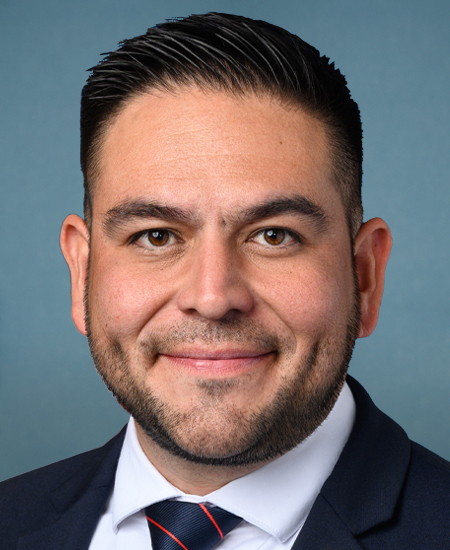
Rep. Gabe Vasquez
Sponsored bills
Maddy summaryThe CARE for First Responders Act (HR 6601) provides mental health support specifically for first responders, including emergency personnel and 911 operators (defined as "qualified emergency response providers"). It requires the creation of a 24/7 confidential hotline via the 988 Suicide Lifeline, peer support programs staffed by trained responders, and mobile crisis units that offer on-site mental health services during major disasters. The bill mandates trauma-informed, culturally appropriate care and education to reduce stigma around mental health, with a focus on helping responders and their families adjust after disaster work. It authorizes $5 million annually (2026-2030) for these services through grants to state/local health entities.
Maddy summaryHJRES 144 is a congressional disapproval resolution targeting a specific rule issued by the Department of Veterans Affairs (VA) on December 31, 2025, which addressed "Reproductive Health Services" (90 Fed. Reg. 61310). This resolution directs Congress to disapprove the VA rule under Chapter 8 of Title 5, U.S. Code, meaning the rule would have no legal effect if passed. The bill directly affects the VA's implementation of reproductive health services for veterans, as it seeks to nullify the agency's existing policy. This is a procedural measure, not a substantive policy change, aimed solely at blocking the VA's rule through congressional action.
Maddy summaryThis bill creates a tax credit for businesses selling products made with U.S.-grown cotton. The credit equals 24% of the cotton's market value if processed only in the U.S. or in countries with U.S. trade deals, or 18% for other processing locations. To qualify, cotton must be digitally traced from U.S. farms to finished products and certified by the USDA as meeting origin requirements. It directly affects clothing and textile manufacturers selling qualifying products in the U.S. market.
Maddy summaryHR 7206, the Farm and Family Relief Act, provides direct financial assistance to agricultural producers facing market challenges during the 2025 crop year. It establishes one-time payments for eligible crop producers (including wheat, corn, soybeans, and cotton) when expected costs exceed expected returns, with payment limits based on farming income (capping at $125,000 or $250,000 depending on farming income percentage). The bill allocates $5 billion for specialty crop producers, $500 million for timber industry assistance, and $330 million for sugar beet producers through cooperative block grants. Additionally, it delays certain cost-shift provisions in food assistance programs and terminates specific tariff-imposing executive orders.
Maddy summaryHR 4105, the VET Act of 2025, establishes a federal grant program to help veterans, active-duty service members transitioning out of the military, and their spouses secure jobs in the energy industry. The program provides grants to energy companies (including manufacturers of solar, wind, or nuclear equipment) to cover costs like job training, recruitment, and relocation for eligible individuals - prioritizing those with military energy experience, in opportunity zones, or facing barriers like homelessness. Grants are capped at $10,000 per hire, with a maximum $500,000 annual limit per company, funded at $60 million yearly from 2026-2031. Companies must report on job retention, employee satisfaction, and program outcomes to the Department of Labor, with a final evaluation due to Congress by 2030.
Maddy summaryHR 7137, the Shutdown Fairness Act, requires federal agencies to pay covered employees (including most federal workers and military personnel) and covered contractors their regular pay during government shutdowns. It appropriates funds from the Treasury to cover standard employee compensation and contractor payments for work performed during a lapse in regular appropriations, ensuring pay continues without delay (within 7 days if a shutdown is ongoing at enactment) and aligns with regular pay schedules. The bill applies only to individuals employed or with accepted offers before the shutdown began and mandates that these payments be charged to future appropriations. It does not change agency obligations under existing contracts or authorize new spending beyond the specified shutdown period.
Maddy summaryHR 7138 disallows tax deductions for mortgage interest and depreciation on single-family homes (1-4 units) owned by large investment entities with over $100 million in assets, while imposing a 100% excise tax on sales or transfers of such properties. The bill directly affects institutional landlords (e.g., large real estate investment firms), excluding government entities, nonprofits, and federally assisted housing. Revenue from the tax will fund low-income housing programs via the Housing Trust Fund. It also prohibits Fannie Mae, Freddie Mac, and Ginnie Mae from purchasing or guaranteeing mortgages for these properties. The provisions apply 18 months after enactment.
Maddy summaryHR 7145 defines "essential health systems" as hospitals serving large numbers of Medicaid and low-income patients, specifically targeting non-Federal, nonprofit, or government-run hospitals that meet one of three criteria for at least two of the past three years (e.g., high Medicaid patient percentage, high uncompensated care, or top 16th percentile in state rankings for low-income care). The bill requires MACPAC to annually publish an "essential health system index" ranking qualifying hospitals nationally, by state, and within local areas, using data from Medicare reporting. Hospitals designated as essential health systems receive a five-year designation, renewable if they maintain eligibility. This framework aims to identify facilities providing critical community care for vulnerable populations through standardized metrics.
Maddy summaryHRES 996 is a resolution introduced by multiple House members to impeach Kristi Lynn Arnold Noem, the Secretary of Homeland Security, for alleged violations of law and the Constitution. It outlines three articles of impeachment: obstructing congressional oversight by denying access to detention facilities and withholding funds, violating public trust through warrantless arrests and excessive force (including tear gas on children), and self-dealing by awarding federal contracts to associates without competitive bidding. If approved by the House, this resolution would formally charge Noem, triggering a Senate trial to determine her removal from office. The resolution itself does not enact new policy but initiates the constitutional impeachment process against a sitting Cabinet official.