

Maddy summaryThe Empowering Striking Workers Act of 2025 would expand unemployment insurance eligibility to workers unable to work due to labor disputes, including strikes or lockouts. It sets a 14-day waiting period (or earlier if replacements are hired, a lockout starts, or the dispute ends) before benefits begin, treating these workers as "unemployed" under federal law. The bill also removes the standard requirement for these workers to actively seek other employment to qualify for benefits. This directly affects workers involved in labor disputes, such as those on strike or unable to work due to employer lockouts.
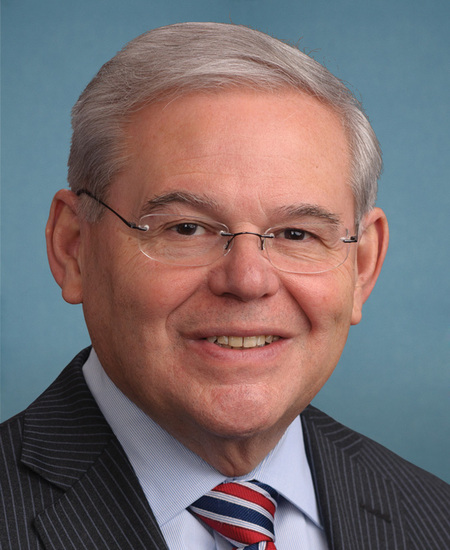
Rep. Robert Menendez
Sponsored bills
Maddy summaryThis bill names the Department of Veterans Affairs community-based outpatient clinic in Toms River, New Jersey, as the "Leonard G. 'Bud' Lomell VA Clinic." It directly affects the existing clinic facility by changing its official name to honor World War II veteran Leonard G. "Bud" Lomell. The key provision updates all federal references to the clinic - including laws, regulations, maps, and documents - to reflect this new designation after the bill's enactment. The change is purely administrative and does not alter the clinic's services or operations.
Maddy summaryHRES 675 is a symbolic resolution expressing the U.S. House of Representatives' support for designating September 2025 as "National Prostate Cancer Awareness Month." It directly affects all Americans, particularly men at risk of prostate cancer - including those with family history, African-American men (who face higher incidence and mortality rates), and men under 65 (40% of new cases). The resolution calls for raising public awareness about screening methods, encouraging research into prevention and treatment, and promoting community actions to combat prostate cancer. It does not create new laws or allocate funding, but urges public and private efforts to improve early detection and outcomes.
Maddy summaryThis bill prohibits Members of Congress, their spouses, and dependent children from owning or trading certain investments, including stocks, commodities, and derivatives (referred to as "covered investments"). It requires affected individuals to divest these investments within 90-180 days, with specific exemptions for Treasury bonds, diversified mutual funds, small business interests, and family trusts meeting strict conditions. Violations incur penalties of 10% of the investment's value plus disgorgement of profits, paid directly to the U.S. Treasury. The law applies to all covered individuals during federal service, with exceptions for investments acquired through inheritance or occupational trading (e.g., a spouse’s finance job).
Maddy summaryHR 5049, the "Protecting Communities from Helicopter Noise Act," requires the Federal Aviation Administration (FAA) to study helicopter operations within a 20-mile radius of the Statue of Liberty National Monument. The study must analyze noise impacts on residential and recreational areas, helicopter traffic patterns, safety and environmental effects, and potential solutions like flight path changes or altitude limits. The FAA must submit a report to Congress within 180 days of the bill's enactment, focusing on concrete data rather than implementing new regulations. This bill directly affects communities near the Statue of Liberty in New York City by mandating an assessment of helicopter noise concerns.
Maddy summaryThis bill (HJRES 115) terminates a presidential emergency declaration made on August 11, 2025, which claimed a "crime emergency" in Washington, D.C. It directly affects the District of Columbia by ending federal restrictions that prevented D.C. from using $1 billion in locally-raised funds for public safety, law enforcement, fire services, and schools. The resolution cites that the emergency declaration was legally flawed - section 740 of the DC Home Rule Act does not permit federalizing the Metropolitan Police Department - and notes that D.C. violent crime has reached a 30-year low. The bill formally ends the emergency under the DC Home Rule Act, restoring D.C.'s authority over its own budget and public safety resources.
Maddy summaryThe Community Parks Revitalization Act establishes a federal program to improve parks and recreation facilities in urban areas through grants and secured loans. It provides competitive grants to eligible local governments for rehabilitation and construction of parks (including safety improvements), innovation programs (like youth services and veteran support), and recovery planning. The program requires local matching funds (3/7 of grant amount) and prioritizes projects that increase access for low-income residents, veterans, and people with disabilities, while incorporating sustainable design features like stormwater management and green infrastructure. The bill also authorizes secured loans and loan guarantees for larger park infrastructure projects with dedicated revenue streams, aiming to improve community health outcomes and economic development through better recreational spaces.
Maddy summaryHRES 648 is a ceremonial resolution honoring Bruce Springsteen's 1975 album *Born to Run* on its 50th anniversary. It celebrates the album's cultural significance, Springsteen's New Jersey roots, and his contributions to American music, citing his Grammy Awards, induction into the Rock Hall, and the album's 7x platinum certification. The resolution contains no policy changes or affected parties - it simply recognizes the album's legacy through a symbolic House statement. It does not create new laws or impact any government programs.
Maddy summaryHR 4966 prohibits grocery stores from selling items at "grossly excessive prices," defined as 120% or more above the average market price over the previous six months (with exceptions for unavoidable cost increases like supply chain issues). It bans using facial recognition or personal data to set different prices for individual customers (e.g., adjusting prices based on shopping history) and requires clear signage if facial recognition is used. Stores over 10,000 square feet must replace electronic shelf labels with physical price tags. The Federal Trade Commission enforces these rules, allowing consumers to seek $3,000 per violation or actual damages, with penalties for willful violations.
Maddy summaryThis bill adjusts health insurance subsidies by modifying the premium tax credit structure under the Internal Revenue Code. It replaces previous income thresholds with a sliding-scale formula, increasing subsidies for households earning between 150% and 400% of the federal poverty level - reducing their required premium payments as income rises within these tiers. The changes apply to tax years beginning after December 31, 2025, directly affecting middle-income individuals and families purchasing coverage through health insurance marketplaces. It also repeals specific provisions from a prior reconciliation law related to health care.