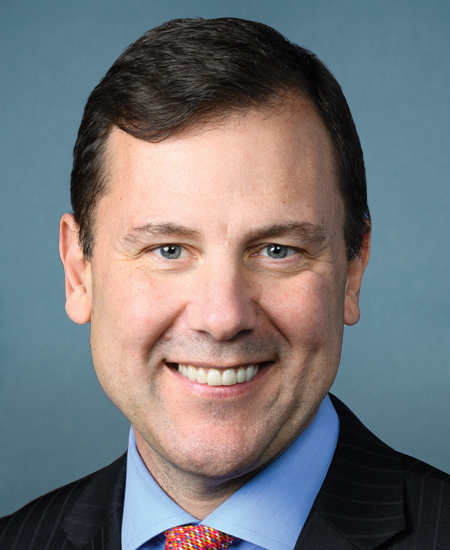
Photo of Thomas H. Kean, Jr.
R United States House · District 7 · New Jersey On the 2026 ballot

Rep. Thomas H. Kean, Jr.

Compare
Total votes
1,879
all sessions
Attendance
92%
152 missed
Lower than 97% of chamber peers
With party
85%
of cast votes
Lower than 80% of chamber peers
Bipartisan score
8%
crosses aisle rarely
Higher than 77% of chamber peers
Sponsored
842
bills & resolutions
Near the chamber average
Committees
7
assignments
842 bills and resolutions

Sponsored bills

Total
842
Primary
65
Co-sponsor
777
This page
842
matching current filters
Co-sponsor HR 8201
In committee · Indiana House · Co-sponsor
To amend Public Health Service Act to require community health centers to provide behavioral and mental health and substance use disorder services, and for other purposes.

Maddy summaryThis bill requires community health centers to include behavioral and mental health services, as well as substance use disorder treatment, among their primary health services. It achieves this by amending the Public Health Service Act to explicitly list these services as required offerings for these centers. The legislation also allocates $700 million annually from 2027 to 2031 to fund these expanded services through the Department of Health and Human Services. The changes directly affect community health centers and the patients who rely on them for primary care.

In committee Jun 25, 2026 1 co-sponsor
Co-sponsor HR 6461
In committee · Indiana House · Co-sponsor
READ AI Models Act

Maddy summaryThe READ AI Models Act directs the National Institute of Standards and Technology (NIST) to develop a free, flexible template for documenting artificial intelligence (AI) models. The template would require basic details like developer information, training data cutoff dates, supported languages, and terms of service for both public and private sector AI models. NIST must gather public input through a 60-day comment period before finalizing the template and technical guidelines. If the pilot program proves effective, NIST would publish the template publicly and report to Congress within one year.

In committee Jun 25, 2026 1 co-sponsor
Primary HR 5584
In committee · Indiana House · Lead sponsor
LIFT AI Act

Maddy summaryThe LIFT AI Act (HR 5584) provides federal funding through competitive grants to develop AI literacy programs for K-12 education. It directly affects elementary and secondary schools, teachers, and students by supporting the creation of AI-focused curricula, teacher training on responsible AI use, and hands-on learning tools. Key provisions include funding for project-based learning materials, professional development for educators, and evaluation methods to assess student AI proficiency. The bill aims to integrate practical AI skills into classrooms while ensuring content adapts to evolving technology. It does not fund direct student programs but enables schools to build foundational AI education through grant-supported resources.

In committee Jun 25, 2026 0 co-sponsors
Co-sponsor HR 2385
In committee · Indiana House · Co-sponsor
CREATE AI Act of 2025

Creating Resources for Every American To Experiment with Artificial Intelligence Act of 2025 or the CREATE AI Act of 2025 This bill establishes a national program to provide U.S. researchers, educators, and students with access to artificial intelligence (AI) data, computational resources, educational tools and services, and testbeds. The program, to be known as the National Artificial Intelligence Research Resource (NAIRR), must be established by the National Science Foundation (NSF) to improve U.S. AI research capacity and spur the strategic development of AI capabilities. NAIRR may accept and use donated resources from the private sector and federal agencies. Those eligible to use NAIRR resources are (1) researchers, educators, and students based in the United States and affiliated with a U.S. institution of higher education, nonprofit, executive agency, or other specified entity; and (2) employees of U.S. executive agencies or federally funded research and development centers with a demonstrable mission need. NSF must select a nongovernmental organization to operate NAIRR (i.e., an operating entity ) through a competitive and transparent process. The operating entity must ensure that a significant percentage of the annual allotment of computational resources is provided to projects primarily focused on AI privacy, ethics, safety, security, risk mitigation, or trustworthiness. The operating entity must also establish minimum security requirements for all individuals interacting with NAIRR. The operating entity may establish a fee schedule for access to NAIRR, which must include a free tier of access and must ensure that the primary purpose of NAIRR is to support research.


In committee Jun 25, 2026 1 co-sponsor
Co-sponsor HR 9250
In committee · Indiana House · Co-sponsor
Great American Outdoors Act 250

Maddy summaryThis bill redesignates the existing National Parks and Public Land Legacy Restoration Fund as the America's Legacy Restoration Fund to address deferred maintenance on federal lands. It directs revenue from recreation fees and a portion of energy development income into the fund, which must be used primarily for repairing critical infrastructure like roads, trails, and buildings managed by agencies such as the National Park Service and the Forest Service. The legislation establishes strict rules requiring that most funds go toward non-transportation projects, mandates transparency through public dashboards tracking project status, and sets aside a small percentage for matching private donations. Additionally, the bill increases entrance fees for foreign visitors to ensure they contribute to the fund, while prohibiting the use of these specific funds for land acquisition or employee bonuses.

In committee Jun 24, 2026 1 co-sponsor
Co-sponsor HR 9105
In committee · Indiana House · Co-sponsor
SAFEGUARD Veterans Act of 2026

Maddy summaryThe SAFEGUARD Veterans Act of 2026 strengthens protections for veterans by imposing stricter penalties on individuals who charge unauthorized fees for helping with benefits claims and requiring that only accredited representatives or those under their supervision provide such assistance. Key provisions include creating an online searchable list of recognized and suspended agents, mandating warnings on Department websites about potential predatory practices, and adding questions to claim forms to identify anyone who charged fees for coaching or filing assistance. The bill also updates federal laws to prohibit the use of automated telephone equipment for making repeated calls to federal agencies and requires the Department of Veterans Affairs to establish a more accessible digital system for recognizing representatives and processing complaints. Additionally, the Department must conduct a review of its current regulations regarding representation and report its findings to Congress within 180 days of the law's enactment.

In committee Jun 23, 2026 1 co-sponsor
Co-sponsor HR 425
In committee · Indiana House · Co-sponsor
Repealing Big Brother Overreach Act

Repealing Big Brother Overreach Act This bill repeals the Corporate Transparency Act. The act requires existing companies and newly created companies to report beneficial ownership information to the Department of the Treasury’s Financial Crimes Enforcement Network for purposes of addressing the financing of terrorism and money laundering.

In committee Jun 18, 2026 1 co-sponsor
Co-sponsor HR 9152
In committee · Indiana House · Co-sponsor
VETRA Act

Maddy summaryThe VETRA Act directs the Department of Veterans Affairs to run a two-year pilot program aimed at upgrading its digital security systems to better protect veterans' benefits and reduce fraud. Under this initiative, the VA will test new multi-layered identity verification methods on up to three high-use platforms, such as those for disability claims, health care enrollment, and educational benefits. The program requires the use of commercially available, independently certified security tools that adjust verification strictness based on the risk level of each transaction. To ensure accountability, the bill mandates regular reports to Congress on performance metrics and requires an independent evaluation by the Government Accountability Office before deciding whether to expand the system nationwide.

In committee Jun 12, 2026 1 co-sponsor
Co-sponsor HR 9262
In committee · Indiana House · Co-sponsor
Local Control Protection Act

Maddy summaryThe Local Control Protection Act restricts federal courts from hearing challenges to local zoning decisions that deny permits for large data centers, provided those denials were made by recorded vote with documented findings. It also prohibits federal agencies from approving permits for these facilities if the developer is currently suing to overturn a local government's denial. Additionally, the bill requires developers of covered data centers to receive tax credits only if they sign enforceable agreements with local officials to address infrastructure impacts, monitor environmental effects, and prioritize hiring local workers and contractors.

In committee Jun 11, 2026 1 co-sponsor
Co-sponsor HR 9214
In committee · Indiana House · Co-sponsor
TSP Modernization Act

Maddy summaryThe TSP Modernization Act allows individuals to electronically transfer money from their Thrift Savings Fund accounts to qualified retirement plans at brokerage firms, a change that takes effect one year after the law is passed. To initiate this transfer, account holders must provide the necessary information to the Federal Retirement Thrith Investment Board. Additionally, the bill requires the board to submit a report to Congress one year after enactment detailing how the electronic transfer process was implemented.

In committee Jun 9, 2026 1 co-sponsor
Showing 61 to 70 of 842 bills
Previous 1 … 6 7 8 … 85 Next