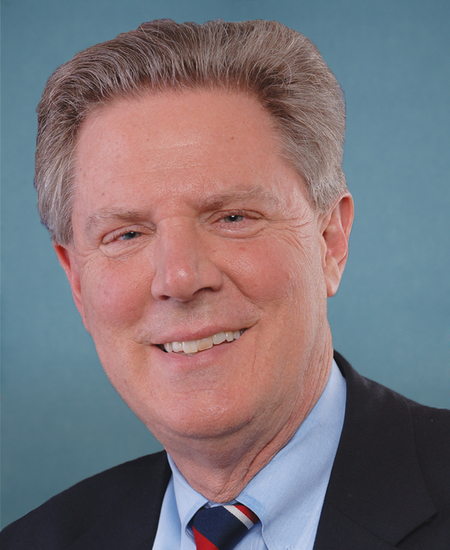
Photo of Frank Pallone, Jr.
D United States House · District 6 · New Jersey On the 2026 ballot

Rep. Frank Pallone, Jr.

Compare
Total votes
2,837
all sessions
Attendance
100%
6 missed
Higher than 89% of chamber peers
With party
97%
of cast votes
Near the chamber average
Bipartisan score
1%
crosses aisle rarely
Near the chamber average
Sponsored
866
bills & resolutions
Near the chamber average
Committees
1
assignment
866 bills and resolutions

Sponsored bills

Total
866
Primary
61
Co-sponsor
805
This page
866
matching current filters
Co-sponsor HR 3267
In committee · Indiana House · Co-sponsor
Protect Drinking Water from PFAS Act of 2021

Protect Drinking Water from PFAS Act of 2021 This bill requires the Environmental Protection Agency (EPA) to address the level of perfluoroalkyl and polyfluoroalkyl substances (PFAS) in drinking water. PFAS are man-made and may have adverse human health effects. A variety of products contain PFAS, such as nonstick cookware or weatherproof clothing. In addition, the EPA must publish a maximum contaminant level goal (MCLG) and promulgate a national primary drinking water regulation for PFAS. The MCLG and regulation must be protective of the health of subpopulations that may be at greater risk than the general population of adverse health effects from exposure to PFAS in drinking water.

In committee May 18, 2021 1 co-sponsor
Co-sponsor HR 1976
In committee · Indiana House · Co-sponsor
Medicare for All Act of 2021

Medicare for All Act of 2021 This bill establishes a national health insurance program that is administered by the Department of Health and Human Services (HHS). Among other requirements, the program must (1) cover all U.S. residents; (2) provide for automatic enrollment of individuals upon birth or residency in the United States; and (3) cover items and services that are medically necessary or appropriate to maintain health or to diagnose, treat, or rehabilitate a health condition, including hospital services, prescription drugs, mental health and substance abuse treatment, dental and vision services, and long-term care. The bill prohibits cost-sharing (e.g., deductibles, coinsurance, and copayments) and other charges for covered services. Additionally, private health insurers and employers may only offer coverage that is supplemental to, and not duplicative of, benefits provided under the program. Health insurance exchanges and specified federal health programs terminate upon program implementation. However, the program does not affect coverage provided through the Department of Veterans Affairs or the Indian Health Service. The bill also establishes a series of implementing provisions relating to (1) health care provider participation; (2) HHS administration; and (3) payments and costs, including the requirement that HHS negotiate prices for prescription drugs. Individuals who are age 18 or younger, age 55 or older, or already enrolled in Medicare may enroll in the program starting one year after enactment of this bill; other individuals may buy into the program at this time. The program must be fully implemented two years after enactment.

In committee May 18, 2021 1 co-sponsor
Co-sponsor HR 1909
In committee · Indiana House · Co-sponsor
Citizenship for Essential Workers Act

Citizenship for Essential Workers Act This bill establishes a mechanism for eligible aliens who worked as essential workers during the declared COVID-19 (i.e., coronavirus disease 2019) public health emergency to apply for and obtain permanent resident status. The bill also narrows certain grounds for deportability and inadmissibility. To be eligible for permanent resident status under this bill, an alien must have earned income at any point during the COVID-19 emergency period doing work deemed essential by the Department of Homeland Security (DHS) or a state or local government. An alien may also be eligible if that alien is a parent, spouse, or child of (1) an eligible alien who died from COVID-19, or (2) a member of the Armed Forces. Certain aliens shall be ineligible, such as an alien who was a refugee on January 1, 2021. To obtain permanent resident status under this bill, an applying alien must satisfy additional requirements, including by passing a background check. Furthermore, the bill repeals provisions providing for three-year bars and permanent bars to admission into the United States. (Generally, these bars apply to aliens who were previously removed or unlawfully present in the United States.) The bill also narrows the scope of certain crime-based grounds for inadmissibility or deportability, such as by redefining the term conviction to exclude expunged convictions. The Department of Justice or DHS may waive certain grounds of inadmissibility or deportability (1) for humanitarian purposes, (2) to ensure family unity, or (3) for the public interest.

In committee May 18, 2021 1 co-sponsor
Co-sponsor HR 1834
In committee · Indiana House · Co-sponsor
Hate Crimes Commission Act of 2021

Hate Crimes Commission Act of 2021 This bill establishes the United States Commission on Hate Crimes. The commission must investigate and report on whether hate crimes have increased; factors that contributed to an increase in hate crimes, if one is determined to exist; policies or actions by law enforcement agencies to reduce the commission of hate crimes; the impact of underreporting on hate crimes statistics and prevention; and successful community bias prevention responses.

In committee May 18, 2021 1 co-sponsor
Co-sponsor HR 1843
In committee · Indiana House · Co-sponsor
COVID–19 Hate Crimes Act

COVID - 19 Hate Crimes Act This bill requires a designated officer or employee of the Department of Justice (DOJ) to facilitate the expedited review of COVID-19 (i.e., coronavirus disease 2019) hate crimes and reports of COVID-19 hate crimes. It defines COVID-19 hate crime as a violent crime that is motivated by two things: (1) the actual or perceived characteristic (e.g., race or ethnicity) of any person, and (2) the actual or perceived relationship to the spread of COVID-19 of any person because of that characteristic. The bill requires DOJ to issue guidance for state and local law enforcement agencies on (1) the establishment of online hate crime reporting processes and the availability of online reporting in multiple languages, and (2) the expansion of culturally competent education campaigns. Additionally, DOJ and the Department of Health and Human Services must issue guidance on best practices for mitigating racially discriminatory language in describing the COVID-19 pandemic.

In committee May 18, 2021 1 co-sponsor
Co-sponsor HR 1752
In committee · Indiana House · Co-sponsor
COOL OFF Act

Choosing Our Own Lives Over Fast Firearms Act or the COOL OFF Act This bill establishes a three-day waiting period for certain handgun transfers. Specifically, the bill makes it unlawful for a licensed importer, manufacturer, or dealer to sell or transfer a handgun to an unlicensed individual unless three business days have elapsed since the licensee initiated a background check. A violator is subject to criminal penalties—a fine, up to one year in prison, or both. Additionally, the bill makes it unlawful for an unlicensed individual to receive a handgun from another unlicensed individual unless at least three business days have elapsed since the recipient most recently offered to take possession of the handgun. A violator is subject to criminal penalties—a fine, up to five years in prison, or both. The three-day waiting period does not apply to certain handgun transfers, such as for a loan between spouses for a lawful purpose.

In committee May 18, 2021 1 co-sponsor
Co-sponsor HR 1570
In committee · Indiana House · Co-sponsor
George Floyd Law Enforcement Trust and Integrity Act of 2021

George Floyd Law Enforcement Trust and Integrity Act of 2021 This bill requires the Department of Justice (DOJ) to take specified steps to address accreditation standards, management operations, and misconduct of law enforcement. Specifically, it requires DOJ to develop uniform accreditation standards for law enforcement agencies and adopt policies and procedures to encourage law enforcement agencies to pursue accreditation. It authorizes DOJ to make grants to law enforcement agencies to obtain accreditation from certified organizations. The bill authorizes DOJ to make grants for studying law enforcement agency management and operations standards and developing pilot programs to address law enforcement misconduct. DOJ must study the prevalence and effect of any law, rule, or procedure that allows a law enforcement officer to delay the investigation and prosecution of complaints of law enforcement misconduct. The bill also establishes the Task Force on Law Enforcement Oversight to coordinate the detection and referral of complaints of alleged law enforcement misconduct. Law enforcement agencies must report data regarding practices on traffic violation stops, pedestrian stops, frisk and body searches, and use of deadly force. Finally, DOJ must create a medallion for survivors of each law enforcement officer killed in the line of duty and memorialized on the wall of the National Law Enforcement Officers Memorial.

In committee May 18, 2021 1 co-sponsor
Co-sponsor HR 1065
Passed · Indiana House · Co-sponsor
Pregnant Workers Fairness Act

Pregnant Workers Fairness Act This bill prohibits employment practices that discriminate against making reasonable accommodations for qualified employees affected by pregnancy, childbirth, or related medical conditions. A qualified employee is an employee or applicant who, with or without reasonable accommodation, can perform the essential functions of the position, with specified exceptions. Specifically, the bill declares that it is an unlawful employment practice to fail to make reasonable accommodations to known limitations of such employees unless the accommodation would impose an undue hardship on an entity's business operation; require a qualified employee affected by such condition to accept an accommodation other than any reasonable accommodation arrived at through an interactive process; deny employment opportunities based on the need of the entity to make such reasonable accommodations to a qualified employee; require such employees to take paid or unpaid leave if another reasonable accommodation can be provided; or take adverse action in terms, conditions, or privileges of employment against a qualified employee requesting or using such reasonable accommodations. The bill sets forth enforcement procedures and remedies that cover different types of employees in relation to such unlawful employment practices. The Equal Employment Opportunity Commission must provide examples of reasonable accommodations that shall be provided to affected employees unless the employer can demonstrate that doing so would impose an undue hardship. The bill prohibits state immunity under the Eleventh Amendment to the Constitution from an action for a violation of this bill.

Passed May 17, 2021 1 co-sponsor
Co-sponsor HR 3244
In committee · Indiana House · Co-sponsor
Teacher, Principal, and Leader Residency Access Act

Teacher, Principal, and Leader Residency Access Act This bill expands the federal work-study programs at institutions of higher education (IHEs) to include work-study programs that compensate students serving in a residency program at the IHE. R esidency program refers to a school-based educator preparation program in which a prospective teacher, principal, or school leader (1) works for one academic year with a mentor teacher, principal, or other school leader; (2) receives concurrent instruction from the IHE; (3) acquires effective teaching or school leader skills; and (4) attains certification or licensure prior to completion of the program.

In committee May 14, 2021 1 co-sponsor
Co-sponsor HR 3194
In committee · Indiana House · Co-sponsor
Fairness for Farm Workers Act

Fairness for Farm Workers Act This bill extends overtime pay protections to agricultural workers. The bill requires employers, beginning in 2022, to compensate agricultural workers for hours worked in excess of their regular hours (i.e., 55 hours in 2022, 50 hours in 2023, 45 hours in 2024, and 40 hours in 2025) at not less than one and one-half times the employee's regular rate. For employers with 25 or fewer employees, the overtime pay requirements begin in 2025. These overtime pay requirements do not apply, as under current law, to employees who are the parent, spouse, child, or other member of the employer's immediate family. The bill also repeals the exemption from overtime pay requirements for employers in various agriculture-related industries, including certain small farms, irrigation projects, sugar processing, and cotton ginning and compressing.

In committee May 13, 2021 1 co-sponsor
Showing 741 to 750 of 866 bills
Previous 1 … 74 75 76 … 87 Next