

Protect Our Workers Act of 2021 This bill requires the Army Corps of Engineers to provide to each Corps district clarifying, uniform guidance with respect to prevailing wage requirements for its contractors and subcontractors. This guidance must conform with the Department of Labor's regulations, policies, and guidance with respect to the proper implementation and enforcement of the Davis-Bacon Act and other related acts; direct Corps districts to investigate worker complaints and third-party complaints within 30 days of the date of filing; and instruct Corps districts that certified payroll reports submitted by contractors and subcontractors and the information contained therein shall be publicly available and are not exempt from disclosure under the Freedom of Information Act.
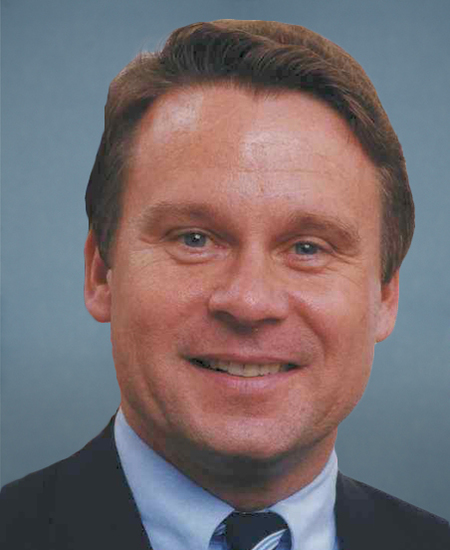
Rep. Christopher H. Smith
Sponsored bills
This joint resolution nullifies a Department of Labor emergency temporary standard for preventing the transmission of COVID-19 in employment settings. Under the standard issued on November 5, 2021, employers with 100 or more employees must require their onsite employees to either be fully vaccinated against COVID-19 or undergo weekly COVID-19 testing.
IDEA Full Funding Act This bill provides permanent, mandatory funding for the grant program that assists states and outlying areas in providing special education and related services to children with disabilities.
Maddy summaryThis bill removes a temporary expiration date for telehealth coverage in health insurance plans. It amends two sections of the Internal Revenue Code to permanently allow health plans to cover telehealth services without the prior deadline of December 31, 2021. The key change makes existing telehealth coverage rules permanent for health insurance plans under federal tax law. This directly affects health insurance plans that provide telehealth benefits, ensuring they can continue covering these services without needing to renew temporary provisions. The bill does not change what telehealth services are covered, only makes the coverage rules permanent.
This concurrent resolution declares that Congress should not impose any new performance fee, tax, royalty, or other charge relating to the public performance of sound recordings on a local radio station for broadcasting sound recordings over the air, or on any business for such public performance of sound recordings.
Maddy summaryHRES 386 is a symbolic resolution introduced in the U.S. House of Representatives that expresses support for recognizing "National Police Week" each year. The resolution acknowledges law enforcement officers' sacrifices, particularly during the pandemic, and encourages the public to honor their service. As a non-binding statement, this resolution does not create new law or change policy but serves as a formal expression of support for law enforcement officers across the United States.
Uyghur Stop Oppressive Sterilizations Act or the Uyghur SOS Act This bill expands existing visa-blocking sanctions to cover certain high-ranking foreign government officials who are responsible for coercive population control policies, such as forced abortions, with a focus on those responsible for such policies against ethnic minority groups in China. Specifically, the Department of State may not issue a visa to a foreign national who is a head of state, head of government, or cabinet-level minister and responsible for establishing or enforcing such policies if the policies are (1) imposed with the intent to destroy a national, ethnic, racial, or religious group; or (2) targeting ethnic minority groups (e.g., Uyghurs, Kazakhs, or Tibetans) or individuals peacefully expressing internationally-recognized human rights in China. (Currently, these sanctions do not apply to any foreign government officials at these higher ranks.) The State Department must make a public announcement each time sanctions are imposed under this bill. The bill also requires the State Department to provide all appropriate assistance to women who belong to an ethnic minority group in China and who have experienced sexual violence, torture, or coercive population control policies.
Protect and Serve Act of 2021 This bill establishes a new criminal offense for knowingly assaulting a law enforcement officer and causing serious bodily injury (or attempting to do so) in circumstances that affect interstate commerce. It imposes criminal penalties—a prison term, a fine, or both—on a violator.
Vietnam Human Rights Act This bill requires actions related to human rights in Vietnam and addresses related issues. The Department of State must assist eligible individuals and entities working to secure the release of political and religious prisoners in Vietnam. The Office of Internet Freedom within the U.S. Agency for Global Media and the Bureau of Democracy, Human Rights, and Labor within the State Department shall prioritize (1) the immediate distribution of censorship circumvention tools for computers and smartphones in Vietnam; and (2) projects to ensure the safety and privacy of bloggers, journalists, and human rights defenders in Vietnam. Foreign assistance may not be used to assist any unit of the Vietnamese government engaged in cyberespionage activities. The State Department may establish programs to (1) monitor and halt sex trafficking of women from Vietnam and other Asian countries, and (2) address Vietnam's growing sex-ratio disparity. The bill also requires various reports to Congress, including reports on (1) persons subject to U.S. sanctions for human rights violations in Vietnam, (2) a strategy to promote internet freedom in Vietnam, and (3) cyberespionage activities sanctioned by the Vietnamese government targeting Vietnamese dissidents and human rights advocates living outside of Vietnam.
Reinforcing Nicaragua's Adherence to Conditions for Electoral Reform Act of 2021 or the RENACER Act This bill establishes measures to monitor, report on, and address corruption and human rights abuses in Nicaragua. Specifically, the bill directs U.S. leadership at international financial institutions to advocate for oversight with respect to any loan or financial or technical assistance for projects in Nicaragua. The Department of State and the Department of the Treasury must establish a strategy to align diplomatic engagement with implementing sanctions to facilitate free, fair, and transparent elections in Nicaragua. Pursuant to this strategy, the President must prioritize implementing targeted sanctions on persons obstructing such elections. The State Department must also engage in diplomatic efforts with partner countries to impose targeted sanctions on such individuals. The bill adds Nicaragua to a list of countries whose citizens are subject to visa-blocking sanctions for knowingly engaging in (1) actions undermining democratic processes or institutions, or (2) significant corruption or obstruction of investigations into such corruption. Further, the bill requires the State Department to report on the involvement of President Daniel Ortega, members of his family, and senior government officials in significant acts of public corruption; Russian activities in Nicaragua; and gross human rights violations by the Ortega government against campesinos (i.e., natives of Latin American rural areas, especially Latin American Indian farmers or farm laborers) and indigenous communities. In addition, the State Department must report on obstacles to news and information about domestic and international affairs and submit a strategy for strengthening independent broadcasting, information distribution, and media platforms in Nicaragua.